
There is a way to understand shelter that goes beyond protection from the elements.
Not just warmth. Not just dryness.
But coherence.
In the exploration of pyramid structures, we find a compelling idea: that geometry itself can function as a kind of technology—organizing subtle energy, stabilizing the field around the body, and creating an environment where the mind and nervous system can settle more deeply.
While much of this language—scalar energy, ORMUS, life force—sits outside conventional scientific frameworks, the underlying principle is not unfamiliar: the environments we inhabit directly shape our physiology, our nervous system, and our capacity to rest and repair.
And when the environment becomes more ordered, the body often follows.
Astrophysicist Ken Rhola is one of the world’s foremost pyramid experts. In this class he explains in much detail the science of how pyramid energy works. Click here if you are curious and want a deeper understanding than this brief article. https://youtu.be/2avTNjuY4ag?si=FiX5f1ff9tT3BBTI
Geometry as a Field Generator
In pyramid science, the structure is understood as a passive energy device.
Its angles and proportions are said to interact with scalar energy—organizing and concentrating it into a coherent field. Within that field, the human system—often described in terms of chi or prana—can become more ordered.
The result is not dramatic. It is subtle, but profound:
Less internal noise.
More clarity.
A body that begins to unwind.
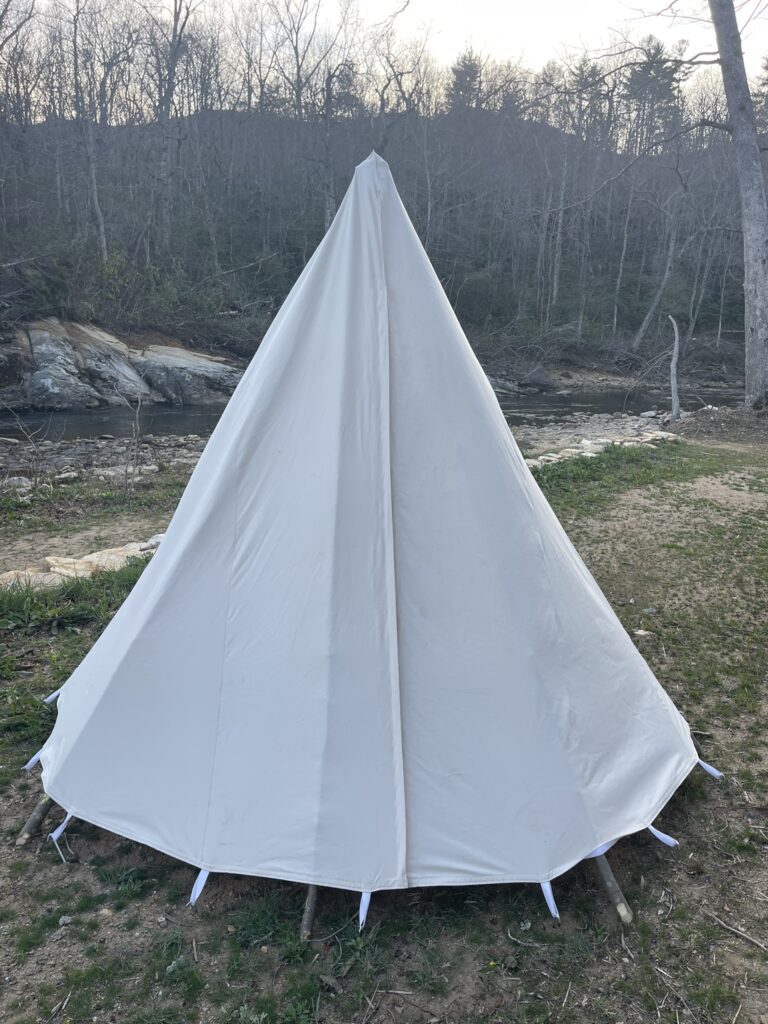
While the tipi does not replicate the exact geometry of a pyramid, it shares key functional principles:
- A centralized apex
- A circular base
- Sloping walls that guide airflow and energy upward
Rather than a rigid geometric amplifier, the tipi acts more like a living field—dynamic, breathable, and responsive.
Natural Materials and the Non-Conductive Field
Material is not a neutral choice.
Modern shelters are often built from synthetic fabrics, metal poles, and treated surfaces—materials that conduct, reflect, and sometimes amplify electromagnetic input.
The result can be subtle, but cumulative: a kind of background noise the body must continuously process.
The Lucky Sheep tipi takes a different approach:
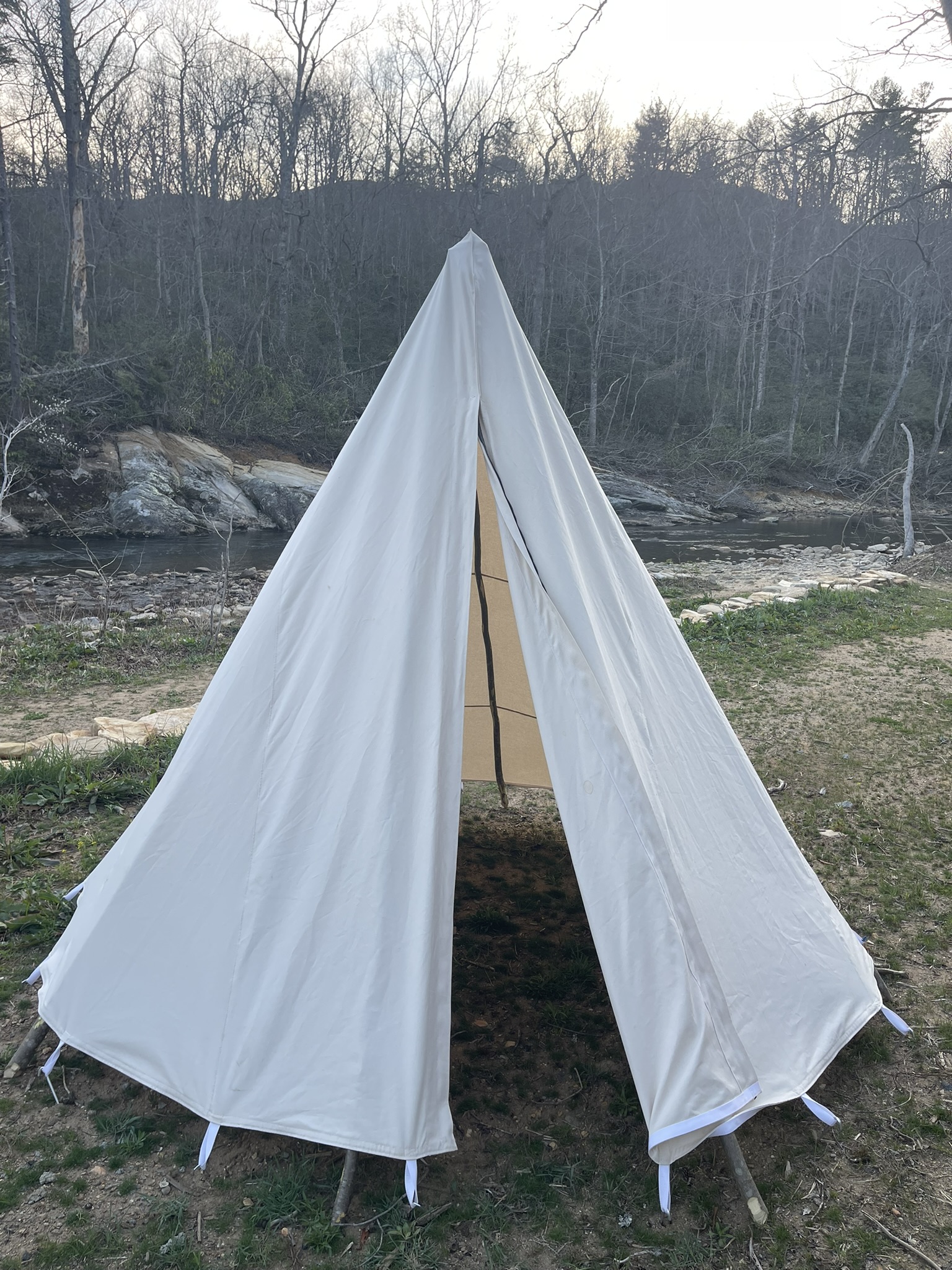
- Poles made from natural wood—non-conductive, grounded, and organically structured
- A cover of natural canvas—breathable, stable, and free from petrochemical inputs
- A beeswax treatment infused with ORMUS minerals
From an energetic perspective, natural, non-conductive materials tend to hold a quieter baseline. They do not scatter the field in the same way synthetics can.
They allow the body to do less work.
ORMUS as a Bridge
The inclusion of ORMUS introduces another layer.
Described as orbitally rearranged monoatomic elements, ORMUS is associated—within alternative research communities—with increased coherence and conductivity at subtle levels of interaction.
When integrated into a beeswax treatment, it becomes part of the shelter itself.
Not added on. Embedded.
Within the tipi, this suggests a space that doesn’t just passively exist, but participates—gently supporting a more coherent internal state.
Scalar Stillness and Breathable Design
Pyramid models often emphasize scalar energy as a form of stillness—a reduction of interference.
The tipi arrives at a similar outcome through different means.
Ventilation. Breathability. Contact with the ground.
Instead of isolating you, it allows exchange. Air moves. Moisture equalizes. Temperature softens. The boundary between inside and outside becomes more permeable.
And in that permeability, the system relaxes.
Not contained—
but connected.
A Moment Inside
Step into the tipi just after sunrise.
The light comes through the canvas softly, diffused and warm. There is a faint scent of beeswax and earth. The air feels alive, but not moving.
You notice something first in your body—not your thoughts.
A kind of exhale.
The usual static isn’t there. No hum of electricity. No synthetic edge.
Just quiet.
And in that quiet, your mind begins to organize itself without effort.
A Therapeutic Dwelling
At a certain point, it becomes clear:
Shelter is not just where you sleep.
It is part of how you heal.
For those navigating environmental sensitivities—chemical, electromagnetic, or otherwise—this is not abstract.
Every input matters.
Every material, every surface, every structural choice either adds to the load—or reduces it.
A tipi, built with intention, becomes more than shelter.
It becomes a therapeutic dwelling.
A Rewilder’s Perspective
From a rewilding lens, this is ultimately about remembering what works.
The body already knows how to regulate.
It already knows how to return to balance.
What it needs is the right environment.
The pyramid offers one model of geometric coherence.
The tipi offers another—rooted in natural materials, breathable design, and direct relationship with the land.
Both point toward the same principle:
When the field around you becomes more ordered, the field within you follows.
Closing
You don’t need to adopt every framework—scalar energy, ORMUS, or otherwise—to explore this for yourself.
You only need to pay attention.
Where do you feel most quiet?
Where does your body soften without effort?
Where does your sleep deepen?
If you are exploring a lower-input way of living outdoors—whether for health, sensitivity, or a deeper connection to the natural world—the structures you choose matter.
The Lucky Sheep tipi is one expression of this idea.
Not just shelter.
But a space designed to reduce interference, support coherence, and allow the body to return to what it already knows how to do it.