The funny thing about my search for non-toxic camping gear is that it started at home. After a decade of living with Multiple Chemical Sensitivities I had gone organic with my clothing, bedding and cleaners — and my outdoor gear, which was supposed to get me closer to nature, was still the most toxic, unnatural thing left in my belongings. Here is where PFAS, flame retardants, coatings and foam hide in camping gear, and what I sleep in and carry instead.
How we sabotage going into nature without realizing it
Many of us feel a pull to connect more deeply with nature, and yet people often go camping and bring the city with them. Modern backpacking has become an arena in which companies compete to outdo one another with the latest NASA-developed gear — and too often that gear, meant to take us into nature, cuts off our natural biological processes and adds more toxins to already overburdened bodies. The outdoor industry has over-domesticated camping.
Let me say this plainly, because I mean it: there is nothing wrong with whatever ways people want to enjoy the outdoors. My quarrel is with fabrics, not with anyone’s weekend. But a trip into the woods is our one chance at a primordial experience, and we blow it by wrapping ourselves in plastic and slathering on chemicals. In A Rewilder’s Guide to Outdoor Adventure I list the ways we sabotage ourselves without meaning to. The ones that live in your pack:
- Synthetic gear. Some synthetic tents and gear off-gas endocrine-disrupting chemicals that accumulate as a body burden. (Silnylon is one of the few that are fairly non-toxic.)
- Synthetic clothing and bedding. In my experience they disrupt the body’s release of moisture and its temperature regulation.
- Bug spray. DEET is a solvent — it dissolves the very polyester and nylon backpackers carry — and I treat it as a hazardous chemical.
- Suntan lotion. I rely on sun-protective clothing, a wool felt hat and a zinc or animal-fat balm instead.
- Chairs and air mattresses. Props that put the body in unnatural positions and off-gas under you all night.
Sunglasses, the trail-mix diet, padded shoes, soft plastic water bladders, blue-light flashlights and overexertion round out the list — leave the ego in the city and walk according to your current fitness level. And I still print sunglasses and sunscreen in the Ten Essentials. It is not black and white.
What non-toxic camping gear can honestly mean
Nothing made of matter is chemical-free, and nothing I sell is free of synthetics. The Rewilder closes with a PFOS-free plastic zipper and is sewn with polyester thread. When I backpack I sleep under a silnylon tarp on a closed-cell foam pad. Lucky Sheep® is built around natural fibers, but we are not opposed to modern materials when they solve a specific problem exceptionally well — a deliberate hybrid approach.
So when I say non-toxic camping gear, I mean something specific you can hold me, or any brand, to. No PFAS or fluorinated water repellent. No flame-retardant treatment. No polyurethane coating, no foam, no synthetic insulation, and every fiber named down to the thread.
Are tents treated with flame retardants?
Many are. Thin synthetic tent fabric is a fire hazard, and so is down, so both are routinely saturated with flame-retardant chemicals — and the tent that is supposed to carry you into nature off-gasses them into the small sealed room you sleep in. Most makers do not say. If you are searching for flame retardant free tents, or a pfas free tent, the only proof is a written answer from the brand.
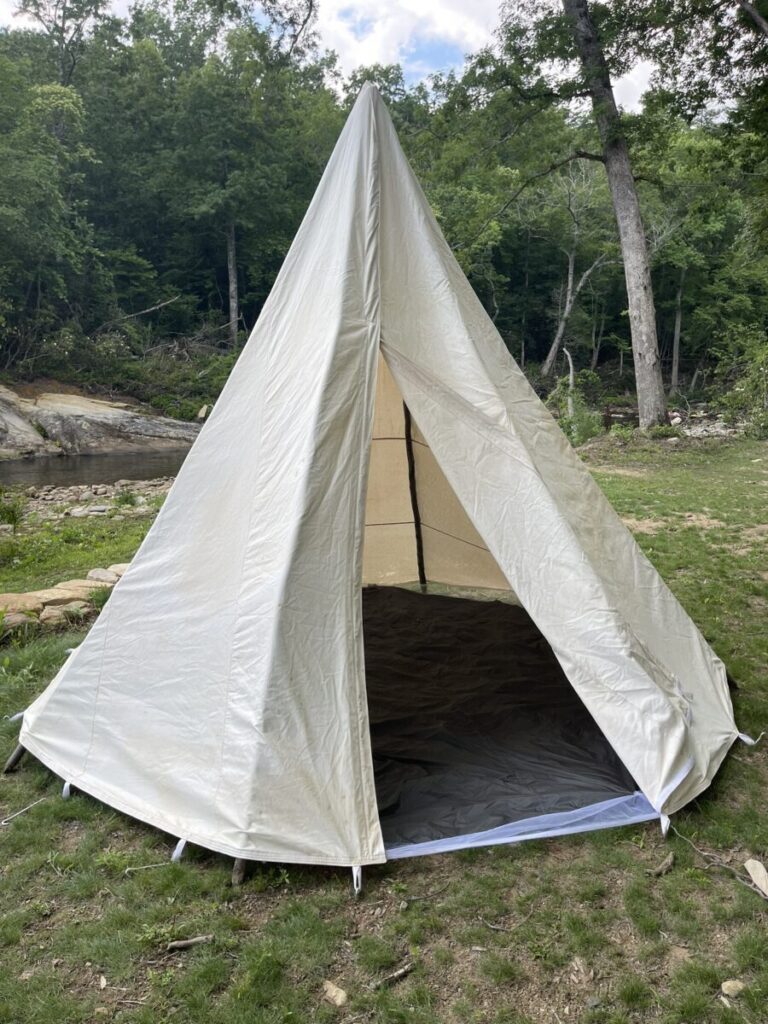
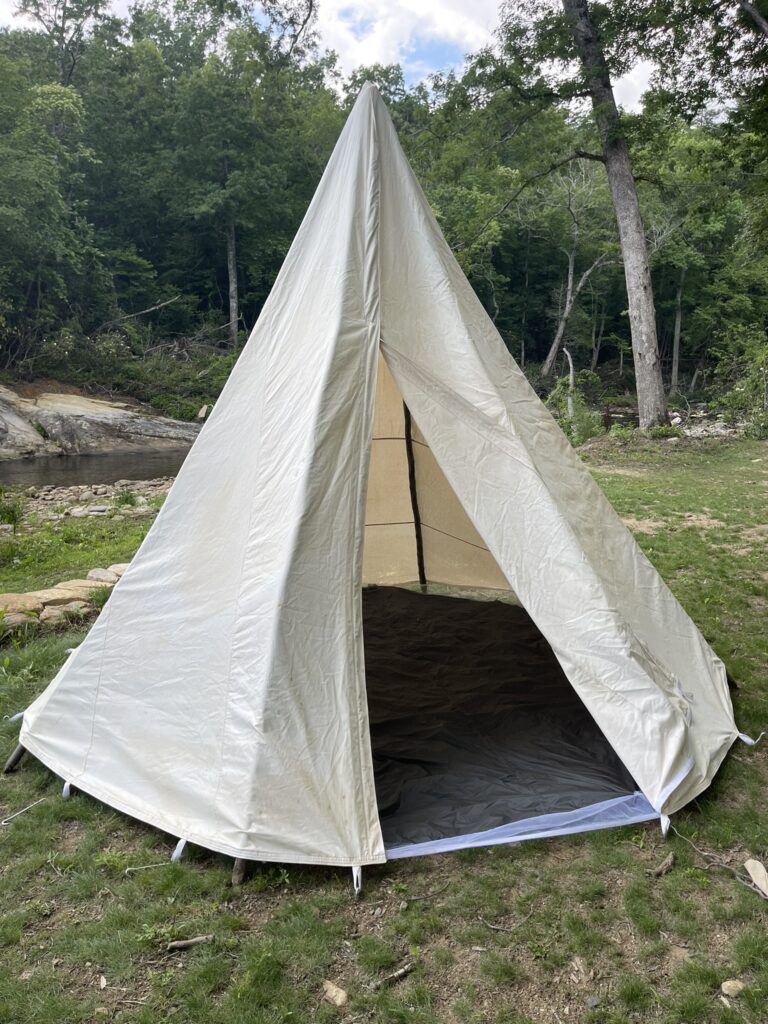
My own tent is organic cotton canvas sealed with beeswax — as I put it in the book, as good as it gets: no VOCs, PBDEs, flame retardants or phthalates at all, and the canvas breathes both ways. It is the best non toxic tent I know of, with one honest trade: untreated canvas will burn, so the fire stays outside and there is no stove jack on purpose. Canvas is also extremely heavy when wet, so it stays at basecamp and the silnylon tarp goes backpacking.
What does PFAS-free mean for camping gear?
PFAS — PFOS and PFOA the best known — are the so-called forever chemicals used to make water-repellent gear: jackets, pants, sleeping bags, boots and tents. A Greenpeace study I cite in the book found them in thirty-six of forty outdoor products tested. They do not break down; they linger in soil and water for decades and build up in fish, birds and, eventually, us.
Many countries have restricted PFOS, but the short-chain PFAS that replaced it may still be harmful, so PFAS-free has to mean no fluorinated finish of any kind — in writing. Some brands now use wax, silicone or plant-based repellents; beeswax on cotton canvas is the oldest of those and the one I use on every shell, tarp and pack I make. On health I will stay hedged: the research I gathered links PFOS to hormonal disruption, and I am not a toxicologist. What I know firsthand is that my health came back as these things left my house and, last of all, my pack.
Is foam in sleeping pads toxic?
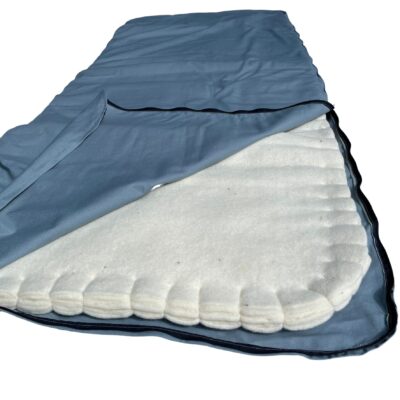
Honest answer: it depends on the foam, and few makers will tell you what is in theirs; the smell of a new pad is chemistry leaving it. My organic wool sleeping pad is dense US wool felt in a removable, machine-washable cotton cover — no foam, no off-gassing. It is what I sleep on at basecamp and at home, and anyone looking for a non toxic camping mattress should start there.
But when I am backpacking, I use a closed-cell foam pad. Although it is synthetic, it is the only thing I know of to date that is really practical on the trail: light, and it does not take on moisture the way wool felt can. A non toxic sleeping pad is a real thing; one that weighs nothing is not, yet. Use whatever tools work for you.
Non toxic camping gear, category by category
Tent
What I look for. Natural fiber, no flame-retardant finish, no PFAS, wooden or bare aluminum poles — and honesty that non toxic tents for camping in canvas are basecamp shelters. What I make. The organic canvas tipi in 8-, 10- and 12-foot diameters: beeswax-sealed organic cotton, about 10 lb of canvas at 9 feet and 20 lb at 12, made in the USA. The canvas tarp is the same fabric without walls — a non toxic tarp for a porch or ground cover — and all our non toxic tents are in the tents category.
Sleeping bag
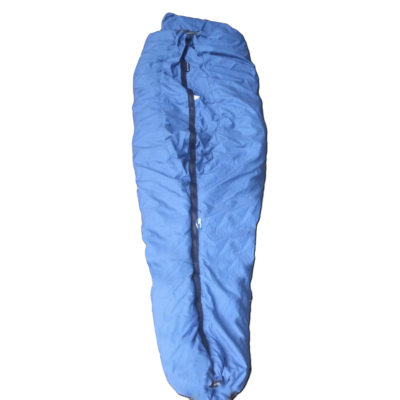
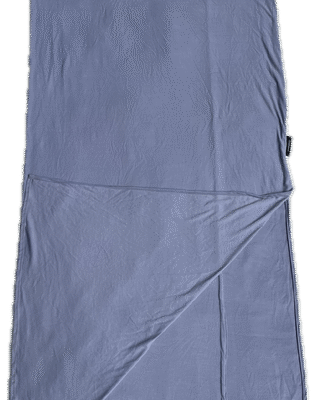
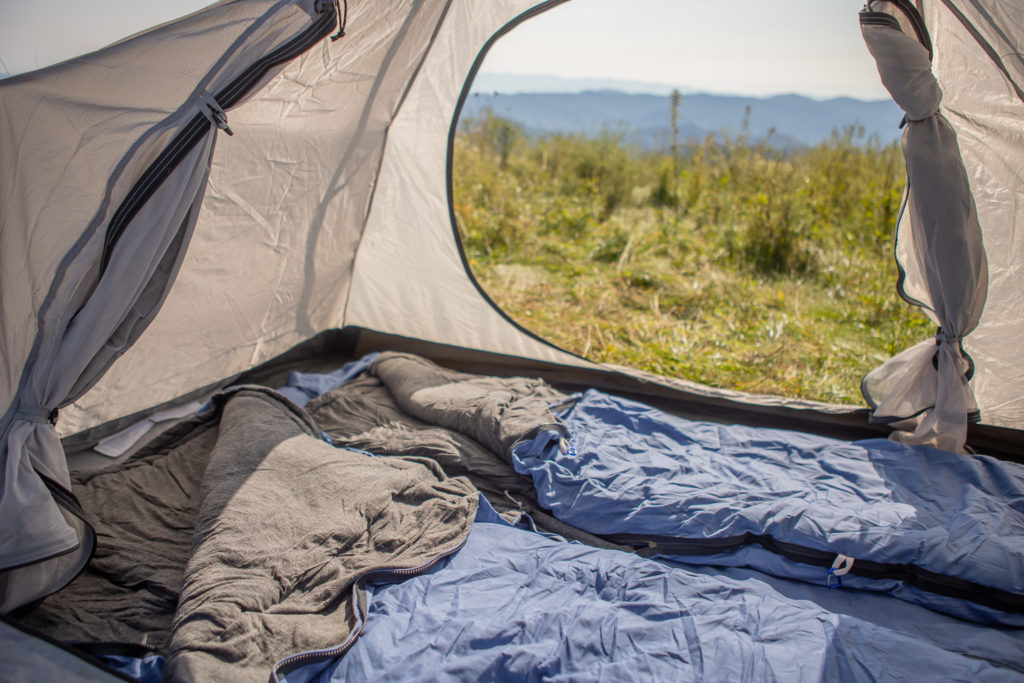
What I look for. A fill you can name, a shell with no coating or water-repellent finish, and a liner you would wear against your skin. What I make. The Rewilder: US wool batting, beeswax organic cotton shell, merino or WeatherWool® liner — no synthetic fill, no PFAS, no flame retardant — sewn in Burnsville, North Carolina. Field-rated to 20°F, 4 lb, about three times a 20°F down quilt; what those pounds buy, and what a pfas free sleeping bag should have, is in my guide to the best non-toxic sleeping bag.
Pack
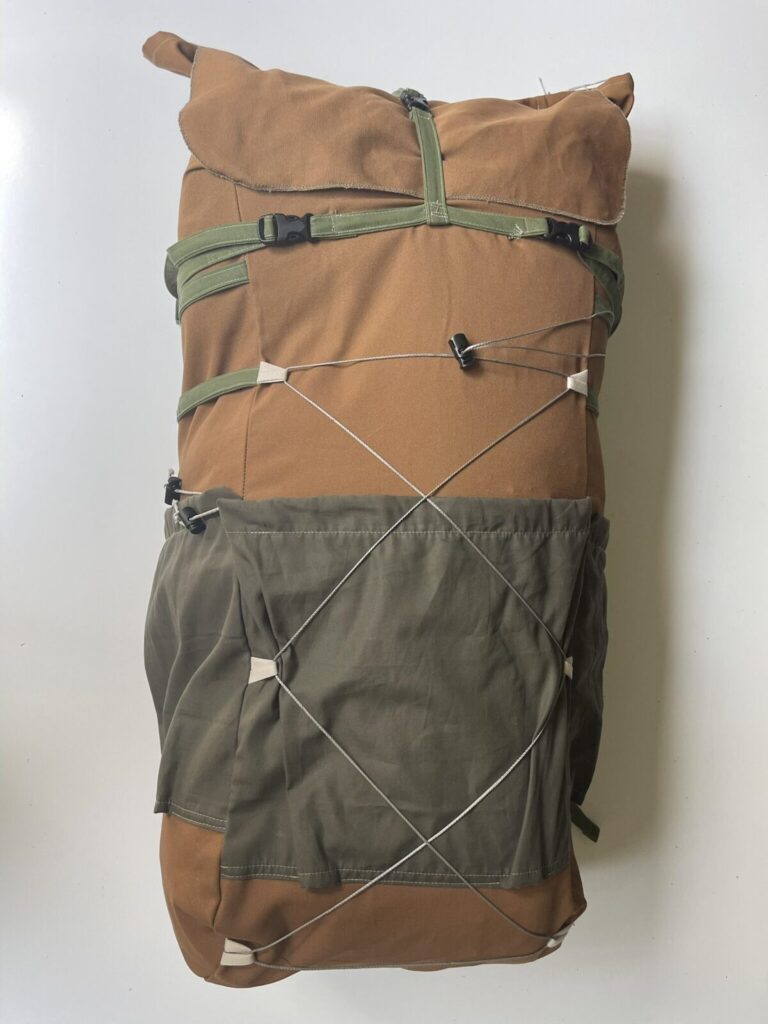
What I look for. Fabric named by fiber, no coated interior, no PFAS, sewn rather than bonded so a needle can fix it. What I make. A 65-liter organic canvas backpack, 32 oz, frameless with the wool pad as the frame — beeswax organic cotton, no nylon, polyester or PFAS. Canvas is heavier than nylon and water-resistant rather than waterproof; it is also re-waxable and re-sewable for decades, a trade I make gladly.
Rain shell and insulation
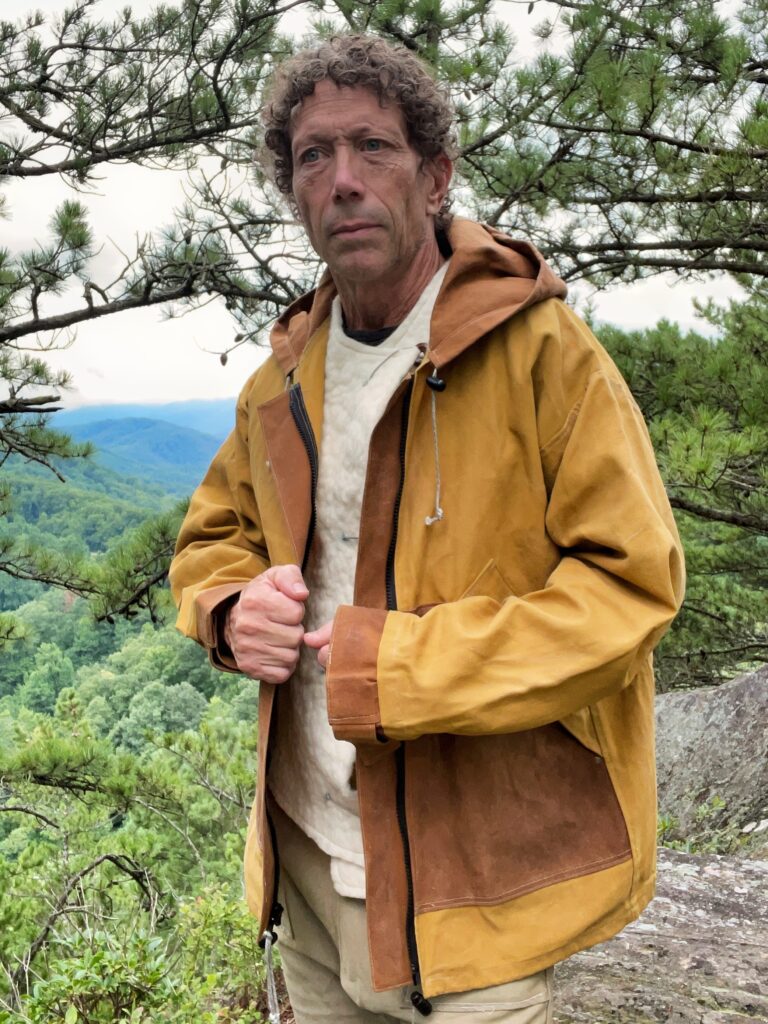
What I look for. A written PFAS-free statement on any membrane jacket, and honesty: waxed cotton is water-resistant, not waterproof — it sheds rain and wind, wets out slowly rather than leaking suddenly, and it breathes. What I make. A 10 oz organic canvas rain jacket with a natural wax finish, about 2 lb, sizes S to XL, cut for wool underneath and re-waxable with our beeswax Trail Wax. Under it, the wool felt adventure vest does a synthetic puffy’s job without the polyester — and wool is self-extinguishing, so it needs no fire-resistant treatment.
How to vet any brand
You do not need a lab. You need five answers, in writing. A maker who has done the work will have them on hand; one who has not will send you a paragraph about their values.
- Fiber content, by percentage, for every layer. Shell, lining, fill, webbing, thread.
- Finishes. A water-repellent finish, and is it fluorinated? A flame-retardant or anti-odor treatment?
- Coatings and films. Polyurethane, silicone, a membrane, or none?
- Certifications, and for which part. A certificate on the shell says nothing about the foam inside.
- Repair and end of life. Can it be re-waxed, re-sewn, re-lofted, and will they do it?
Ask Lucky Sheep® the same questions; I will put the actual canvas, felt and merino in your hands in a free sample packet first.
What I would tell you
If your trip is a fast push over dry alpine ground, a synthetic kit may be the right tool — buy the PFAS-free, flame-retardant-free version and enjoy your trip. Weight isn’t the only thing that matters, but it matters, and I will not pretend canvas and wool are light.
My trips are damp Appalachian forests and basecamps in the Black Mountains above Burnsville, and there natural fiber wins on more rows than it loses. I sleep under a tarp with both ends open, on wool, in wool, with the night air moving through, and I come home restored instead of depleted. Real fibers for real conditions.
Reviewed September 2026 by the Lucky Sheep® team.
Sleep warm out there — in wool
The Rewilder is a 20°F backpacking sleeping bag (4 lb, packs to 11 × 11 in) that keeps insulating when conditions turn damp. Add the merino liner for another ~10°F and a wool pad underneath for a complete natural-fiber sleep system.
-
Lightweight Wool Sleeping Bag–The Rewilder
The lightest all-natural backpacking bag
4 lb / 1.8 kg20°F / −6°C (10°F option)Packs to 11 × 11 in
Price range: $557.00 through $888.00 Select options This product has multiple variants. The options may be chosen on the product page -
Merino Wool Sleeping Bag Liner & Sleep Sack
Warm, washable wool liner for any bag
1.9 lb / 0.9 kgAdds ~10°F30 oz merino jersey
Price range: $200.00 through $235.00 Select options This product has multiple variants. The options may be chosen on the product page -
Organic Wool Sleeping Pad
Firm, breathable, machine-washable cover
¼ – 1.5 in wool felt24 – 60 in wide
Price range: $150.00 through $1,100.00 Select options This product has multiple variants. The options may be chosen on the product page