A camping pillow is the piece of the sleep system most people leave at home and then spend the night wishing they had not. On a firm pad the neck needs real support, and the three usual answers—an inflatable, a wool-filled camp pillow, or a stuff sack of clothes—behave very differently at 2 a.m. Here is what I actually pack, how I set the height for side and back sleeping, and why wool is the fill I chose.
Do you need a pillow for camping? What I pack
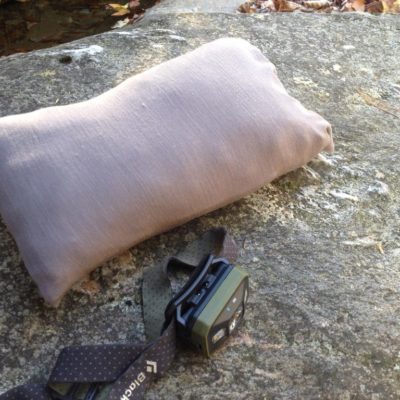
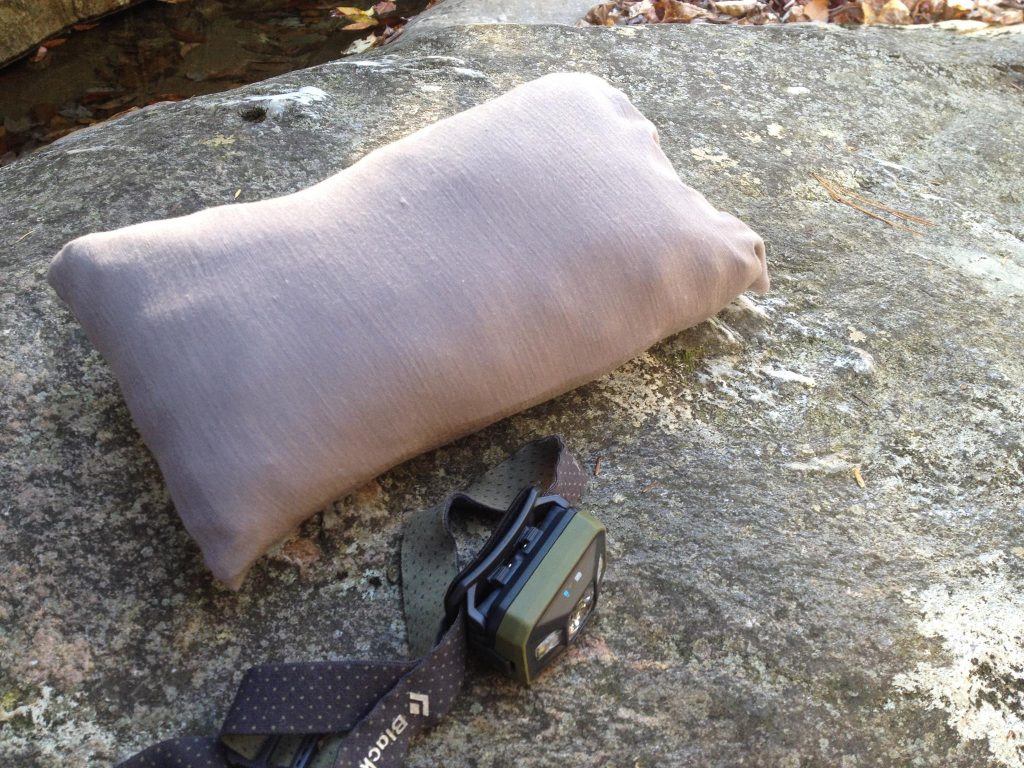
My philosophy is that the body is the first piece of gear. A strong, supple body can lie on a firm surface and rest, and no pillow will fix a neck that has spent all year propped on foam. So on a backpacking trip I do not carry a pillow at all. I make one by stuffing extra clothing into my stuff sack—the same sack that holds the dry merino set I keep for sleeping—and adjust its size with a push of the hand.
If there is no pillow, I keep my bottom arm extended and my bicep becomes the pillow. That is the whole of it, and it has done me for decades. Where weight is not the question—basecamp, a canoe, a cabin, the bed at home—I use a small, firm wool pillow, because it does the same job better and I would rather sleep well than prove a point.
Why a camping pillow matters more on a firm pad
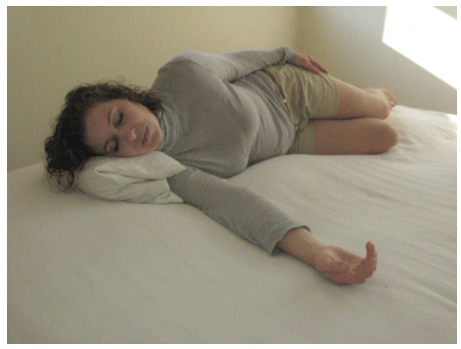
On a soft mattress your shoulder sinks and the pillow only fills a small gap. On a closed-cell foam pad—which is what I carry when backpacking, an inch or two of padding at most—your shoulder does not sink at all. A side sleeper’s head is then a full shoulder-width above the surface and needs a pillow tall enough to keep the neck level. A back sleeper needs the opposite: a low roll under the curve of the neck that does not push the head forward.
The firm surface is a feature, not a hardship. It keeps the hips from sinking and twisting the spine, and I find people sleep deeply on it once they are used to it, even while they complain that it is hard. That is also why I do not like air mattresses or hammocks for night sleeping: they bow the body and hamper breathing and alignment. If one makes you happy, so be it—but a good pillow matters more on a firm pad than anywhere else.

Inflatable vs wool camping pillow vs a stuff sack of clothes
The wool pillow here is the Lucky Sheep® camp pillow: wool fill in an organic cotton cover, $40. The inflatable column describes the type, not any one brand.
| Inflatable | Wool-filled camp pillow | Stuff sack of clothes | |
|---|---|---|---|
| Weight | Lightest; a few ounces | Heavier than an inflatable; a small pillow of packed wool | Nothing extra; you carry the clothes anyway |
| Packed size | Smallest; fits in a pocket | A soft loaf that stuffs into the hood of the bag or the pack lid | None; it is your clothes bag |
| Feel | Firm, bouncy and slippery; the head rolls off; one height unless you get up and fiddle with the valve | Dense and even; shape it with a hand and it stays | Lumpy; reshapes freely |
| Noise | Crinkles with every turn | Silent | Nylon sacks rustle |
| Cold and breath | Cold to the cheek by morning; breath condenses on the surface | Warm to the touch; the wool takes breath moisture into the fibre | Neutral, unless the clothes are damp |
| Washing | Wipe down | Cover machine washes; fill airs in the sun | Wash the clothes |
| Lifespan | Until the valve or a seam gives | Decades; wool does not clump or flatten for good | Indefinite |
| Price | Cheap to mid-priced | $40 | Free |
Read the weight row honestly. If you are cutting every ounce, the stuff sack wins and the inflatable is second. The wool pillow is for people who have tried both and would rather carry a few more ounces than sleep on a balloon. Weight is not the only thing that matters—but I will not pretend it does not matter.
How high should a camping pillow be for side sleepers?
These are the tricks I use to make a firm surface comfortable, and they work with any pillow you can shape.
- Side sleeping: level with the shoulder. The pillow should keep your head level with your shoulder so the shoulder is fully extended. Fold the camp pillow in half or stack the clothes bag under it. Extend the bottom leg straight, bend the top knee and lay it over the bottom leg to take the load off the hip.
- Back sleeping: small, and only at the neck. Push the fill into a firm roll and place it under the curve of the neck so you get cervical support and a little traction that decompresses the neck. It should not push the back of the head up. A rolled-up sock in the small of the back helps too.
- Head uphill. I sleep on a gentle slope, no steeper than about eleven degrees—about a six-inch rise from head to toe. In my experience it lowers the heart rate and deepens sleep and dreaming, and a slope is easier to find in the mountains than a flat spot anyway.
- Cover the eyes and ears. A bandana over the eyes and silicone earplugs make a sanctuary out of an open tarp. I sleep deeper this way beside loud water or in wind and rain.
- Change position between sleep cycles. You wake briefly a few times a night on a firm surface. Roll from back to side, reshape the pillow to the new height, and go back down.
This is where an inflatable loses. It has one height, it is round so the head rolls, and changing it means sitting up in the dark. Wool and a sack of clothes reshape with a push.
Can you use a stuff sack of clothes as a pillow?
Yes, and on a long walk it is what I do. The sack that works best is the one already in your pack: the dry set of clothes reserved for camp—merino top and bottom, wool socks, hat, sweater—kept in a waterproof bag. This is one place where I use synthetic, a silnylon liner bag, because a very little material keeps that set dry through a wet day. Put the softest thing on top, wrap the sack in your wool hat or bandana if the fabric rustles, and size it as above.
The one rule: the clothes have to be dry. A sack of damp clothes is a cold pillow, and they are the clothes you need in the morning.
Why a wool filled pillow does not clump or sweat
A pillow has two enemies: your breath and the weight of your head. Your face gives off a good share of the moisture you lose overnight, and most of it lands in the pillow. Down and polyester batting hold that moisture between the fibres, where it makes the fill damp and heavy, and the head then packs the damp fibres into lumps. Waking with your head on a sweaty pillow is never enjoyable, and that is exactly what down’s little microclimates give you.
Wool takes the moisture into the fibre itself—published textile data puts wool’s regain at 13 to 16 percent of its weight, against 0.4 percent for polyester—so the fill stays dry to the touch and gives back a little warmth as it does so, which helps explain why it is warm to the cheek on a frosty morning. The natural crimp springs back each day rather than matting. Sheep wool pillows aired in the sun now and then keep their shape for decades. The cotton cover comes off and goes in the wash; the fill is aired, not washed.
Wool filled pillow at home
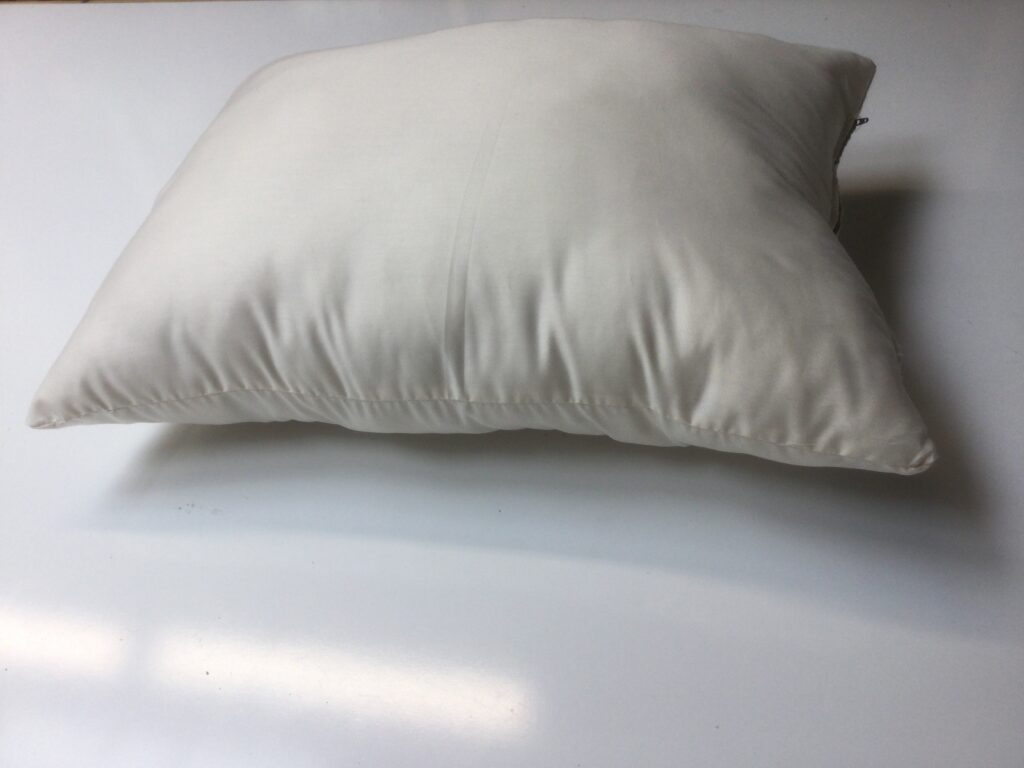
Everything above applies in the bedroom, where the pillow is the wettest thing in the bed for the same reason. The wool-filled bed pillow is the camp pillow’s full-size relative: wool fill in an organic cotton cover, dense enough to shape, and it stays put. I keep mine small and firm for back sleeping and fold it or stack a second for side sleeping, exactly as on the trail. If you are moving the bed toward wool one piece at a time, wool pillows are the second thing to change after the sheet; the reasoning is in Wool Bedding: Why It Sleeps Cooler, Drier and Quieter.
Which camp pillow to bring
- Thru-hike or a long, light trip: the stuff sack. Learn the neck roll and the bicep trick and you will not miss a pillow.
- Weekend backpacking: a small camping pillow of wool if comfort is the point of the trip; the sack if you are chasing miles. Many people carry the wool pillow and put the clothes bag under it for side-sleeping height.
- Car camping, canoe trips, basecamp, cabins: the wool camp pillow, or bring the home pillow. Weight does not matter here and the sleep does.
- Inflatable: only when packed size is everything and you sleep on your back. On a firm pad, for a side sleeper, it is the worst of the three. People also ask for a sleeping bag with pillow built in; I would rather keep them separate so the height can change in the night.
The pillow is one of four pieces—bag, pad, liner, pillow—that only work properly as a set. How they fit together by season is in How to Sleep Outside, and the pad it sits on is compared with foam and inflatables in Wool Sleeping Pad vs Foam and Inflatable Pads. Use whatever tools work for you. Simple. Light. Adaptable.
Reviewed September 2026 by the Lucky Sheep® team.
A firm, breathable, foam-free place to sleep
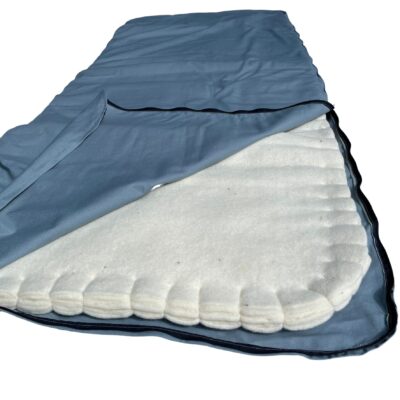
Our wool sleeping pad is dense US wool felt in a washable organic cotton cover — a non-toxic sleeping pad for the tent or the floor at home. Pair it with the wool felt bedroll and a camp pillow.
-
Organic Wool Sleeping Pad
Firm, breathable, machine-washable cover
¼ – 1.5 in wool felt24 – 60 in wide
Price range: $150.00 through $1,100.00 Select options This product has multiple variants. The options may be chosen on the product page -
Wool Felt Bedroll Blanket
Blanket, quilt, pad or liner
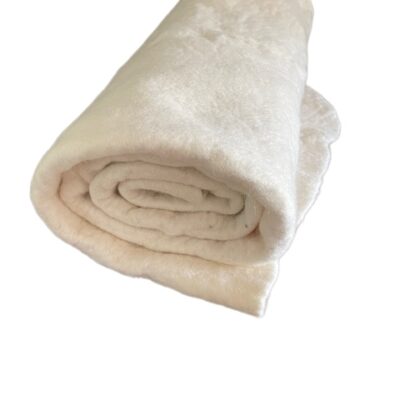
4 lb / 1.8 kg50 × 76 inUS wool felt
Price range: $275.00 through $325.00 Select options This product has multiple variants. The options may be chosen on the product page