The best non-toxic sleeping bag is the one whose materials you can name all the way down — fill, shell, liner, thread and zipper — because you spend eight hours a night with your face on the collar, breathing whatever it gives off. I sewed my first one because I had become allergic to my own tent and sleeping bag. This is what I learned to look for in a natural sleeping bag, what to avoid, and how my two wool bags measure up against my own checklist.
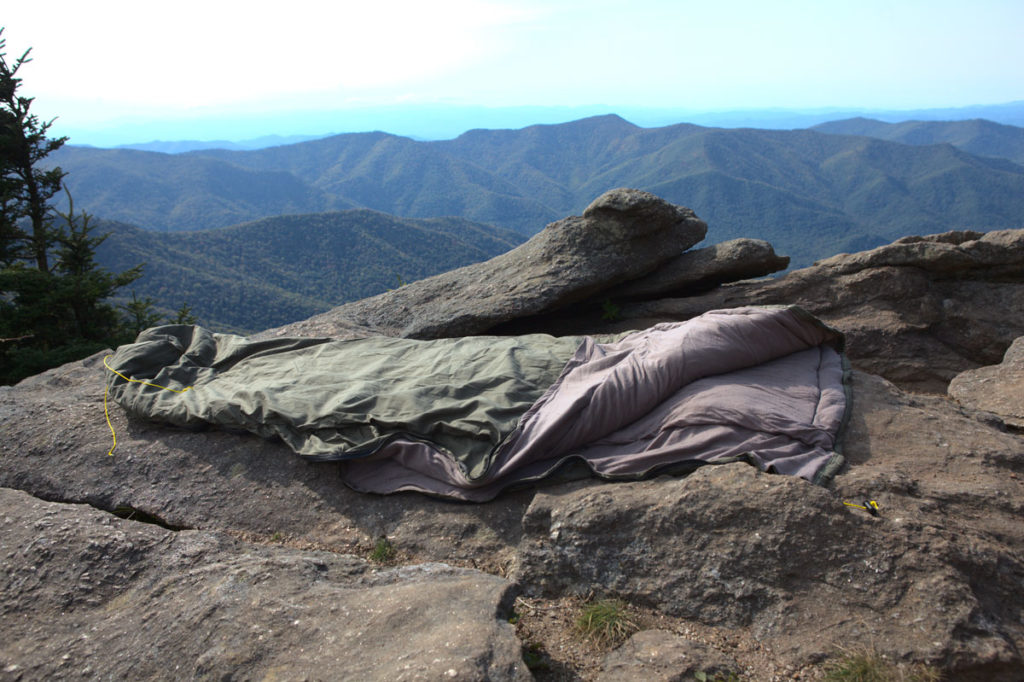
Three layers of plastic: why I stopped trusting synthetic sleeping bags
Our world has become ubiquitously synthetic. There are fake foods, fake news and artificial everything, including fibers, and in the last thirty years the old fabrics — silk, cotton, linen, hemp and wool — have been replaced by cheaper nylon and polyester. When we zip ourselves up inside a synthetic sleeping bag (even down fill lives inside synthetic fabric), inside a synthetic tent, usually wearing synthetic clothing, we have effectively wrapped ourselves in three layers of plastic. And you will still find few alternatives in the outdoor stores.
Synthetics can fairly be called plastic, because they are the same petroleum molecule and behave the same way. Water does not go into the fiber; it sits in droplets on the surface and runs along the weave until it reaches the outside and evaporates. That is the actual mechanism of moisture-wicking, and it has a dark side: the same fabric holds moisture next to the skin. Think plastic bag. Wicking does not necessarily make you dry.
“I was on a trip in the Sierras and experienced what I call ‘synthetic hell.’ I was wearing wet plastic clothes inside a wet plastic bag inside a tiny wet plastic tent, all in 25-degree weather with 14 inches of snow on top. I’m throwing all that crap away and starting over with a more natural system.”
A Lucky Sheep® customer, quoted in A Rewilder’s Guide to Outdoor Adventure
None of this is a purity contest. I still pack my dry sleep clothes in a silnylon stuff sack and sleep on a closed-cell foam pad when I backpack — a deliberate hybrid approach, natural fibers where their performance makes sense and lightweight technical materials where they give a clear advantage. What I will not compromise on is the layer I sleep inside.
What makes a sleeping bag non-toxic?
A bag is four material decisions — fill, shell, liner and hardware — plus whatever finishes have been sprayed onto them, and none of that is on the hang tag. A bag can have an organic cotton sleeping bag shell on the outside and be a chemistry set inside. So my definition of the best non-toxic sleeping bag is specific: no synthetic insulation, no PFAS or fluorinated water repellent, no flame-retardant treatment, no polyurethane coating, and every fiber disclosed. Chemical free sleeping bags do not exist; non toxic sleeping bags do.
Be realistic about hardware. Virtually every sleeping bag on the market, mine included, closes with a plastic coil zipper — ours are PFOS-free — and is sewn with polyester thread, because nothing else is light and reliable enough. A bag that is natural fiber everywhere except the zipper is a very different object from a bag that is polyester everywhere except the label. Judge the bag by the fabric you sleep in, not the slider.
Is polyester fill toxic?
I will answer as the man who got sick, not as a chemist. Polyester and nylon are extremely flammable, so budget bags are often treated with flame retardants, and plastics carry thousands of additives — some of them estrogenic — that ride along on every fiber fragment a bag sheds. In my research for the book I found that a single synthetic garment can release 120,000 to 730,000 microfibers in one wash. That is the environmental case, and it is enough on its own.
The case I am surest of is what happens to your sleep. Because synthetic fabric traps moisture and heat next to the skin, the heart has to pump faster to adjust body temperature, and when it beats faster all night the sleep cycle is interrupted. You wake not feeling fully refreshed, and most people attribute this discomfort to the fact that they are camping. In the book I go further and argue that synthetics unground the body and short-circuit the skin’s electrical flow; I hold that view, and I offer it as my view, not as a product claim.
Are there PFAS in sleeping bags?
Yes, on many of them. PFOS, PFOA and their forever-chemical cousins are used to make water-repellent equipment — jackets, pants, boots, tents and sleeping bags — and a Greenpeace study I cite found traces of these compounds in thirty-six of forty outdoor products it tested. They persist in soil and water for decades and accumulate up the food chain. Down gets a version of the same treatment: chemicals are added to make the feathers more water-repellent, which actually makes them slower to dry.
Many countries have restricted PFOS, but the short-chain PFAS that replaced it may still be harmful, so a pfas free sleeping bag needs a written statement that no fluorinated finish was applied — not a hang tag that says water-resistant. A wool bag does not need a water-repellent shell at all, because wool does not fail when it gets damp. I cover the rest of the chemistry, tents and pads included, in my non-toxic camping gear guide.
Why down is not the natural answer either
Down has come to be considered the highest choice by the majority, and down bags are certainly light and pack really small, but the benefits stop there. Down does not work if wet, so there is no backup plan. It cannot take humid, damp conditions, so you zip yourself into a tent — and the tent builds a humid microclimate out of your own breath and insensible perspiration, which makes you colder. That thermal stress causes the body to expend energy rather than restore it.
Down is extremely flammable, and the only way to reduce that is chemical saturation of the feathers, on top of the chemicals used to process and clean them. Much of it is live-plucked. It creates microclimates where you are roasting under one section and cold under another, and I have honestly never felt truly warm in down or synthetic. If you want down anyway, ask for the welfare certificate and an untreated shell, and read the lab rating as a dry-conditions number.

What wool does that no other fill does
Wool is an active fiber. Water vapor molecules absorbed by wool attach to sites inside the fiber and give up energy as heat — the heat of adsorption — so as the humidity in your bag rises through the night, the fiber warms. A kilogram of dry wool placed in moisture-saturated air releases about as much heat as an electric blanket running for eight hours, and the Rewilder carries about two pounds of wool batting. Wool can hold a large share of its weight in vapor without feeling wet, and it dries from your body heat.
This is why I can crawl into my bag, pull the top over my head and breathe. The moisture in my breath is adsorbed into the wool, migrates outward and is released, and I get warm from the inside. This cannot be done inside a synthetic or down-filled bag; you would only get humid and colder. Wool fibers are also difficult to ignite and self-extinguishing, which eliminates the need for fire-resistant treatments — one whole class of chemistry gone.
The honest trade-offs: weight, price and care
The best non toxic sleeping bag will cost you three things, and it is better to know them up front. Weight first: my 20°F Rewilder weighs 4 lb where a 20°F down quilt weighs one to two — about three times as much. The warmth-to-weight ratio that argument rests on only applies under ideal conditions. That means dry conditions. In rain, mist and exertion, where the down user is zipped in a tent protecting the feathers, the wool user is drying out from body heat, and that is what the extra pounds buy. Weight isn’t the only thing that matters, but it matters, and I will not call this bag light.
Price: organic cotton, US wool and small-batch sewing in Burnsville, North Carolina cost more than polyester from a large factory; the Rewilder starts at $557. Care: a wool bag is aired in the sun and spot-cleaned, and the merino liner takes the washing. And temperature ratings deserve their own honesty — ours are field ratings from years of use in the Southern Appalachians, not ISO 23537-1 lab results. Compare them with a lab comfort figure, not a limit figure.
Best non toxic sleeping bag checklist
- Fill named and sourced: wool, or down with a welfare standard. No polyester fill.
- Shell is organic cotton or another natural fiber; if synthetic, a written PFAS-free statement.
- No polyurethane coating or laminate anywhere on the bag.
- No flame-retardant treatment, confirmed in writing.
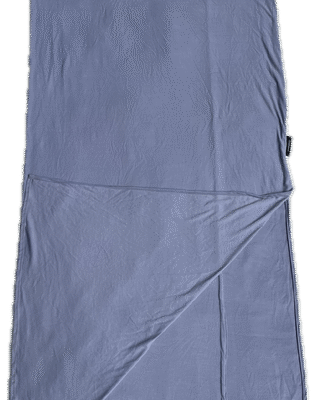
- Liner is merino or wool against your skin, or removable so you can replace it.
- No antimicrobial or odor treatments — wool does not need them.
- Certifications matched to the part they cover; a certificate on the shell says nothing about the fill.
- Temperature rating labeled as an ISO figure or a field rating, and you know which.
- Repairable, with a workmanship guarantee, and made somewhere you can ask questions — sleeping bags made in USA are easier to ask about.
How the Rewilder and Aurora Borealis meet the checklist
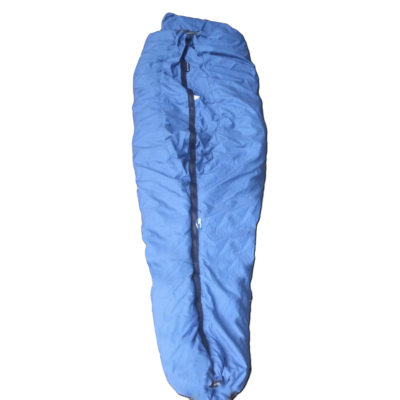
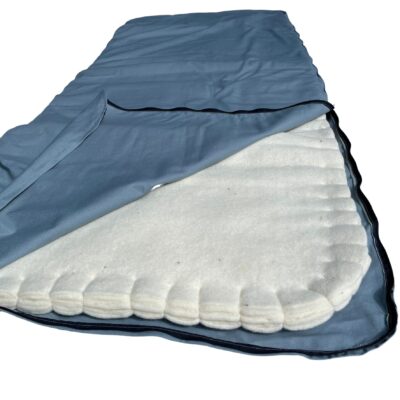
Both bags share the same construction: US wool batting, a beeswax-treated organic cotton shell, a merino jersey or WeatherWool® worsted liner, polyester thread and a PFOS-free plastic zipper. No synthetic fill, no PFAS, no polyurethane, no foam, no flame retardant. Both are made in the USA, ship in 2 to 5 days, and carry a lifetime workmanship guarantee. Pay-later checkout and pricing in CAD, GBP, AUD and NZD are on the site if that helps.
| The Rewilder | Aurora Borealis | |
|---|---|---|
| Best for | Backpacking, three-season | Car camping, cabin, hunting camp, winter basecamp |
| Shape | Tapered | Rectangular; opens to a queen quilt; two zip together |
| Field rating | 20°F / −6°C (2 in loft) or 10°F / −12°C (3 in loft) | 20°F / 10°F / −5°F (2 / 3 / 5 in loft) |
| Weight | 4 lb Standard 2 in; up to about 5.5 lb Long, Wide or 3 in | About 7 / 10 / 15 lb |
| Packed size | About 11 × 11 in with included compression straps | Not for carrying |
| Sizes | Standard 80 in (to about 5 ft 10 in) or Long 86 in (5 ft 11 in to 6 ft 3 in); 54 in or 64 in wide; sized to pull over your head | One size |
| Fill | US wool batting | US wool batting |
| Shell / liner | Beeswax organic cotton / merino or WeatherWool | Beeswax organic cotton / merino or WeatherWool |
| Finishes | None: no PFAS, DWR, PU or flame retardant | None: no PFAS, DWR, PU or flame retardant |
| Price | From $557 | From $752 |
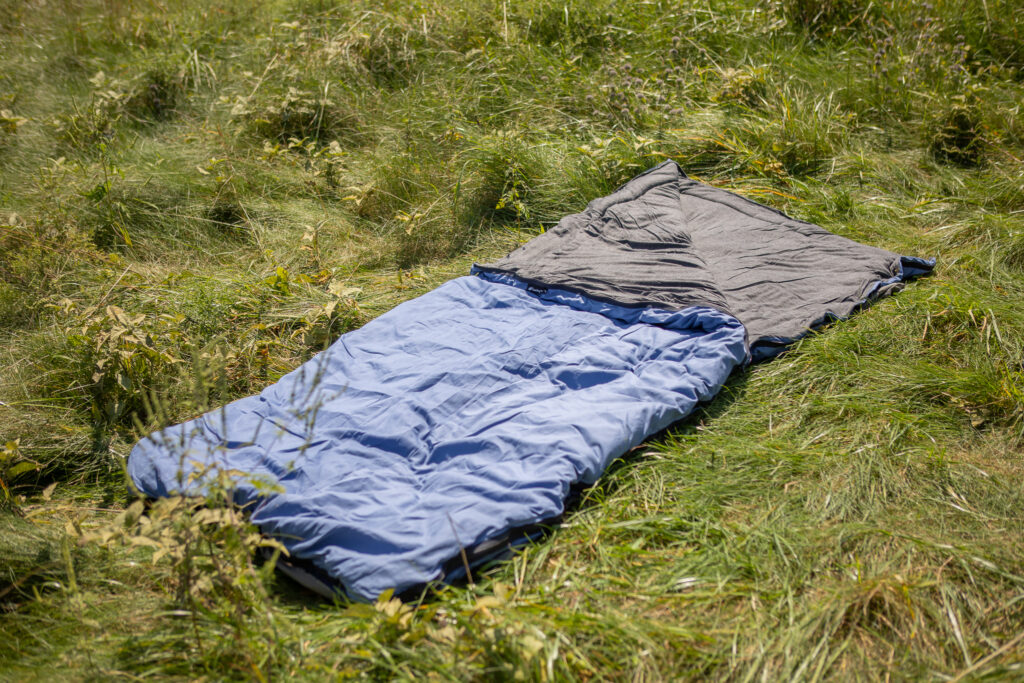
The Rewilder is the bag for anyone carrying it: tapered, 4 lb, packed to about 11 by 11 inches with the included compression straps, and field-rated to 20°F. The Aurora Borealis is the bag for anyone who drives to camp and wants 5 inches of wool over them at −5°F; it opens into a queen-size quilt, and two of them zip together.
Where can I find eco-conscious sleeping bags and pads?
The plain answer is our sleeping bag category, where the two bags sit side by side with the merino liner — and I would put an organic sleeping bag from any maker who can answer the checklist above on the same list. Whether you are hunting for the best natural sleeping bag, the best organic sleeping bag, the best eco friendly sleeping bag or simply a non toxic sleeping bag that will not off-gas on your face, the questions are the same. The pad matters too: a wool bag on a polyurethane-foam or inflatable pad is half an answer, because the pad is under you all night.
We approach shelter a little differently. Tarp above. Waterproof barrier below. Wool around you. Air moving through. Under the body, at basecamp, that means the wool felt sleeping pad — no foam, no off-gassing. On the trail I use a closed-cell foam pad and say so, because wool felt takes on moisture and the pounds add up.
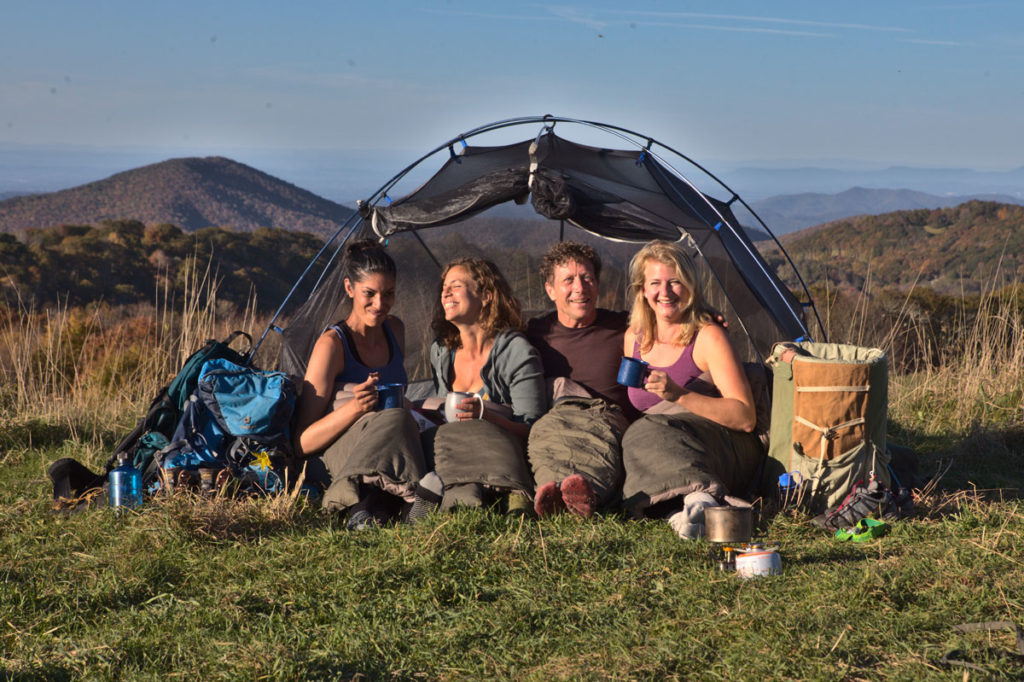
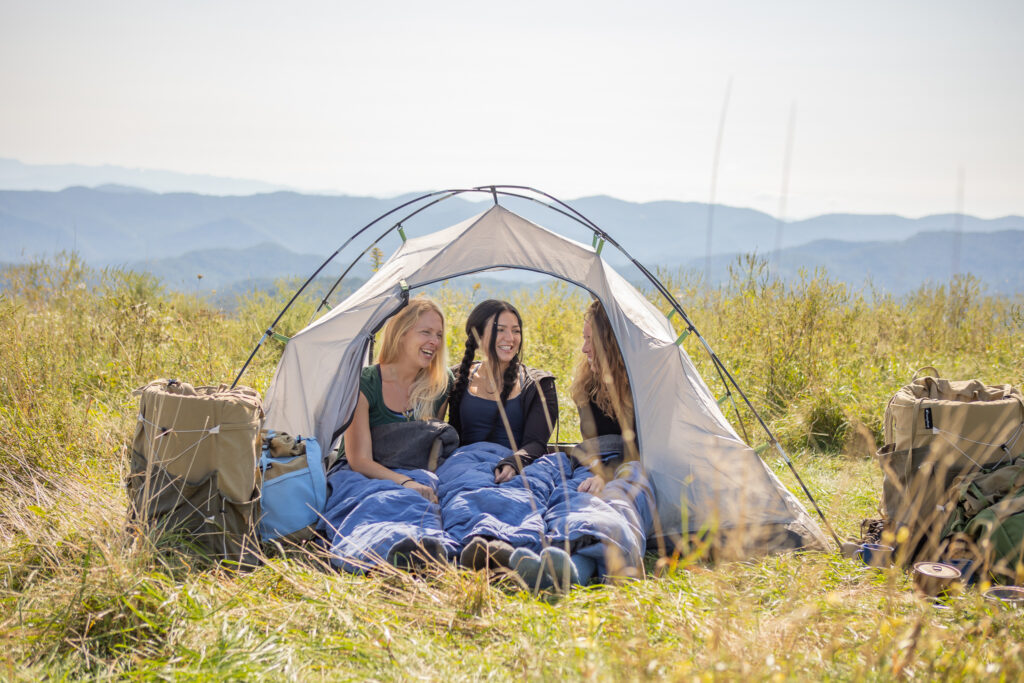
What I would tell you is this. Nature is supposed to be a health spa, and the bag is where you spend a third of the trip. Name every layer, refuse the finishes, accept the pounds, and sleep with the ends of the tarp open. Go Wild. Go Light. Go Natural.
Reviewed September 2026 by the Lucky Sheep® team.
Sleep warm out there — in wool
The Rewilder is a 20°F backpacking sleeping bag (4 lb, packs to 11 × 11 in) that keeps insulating when conditions turn damp. Add the merino liner for another ~10°F and a wool pad underneath for a complete natural-fiber sleep system.
-
Lightweight Wool Sleeping Bag–The Rewilder
The lightest all-natural backpacking bag
4 lb / 1.8 kg20°F / −6°C (10°F option)Packs to 11 × 11 in
Price range: $557.00 through $888.00 Select options This product has multiple variants. The options may be chosen on the product page -
Merino Wool Sleeping Bag Liner & Sleep Sack
Warm, washable wool liner for any bag
1.9 lb / 0.9 kgAdds ~10°F30 oz merino jersey
Price range: $200.00 through $235.00 Select options This product has multiple variants. The options may be chosen on the product page -
Organic Wool Sleeping Pad
Firm, breathable, machine-washable cover
¼ – 1.5 in wool felt24 – 60 in wide
Price range: $150.00 through $1,100.00 Select options This product has multiple variants. The options may be chosen on the product page