Good outdoor sleep is a skill, not a piece of gear. These are the ten things I actually do, at home and on the trail, so that when I sleep outside I wake up refreshed instead of depleted. I wrote them in 2019 after two years of living in a tipi; they still hold, and I have added a few notes on what I have learned since.
When I take my friends camping they are amazed at how easy I make it look. I just whip out my gear, have the tarp up and everything organized no matter the weather, and usually fall asleep about as soon as I hit the sleeping bag. I have spent many years trying to find a way to be more comfortable outdoors. My goal was to make it feel like home. What I mean by that is that I want to feel relaxed, safe and comfortable. After all, I came to nature to get closer to my primordial existence. So wouldn’t it make sense to feel more at home?
The barriers to reaching that place are many. It has taken me years to reach my goal, which was to easily transition from indoors to outdoors as if there were not that much difference. The first step was overcoming health challenges, which happened when I turned to Ancestral Health, Paleo and a pro-thyroid approach. The second step was developing gear that allowed a natural experience of nature. And the third step was practicing and tweaking my technique.
I use my everyday lifestyle to train for the outdoors. This is how I have built a badass outdoor body and mind ready for the rigors of the wilderness. Our over-protected, over-padded, over-domesticated, over-processed culture pushes nature out. If we design our indoor environments and lifestyles with rewilding in mind we will be halfway there before we even get to the trailhead. If we go from overheated and over-cooled indoor spaces where everything is push-button and every surface is level, and then suddenly we’re outside on the weekend, not accustomed to uneven terrain, temperature fluctuations, bugs, sun, noise from wind… we’re probably not going to sleep well.
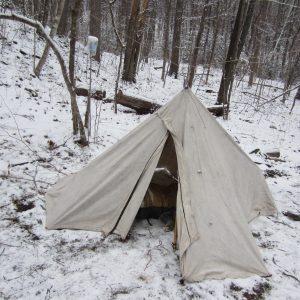
However, the typical approach is to bring our fear of nature with us, and we do it in several ways that sabotage our outdoor experience. We spray repellent on our skin and clothing to keep the bugs away; we zip up inside a synthetic tent that is off-gassing, inside a synthetic sleeping bag and clothing that keep our skin from breathing and keep us from the rejuvenating air renewed by the trees and moving water; we cover our skin with sunscreen and our eyes with sunglasses. The self-sabotaging practices of the modern outdoor enthusiast can be easily remedied by applying rewilding principles.
Several years ago, when everyone was trying to biohack their homes for EMF protection, grounding, lighting and temperature, I went the opposite direction… back to nature. I moved into a tipi, which was a most extreme lifestyle experiment. It was amazingly healing to live so close to nature. I had a canvas tipi coated with beeswax and made my first wool sleeping bag. This allowed a natural flow of air, which was critical for maximum comfort. I kept the ground bare dirt and placed my bed and belongings on slatted wooden frames. Then I started finding ways to bring this kind of living on my backpacking adventures. So the goal for a good outdoor experience would be homeostasis, good sleep, and predicting dangers and hazards ahead to prevent and mitigate. You know you’ve achieved this if you come back refreshed and not depleted, needing time to recuperate.

1—Overcoming Fears
Looking back, I think fear was the biggest barrier to sleeping outside — bigger than any piece of gear.
I spent over two years sleeping and living outside, both in my tipi and on wilderness excursions. During this time I developed a spiritual and psychological reset where nature became my default place to be. That means home. It also required me to find a way to be at home in different locations… like a nomad. I used breath awareness and meditation to connect with my heart center and pull myself into the present moment. This was extremely useful, because before I learned to do that I would be associating a place to return to as home. (See The Tipi Experiment)
What I noticed is my relationship with the forest changed. Suddenly I was noticing things I hadn’t before. The main thing was I felt a kinship with animals and plants and even the earth and weather. I could feel the aliveness of the forest. It wasn’t a boring bedroom with four walls and total predictability. In the wilderness things are in constant flux: weather, the day/night cycle, animals, terrain. The ground is uneven. There is no furniture other than the occasional boulder the perfect shape for a chair. There is no big building to protect from temperature and weather extremes. Also, it is pretty easy to have unpleasant things happen — sunburn, bug bites, bruises, sprains, poison ivy, hypothermia, or simply anxiety from fear of the dark or things that go bump in the night.
Anyone can overcome the fears of being vulnerable in nature. It mostly takes practice, and it helps to have someone with experience show you the way. Find friends or join a Meetup hiking club.
2—Cultivate a Relationship with the Animals, Plants, Earth, Weather
The night is busier than most of us imagine. In my experience that is a reason to relax, not a reason to seal yourself in.
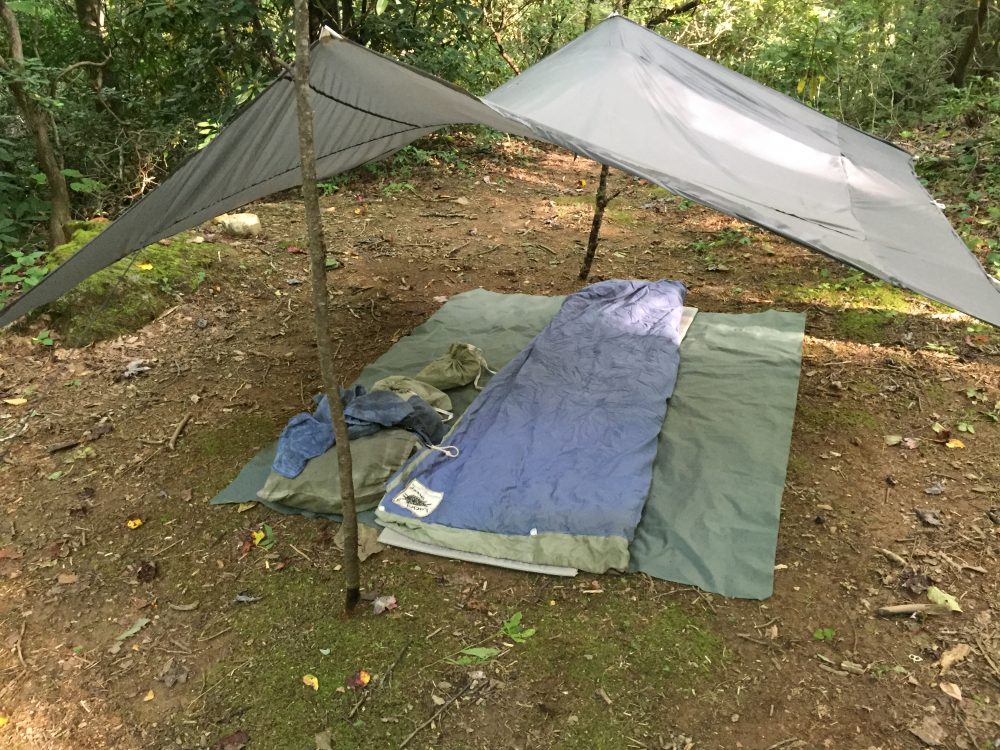
I have had many nights of animal encounters: deer, owls, coyotes, foxes and even frogs. (Yes — one night sleeping near a stream some frogs jumped on top of me as they were making their way back to the water.) I do keep my food properly tied up high on a tree limb. But even without food, animals are moving around in the night. And I sleep either under an open tarp or under the open sky. What I found out is the animals actually give me space and in general are not a threat. After so many encounters I now relax around the whole teeming wilderness and feel like my space is respected. I feel like I earned this respect by dropping my fear. This happened by facing my fears and challenging them one by one. We humans don’t realize how we live our lives in pretense. We hide behind our machines, appearance, identity, accomplishments, buildings. We live our lives through our egos. There is no way to see this until we step outside.
Many years ago I had a near-death experience, lost on Black Dome — the highest mountain on the East Coast — at night in October, and survived by piling up some leaves to crawl under. After that I was humbled to feel how little I am in the eyes of the mountain… and nature.
In the beginning it was really scary to be walking through the forest at night. It seemed like a thousand eyes were watching my every move. And actually there probably were, and are. Out there, you can hide nothing. Nature is where truth has no barriers. Your thoughts become amplified and you see your life clearly, and perhaps that is the biggest fear of all… the fear of being alone.
One night I was sleeping on a trail and I awoke to the sound of a lady screaming in distress. It wasn’t the first time; I knew it was a fox, and it seemed pretty far away. But in 30 seconds it screamed again and it was getting closer. I wondered what was going to happen, because it was obviously coming down the trail I was on and probably didn’t know I was there — would it run right into me? Suddenly it screamed within a few feet of me and I screamed back out of terror. About 30 seconds later I heard it again, far down the trail on the other side of me. The fox had been as frightened of me as I was of it.
Sometimes owls have appeared in the middle of the night, sometimes in a tree right above me. I like to ask, “What do you have to tell me?” It can be extremely startling, but we can learn to relax around it by knowing we are all one tribe on planet earth. Just this week an owl did the same thing. It made six calls, slowly and spaced out. Haunting, eerie, and it left me wondering… the number six.
Many nights I have woken up to coyotes. Sometimes they are very near, howling into the night, and sometimes farther away. I used to know an old-timer friend in Kansas who was a freight-train-hopping hobo. He woke up one night when he was sleeping under a bridge to a coyote licking his face. The point being, coyotes are tricksters; they are not dangerous and don’t attack people. So I just roll over and fall asleep, although they do sound pretty heinous sometimes as they are yipping. On the other hand, I had a friend recently who had a pack of coyotes slowly surrounding her as she was camping alone. A good defense is a small personal siren that emits a blinding light and a loud alarm.
I live in the Southern Appalachians, which overall are forgiving and gentle, and I know other lands can have dangers that take more precautions — grizzlies, alligators, scorpions. This attitude can still be practiced while dealing safely with each situation based on knowledge of each locale. I would not enter a new land without doing research and knowing what to prepare for.
3) Learn and practice sleeping with a minimalist environment at home.
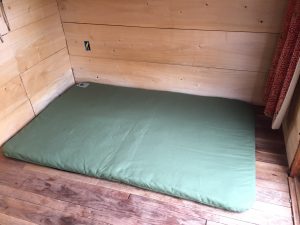
The bed at home is not the benchmark. I have found the body adapts to whatever surface you give it, which is why I train for the ground at home.
This means a firm surface such as the floor or a slatted wooden bed frame. Sleeping on a firm surface at home will prepare us for the transition when we venture into the wilderness.
If possible, sleep on your deck or porch, or in a tent in the yard. Keep windows open as much as possible and the room as cool as possible. The best sleeping is freezing winter nights under enough layers of wool… as I found out during my tipi days, and which I still practice to this day.
The main tricks to make sleeping on a firm surface comfortable, easy and enjoyable are:
a) When sleeping on your side, extend the bottom leg straight out and bend the knee of the top leg and extend it over the bottom leg.
b) When sleeping on your back, place a rolled-up sock in the small of your back.
c) Make a pillow by placing extra clothing in your stuff sack. For side sleeping the pillow should keep your head level with your shoulder, so that the shoulder is fully extended. If no pillow, then keep your bottom arm extended and your bicep becomes your pillow. For back sleeping the pillow should be adjusted smaller and placed only at your neck so you have cervical support — traction that decompresses your neck and doesn’t push the back of the head up.
I don’t believe in hammocks for night sleeping unless there is some reason, such as no level ground or needing protection from ground-crawling insects. Hammocks tend to bow the back, which hampers breathing and alignment and thus compromises sleep. I also don’t like air mattresses in general. But if someone has an injury or a mere preference and it makes them happy, so be it.
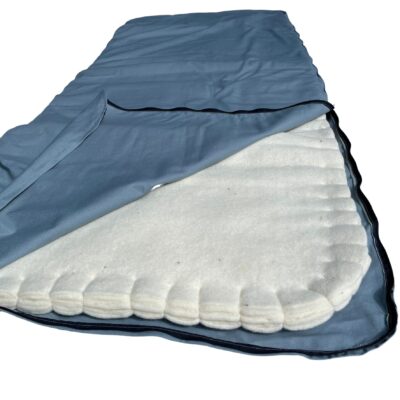
When backpacking I use a closed-cell foam pad. Yes, this is synthetic, but it is the only thing I know of to date that is really practical for outdoor adventure. The wool felt pad above is for camp — the tipi, the porch, the truck, a basecamp — where weight is not the primary consideration. In the old days they would have used a piece of tanned animal hide with the fur on, which is similar to the felted wool pad.
4) Learn constructive primal movement.
My view is that a body that can squat, kneel and get up off the ground without thinking about it sleeps better on the ground, too.
Our push-button society has taken the healthy movement out of our lives. There is no opportunity to sit on the floor, squat, kneel, crawl and stretch in all the many ways we would if we were hunting and gathering. Movement is required for us to remain healthy, flexible, resilient, strong and supple, and to maintain a healthy range of motion and mobility. Backpacking is a great way to bring this movement back. However, it is good to have some training so you don’t carry unhealthy patterns with you. There are many schools for this and it is easy to find free instruction online: Feldenkrais, Alexander Technique, yoga, MovNat, ecstatic dance. Specifically, the primary primal movements we need outdoors are:
a) Walking. (Yes, walking. We don’t do this right.) Great video here.
b) Getting up and down to the ground. (Sounds simple, but chances are you have no idea how to do it constructively.)
c) Squatting. (This is the perfect resting position, and also for pooping and peeing.)
d) Lying down. (It’s crazy, but we can’t even do this right.) This is why rewilding is so important. We are simply reacquainting ourselves with our native birthright to be a human being under the sun.
Here’s my own video from a few years ago: Sleeping on the Floor, How and Why.
5) Use Well Ventilated Tent or Tarp and Wool for Clothing and Bedding
We want maximum exposure to air. That one principle is behind everything I make and everything below.
What if your experience in nature was “as comfortable as your own bed”? It can be this way if we value quality sleep and invest in the right gear to make it work. This means primarily not zipping ourselves into a sealed synthetic tent inside a synthetic sleeping bag. Rather, use a natural wool sleeping bag and a tent that allows ample air circulation, or a tarp. The reason this creates the ultimate sleep is because you get maximum air to breathe, and to ventilate and move the insensible perspiration and the condensation from dew and frost. Wool bedding and clothing allow the body to regulate temperature as the air gets colder or warmer throughout the night. When we zip ourselves up in standard synthetic backpacking gear, we can interfere with the body’s natural ability to maintain its temperature and breathe through the skin. We can so easily wake up clammy, sweaty and not know why we didn’t sleep well.
I find sleeping under the open sky is the ultimate. Even a tarp blocks some of the air. There is nothing like getting a super dose of oxygen and negative ions to create a sleep like nothing else. When camping in ways other than backpacking, I like to use a canvas tent for optimal ventilation.
6) The best camping food is pemmican.
This is not what you find in camping stores and supermarkets selling camping foods, which are grain-based and processed. Here is my own video on how to make it.
This is sleep food. In my experience, fat and animal protein keep me steady through the night — no crash at three in the morning — and help my body handle the rough-and-tumble world of outdoor adventure and adapt to the cold. It is what has worked for me; I share it so you can decide. In the tropics it would be somewhat different, using more of the fruits that grow there.
7) Cold adapting
I have found the body only knows it is winter if you let it feel winter.
If you live near a cold mountain stream, start getting in it for incrementally longer periods of time. If you are in the city, use your bathtub and frozen plastic jugs of ice, or some kind of tub in your backyard. Alternatively, you can simply keep your house cooler in winter and expose yourself to the cold air when outdoors every day… so your body knows it’s winter.
8) Cover the eyes and ears:
Earplugs (silicone) and a cloth (bandana) over the eyes. Since you don’t have a room or cave to block the light and sound, you can create a sanctuary this way. This is a personal preference, because some people don’t like doing this for one reason or another. I find I sleep deeper, especially when there is loud crashing water nearby, wind, rain pelting my tarp, or loud crickets and cicadas. Sometimes I also practice listening to the sounds and merging with them. It can be delicious to really hear the sounds as though they are a symphony. Other times I don’t hear any sounds at all, even though they are there.
9) Inclined Bed Therapy
Find the right slope, no greater than 11 degrees, and place your head on the uphill side. This is about six inches of rise from head to toe. The people who practice Inclined Bed Therapy say it helps circulation, and I find it makes for better sleep and dreaming than lying dead flat. It is usually easy to find these slopes in the mountains — usually easier than finding a flat spot. I also recommend creating a sloped surface at home to sleep on. Not only do I think it is better for your sleep, but it will also condition you for your wilderness trips.
10) Choose the right campsite
a) Avoid widow makers (loose limbs or trees leaning that might fall over).
b) Look for good air circulation. This is a spot without a lot of undergrowth. Without this the spot can be prone to mold.
c) Look for good water drainage. Not a low-lying flat place that might become a pond. A slight slope is good. If you do have water flowing under your tarp during a heavy rain, be prepared to turn up the sides of your ground sheet so there is a slight wall of 3–6 inches.
d) Protect from insects. I recommend a net tent pitched under the tarp, or alternatively a tent with no-see-um netting. I also carry a bottle of eucalyptus and lemongrass essential oil and apply it when needed. Or I carry a piece of no-see-um netting and place it over my face, sometimes propped with my umbrella.
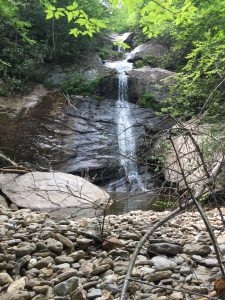
e) Ultimate places to pitch a tent: waterfalls, streams, lakes. In summer I like the tops of the mountains, and in winter be sure to camp in places protected from the wind.
f) Trust the feel of a spot. If you don’t feel well at a campsite, some people put it down to what they call geopathic stress, and some dowse to check a site. I don’t claim to know. What I do know is that if a spot doesn’t feel right, simply shift somewhere nearby. Even a few feet can make a difference.
Build the sleep system behind these tips
These ten tips are the technique. The gear that lets them work is what we call the Lucky Sheep® Sleep System: tarp above, waterproof barrier below, wool around you, air moving through. Protection where you need it, ventilation where you want it.
If you are new to sleeping outside, start with the full guide, How to Sleep Outside: The Natural Way to Sleep Outdoors — this post is the practice notes that go with it. For the surface (tip 3), read the guide to sleeping on a firm surface; for the pillow, how to sleep on your neck outdoors. The bag I sleep in from the tipi to the trail is the Rewilder wool sleeping bag. And if you want a straight answer on which layers you need for your trips, the five-question sleep-system finder will tell you.
Invite the weather in — and use natural materials that know what to do with it.
Reviewed September 2026 · originally published 2019.
Sleep warm out there — in wool
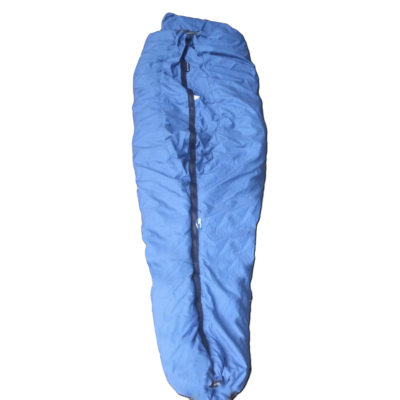
The Rewilder is a 20°F backpacking sleeping bag (4 lb, packs to 11 × 11 in) that keeps insulating when conditions turn damp. Add the merino liner for another ~10°F and a wool pad underneath for a complete natural-fiber sleep system.
-
Lightweight Wool Sleeping Bag–The Rewilder
The lightest all-natural backpacking bag
4 lb / 1.8 kg20°F / −6°C (10°F option)Packs to 11 × 11 in
Price range: $557.00 through $888.00 Select options This product has multiple variants. The options may be chosen on the product page -
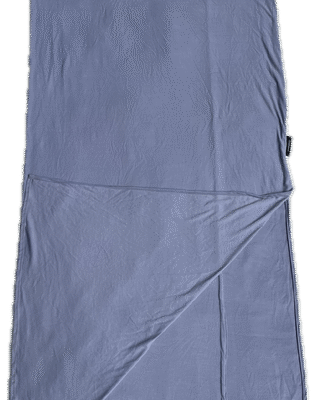
Merino Wool Sleeping Bag Liner & Sleep Sack
Warm, washable wool liner for any bag
1.9 lb / 0.9 kgAdds ~10°F30 oz merino jersey
Price range: $200.00 through $235.00 Select options This product has multiple variants. The options may be chosen on the product page -
Organic Wool Sleeping Pad
Firm, breathable, machine-washable cover
¼ – 1.5 in wool felt24 – 60 in wide
Price range: $150.00 through $1,100.00 Select options This product has multiple variants. The options may be chosen on the product page