Down bags are light and pack really small. I have said that in print and I will say it again here: a 20°F down quilt weighs one to two pounds, and my Rewilder wool sleeping bag weighs four. If weight were the whole wool vs down sleeping bag question, this would be a very short article. It is not — and after forty years of sleeping in both, I think the rest of the comparison matters more than the first two pounds. Here is where down wins, where wool wins, where synthetic fits, and who should still buy down.
Paul Petzoldt warned us to stay away from down
I cut my teeth with Paul Petzoldt, the founder of NOLS and the Wilderness Education Association. In 1983 I was a college freshman, eighteen years old and the youngest of twenty-two people on a six-week Outdoor Leadership Training expedition in the Nantahala National Forest. Paul was seventy-six and teaching one of his last courses.
He took me under his wing. Synthetic pile jackets were just starting to catch on, and he gave me first pick from a pile of wool sweaters, which were still plentiful in those days. Paul had climbed before synthetic fibers existed — he was on the first attempt at K2 in 1938 — and he was all about moisture wicking and ventilation. He warned us to stay away from down.
I went along with the trends anyway for years, like everyone else — and in all that time I never actually felt truly warm in down or synthetic. It took me a long while to understand why. Paul had been right.
Wool vs down sleeping bag: is wool warmer than down?
It depends on the night. On a dry, still night, ounce for ounce, down is hard to beat and I will not pretend otherwise. But that warmth-to-weight ratio only applies under ideal conditions — and ideal means dry. Where there is mist, exertion, dew on the meadow or a creek in the hollow, the ratio stops meaning much.
Wool has a property that down and polyester simply do not have. Water vapor goes into the fiber, and as it does, a small amount of heat comes out. This is generally known as the heat of adsorption, and it is why wool feels warm even when it is damp. Down is the opposite: the moisture goes into the cluster and the loft goes out of it.
My favorite demonstration is simple. On a cold night I pull the Rewilder over my head and breathe inside it. The moisture in my breath is taken up by the wool and moves to the outside, and the bag warms from the inside out. Try that in a down bag and you will be humid and colder within minutes. I explain the mechanism in how wool stays warm when wet.
What happens to a down sleeping bag when it gets wet?
Here is the chain of compromises most people never notice, because each link seems reasonable on its own.
- Down does not work wet. So there is no backup plan when the weather turns and you are two days from the car.
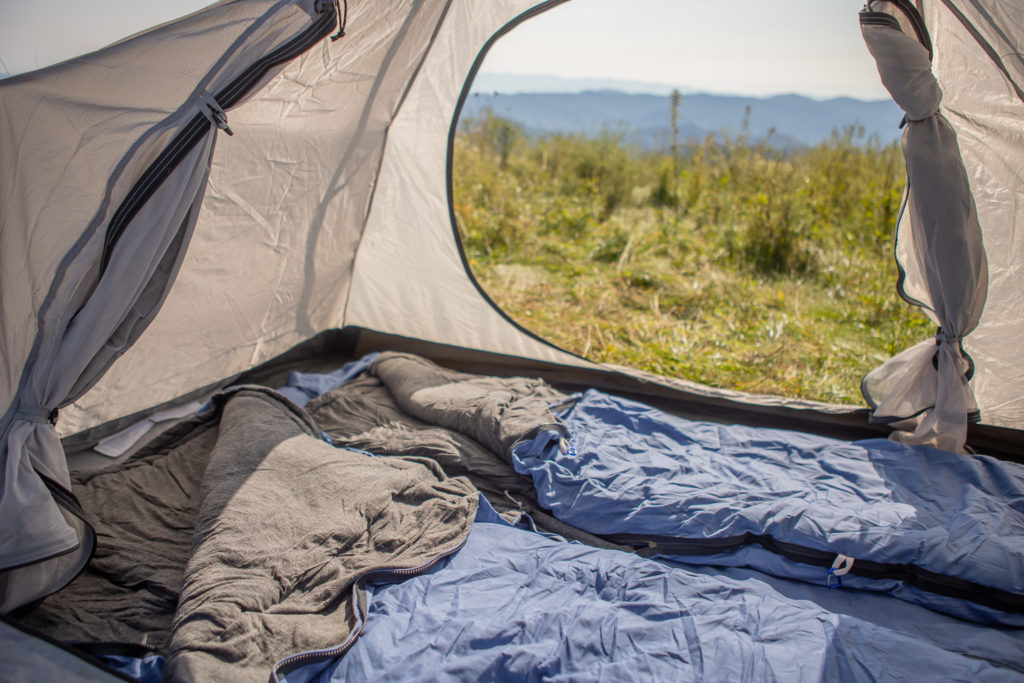
- Down cannot take humid or damp air. So you zip yourself inside a tent to protect it.
- The sealed tent traps your own moisture. We each give off about a cup of water a night in breath and insensible perspiration, and in a closed tent it has nowhere to go. That humid microclimate makes you colder.
- Thermal stress costs energy. A body that spends the night fighting damp cold is expending energy rather than restoring it. You wake up tired and blame the camping.
- Water-repellent treatments do not fix it. In my reading, the chemicals added to make down shed water also make it slower to dry once the water is in.
I watched this happen on a four-day trip in Linville Gorge. We camped by a creek on the third night, damp and cold the way winter creek bottoms are. The others went into their tents to keep the dampness off their down — and then had to close the tents up, which kept their own breath in. Under my open tarp, in wool, I felt warm and dry. That is the whole down sleeping bag wet problem in one campsite.

How much does a down sleeping bag weigh vs wool?
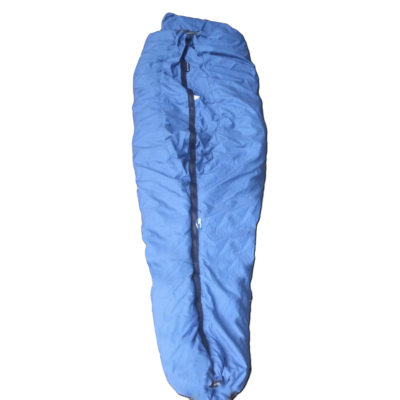
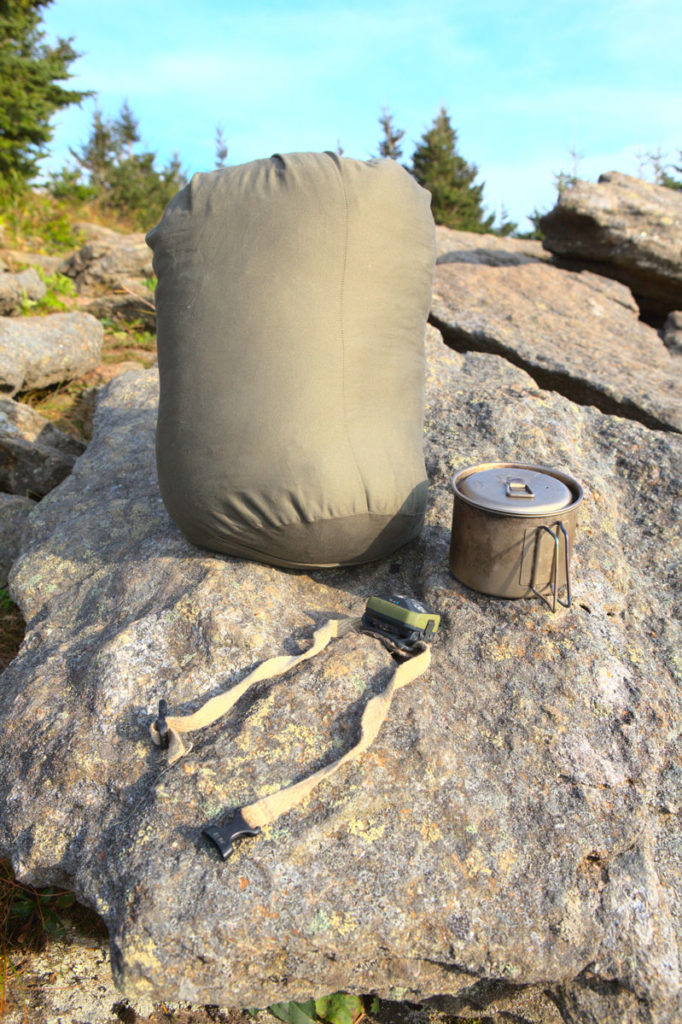
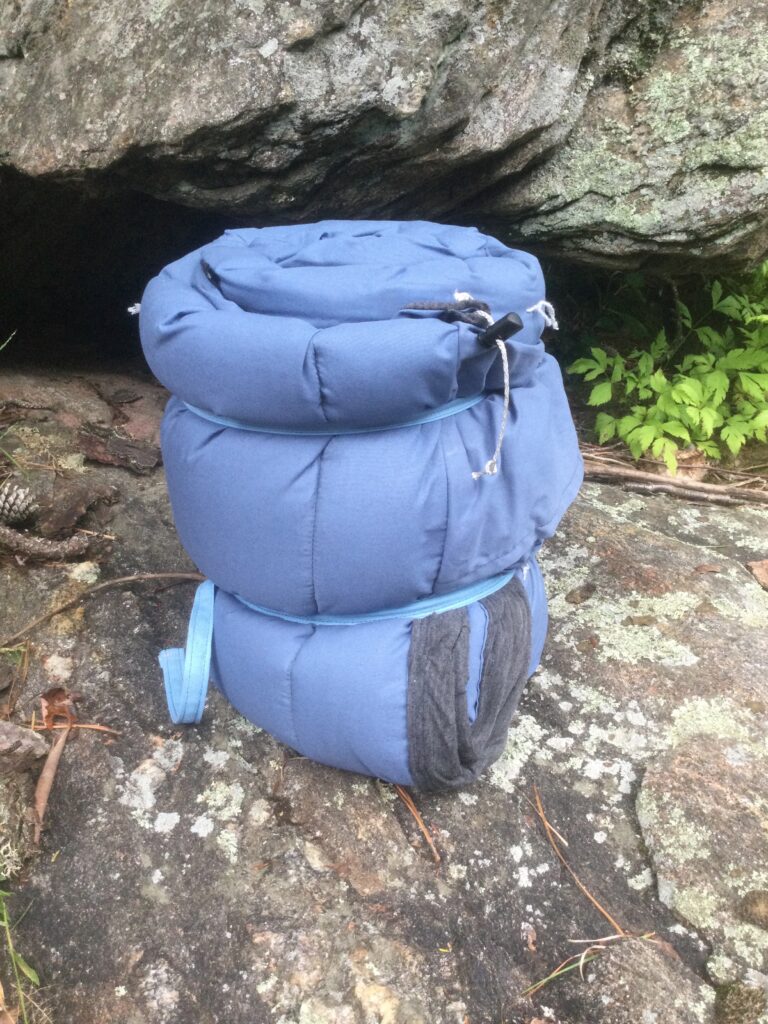
The average 20 degree down sleeping bag for backpacking weighs about one to two pounds, and a lightweight down quilt can come in under that. The Rewilder in Standard 2″ loft, field rated 20°F, is 4 lb / 1.8 kg — roughly three times a 20°F down quilt. It packs to about 11 × 11 inches with the included compression straps, against something the size of a loaf of bread for the quilt.
There is no way to talk around that. But a bag is carried in a system, not alone, and my whole pack has come in at the same weight as the group’s on the trailhead scale. I work through that arithmetic — and what three pounds actually costs you in miles — in how much does a wool sleeping bag weigh.
Microclimates, dust mites and flame retardants
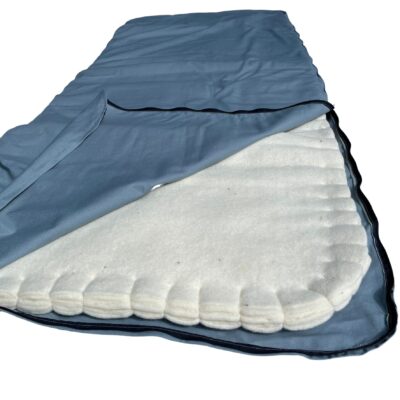
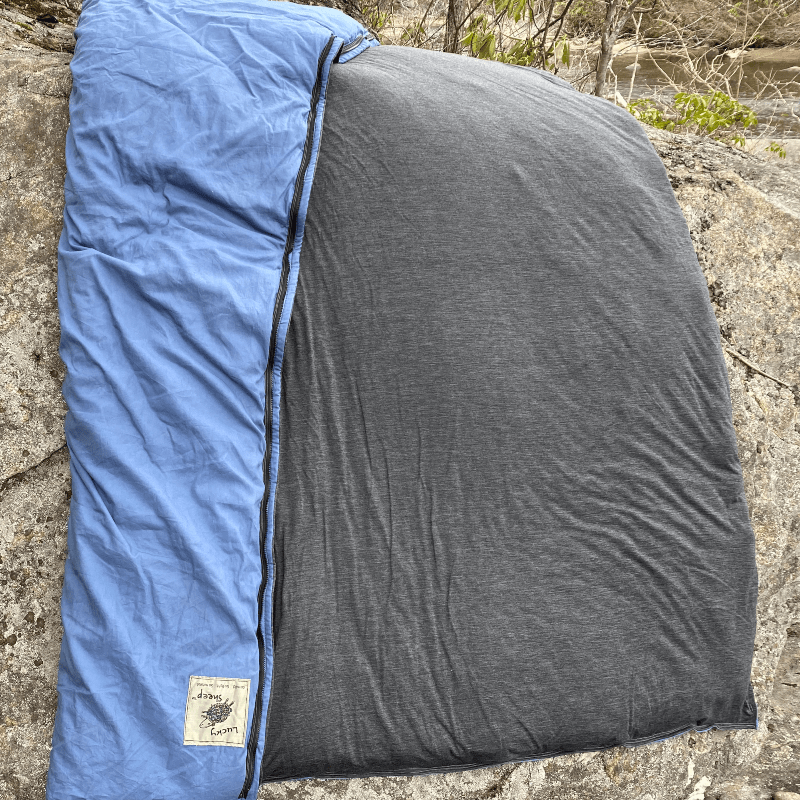
Down is loose fill, so it has to be sewn into baffles, and it migrates inside them. The result is what I call microclimates: perfectly warm under one section and roasting under another, with a thin seam between, and your body works all night to average that out. Waking up with your head on a sweaty pillow, or with that clammy feeling inside the bag, is never enjoyable. Wool batting is one continuous sheet — the loft over your shoulder is the loft over your knee — which is also why the Rewilder opens flat into a quilt without a “warm side.”
Down and synthetic fill are flammable, and the usual answer is chemical flame-retardant treatment. Wool is difficult to ignite and self-extinguishing, so it needs none. Down is a breeding ground for dust mites; wool resists them, which mattered to me when my chemical sensitivities were at their worst. And live-plucking is still a concern in the trade — I would rather not have that under my chin.
The Rewilder and the Aurora use US wool batting, a beeswax-treated organic cotton shell and a merino jersey or WeatherWool® liner — no synthetic fill, no PFAS, no water-repellent coating, no foam, no flame retardants. The zipper is PFOS-free and the thread is polyester; I am not opposed to a modern material where it solves a specific problem well.
What is the difference between down and synthetic sleeping bags?
Synthetic fill deserves its own column, because it is not down and it is not wool. The best synthetic sleeping bag holds more of its loft than down when soaked and dries faster, and it is the cheapest way to get a rated bag. Its weakness is the one people live with for years without naming: the loft fades a little with every compression, and the shell is the same clammy nylon as down’s. A synthetic-down hybrid inherits both sets of problems. Here is the wool vs down sleeping bag comparison for a 20°F bag with synthetic alongside; the wool column is the Rewilder Standard 2″ — the only truly non-synthetic sleeping bag of the three, since a down quilt is natural fill inside a synthetic shell.
| 20°F bag | Down quilt | Synthetic bag | Rewilder (wool) |
|---|---|---|---|
| Weight | About 1–2 lb | Between the two | 4 lb / 1.8 kg |
| Packed size | Loaf of bread | Larger than down | About 11 × 11 in, compression straps |
| Warm when damp | No | Partly | Yes — heat of adsorption |
| Dries from body heat overnight | No | Slowly | Yes |
| Breathe inside the bag for warmth | No — gets humid and colder | No | Yes |
| Shell | Nylon, usually coated | Nylon or polyester | Beeswax organic cotton, merino liner |
| Cold spots | Baffle seams, migration | Few | None — continuous batting |
| Flame retardant needed | Commonly | Commonly | No — wool self-extinguishes |
| Repair | Patch tape; baffles are hard | Patch tape | Sew, re-wax, replace the liner |
| Life | Until the down breaks down | Until the loft fades | Decades; lifetime workmanship guarantee |
| Price | Varies widely | Lowest | From $557 |
| Made in USA | Some | Rarely | Yes — Burnsville, NC |
Who should still buy down?
I would rather tell you this than sell you a bag you resent by the second week. Buy down if you are a thru-hiker on a five-month schedule working to a sub-10-pound base weight, if you are carrying the bag on a multi-day climb where volume is the limit, if your pack is under about 50 liters, or if nearly all your nights are in dry cold — high desert, the interior West in winter. In those places the best down sleeping bag is the right tool, and the down sleeping bag weight is the reason.
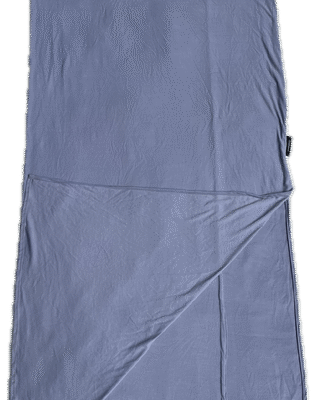
Even then, carry the merino liner inside it. Thirty ounces, adds about 10°F, and it puts wool at the skin where the clamminess starts. On its own it is a down alternative sleeping bag for summer nights and hostels.
Who should buy wool, and what it costs over a lifetime
If you camp where I camp — the eastern US, the Pacific Northwest, Britain, anywhere with fog, dew and rain between 30°F and 50°F — the wool vs down sleeping bag choice comes down to the second and third nights out, and the extra pounds buy those. If you have ever woken damp and sticky in a down bag and blamed yourself, the Rewilder is the bag I made for you. For hunting camp, a cabin, a truck or the bed at home, the Aurora Borealis is the one: rectangular, 2″, 3″ or 5″ of loft, opens into a queen quilt, and two of them zip together.
A wool bag is more on the tag and less over a life. A down bag is generally replaced once the down has broken down and the baffles have leaked. A Rewilder gets its shell re-waxed and its liner replaced, and I expect to repair it rather than retire it — that is what the lifetime workmanship guarantee is for. Do the arithmetic across twenty years of trips.
What I carry
Forty years after Paul handed me that sweater, I sleep under an open tarp in the Rewilder, in a merino base layer, with a merino scarf around my head. When the cold comes in I pull the bag over my head and breathe. At Lucky Sheep® we do not think of the weather as something to seal out. We invite it in — and use natural materials that know what to do with it.
Real fibers for real conditions.
Reviewed September 2026 by the Lucky Sheep® team.
Sleep warm out there — in wool
The Rewilder is a 20°F backpacking sleeping bag (4 lb, packs to 11 × 11 in) that keeps insulating when conditions turn damp. Add the merino liner for another ~10°F and a wool pad underneath for a complete natural-fiber sleep system.
-
Lightweight Wool Sleeping Bag–The Rewilder
The lightest all-natural backpacking bag
4 lb / 1.8 kg20°F / −6°C (10°F option)Packs to 11 × 11 in
Price range: $557.00 through $888.00 Select options This product has multiple variants. The options may be chosen on the product page -
Merino Wool Sleeping Bag Liner & Sleep Sack
Warm, washable wool liner for any bag
1.9 lb / 0.9 kgAdds ~10°F30 oz merino jersey
Price range: $200.00 through $235.00 Select options This product has multiple variants. The options may be chosen on the product page -
Organic Wool Sleeping Pad
Firm, breathable, machine-washable cover
¼ – 1.5 in wool felt24 – 60 in wide
Price range: $150.00 through $1,100.00 Select options This product has multiple variants. The options may be chosen on the product page