
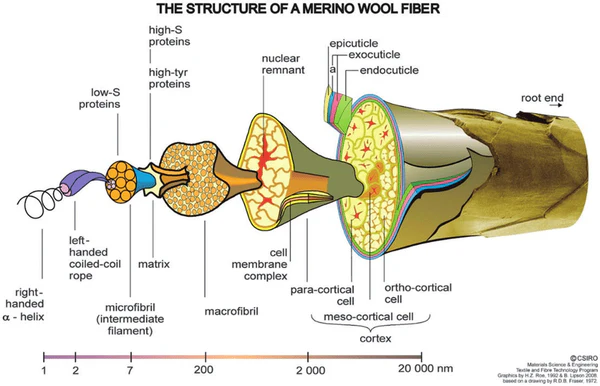
Wool has a special ability to manage moisture in a way that makes it ideal for outdoor clothing. Here’s what happens:
- Adsorbing Moisture Releases Heat: Wool fibers naturally adsorb water vapor from your body or the air. Adsorption means that water molecules get trapped in the naturally porous fibers of the fabric versus absorption where water molecules permeate the fabric and are wet to the touch. For wool, because the water is trapped, it doesn’t feel wet to the touch. As this moisture enters the fibers, a small amount of heat is released. This is known as the heat of adsorption, and it’s why wool feels warm, even when it’s damp.
- Keeps You Warm in Wet Conditions: This ability to trap heat while managing moisture makes wool perfect for cold, wet environments. If you’re caught in the rain or snow, wool doesn’t lose its insulating power the way many other fabrics do.
- Regulates Your Temperature: Wool adapts to your body’s needs. In cold weather, it traps heat, keeping you warm. In milder conditions, wool pulls moisture away from your skin and helps prevent overheating, creating a balanced and comfortable experience.
This makes wool an all-around excellent choice for outdoor clothing, where moisture and temperature can fluctuate.
How Synthetic Clothing Handles Moisture and Warmth
Synthetic fabrics like polyester, nylon, or polypropylene are engineered to handle moisture in a completely different way. Here’s what sets them apart:
- Repelling Rather Than Absorbing Moisture: Unlike wool, synthetic fibers don’t absorb moisture into their structure. Instead, they are designed to wick sweat away from your skin to the fabric’s surface, where it evaporates.
- Synthetic materials such as pile jackets or synthetic or down filled sleeping bags sewn with synthetic fabric, do not dry from the body heat while wearing. The only way to dry these is in the air or with a fire. This can be a problem during wet conditions where sometimes neither options are available.
- No Heat from Absorption: Since synthetic fabrics don’t absorb water vapor, they don’t release heat when they get damp. If synthetic clothing gets wet (like in a rainstorm), it can often feel cold and uncomfortable because water gets trapped between the fabric and your skin.
- With synthetic fabrics the sweat does not leave through the fibers, but rather in between the weave of the fibers. This makes the process of evaporation inefficient because some moisture is always trapped next to the skin.
Wool can be considered an ‘active’ fiber due to its ability to absorb and desorb moisture vapour as conditions around it change.
Water vapor molecules absorbed by wool attach to specific chemical sites within the structure, losing some of their energy as heat. Thus moisture absorption by wool as humidity rises increases the fiber temperature, and moisture release following a decrease in humidity lowers it. The amount of heat involved is significant. A kilogram of dry wool placed in an atmosphere of air saturated with moisture releases about the same amount of heat as that given off by an electric blanket running for eight hours. In the Lucky Sheep Rewilder20 Wool Sleeping Bag, there are about two pounds of wool batting insulation. This is the equivalent of the amount needed to release heat for eight hours.
Also, inside the wool sleeping bag, the camper can add their own moisture by breathing inside the bag. That means, pulling the top over the head, and breathing the warm air inside the bag. The moisture in the breath will be adsorbed into the wool fibers and migrate to the outside where it will be released. This cannot be done inside a synthetic or down-filled sleeping bag where it would actually make the camper colder by holding the moisture inside, but is unique to wool alone.
Wool can be used in based layers as well as insulation layers. Some types of wool even shed water thus acting as a shell layer.
During a rainy hike, a wool garment will shed the rain (liquid water), but adsorb internally the water vapor generated by the body in response to the effort of hiking. The exact degree to which this works depends on the type of wool fabric. Some wool fabric is made for this type of action.
Key Differences Between Wool and Synthetic Clothing for Outdoor Use
Let’s compare wool and synthetic clothing side by side to highlight their advantages and disadvantages in outdoor conditions:
Warmth When Wet
- Wool: Stays warm even when damp, thanks to the heat released during moisture absorption.
- Synthetic: Loses its insulating ability and can feel cold and clammy when wet.
Moisture Management
- Wool: Adsorbs moisture into its fibers, managing it slowly while keeping you comfortable.
- You can wear wool even when wet as it will still keep you warm and will slowly dry out from your body heat.
- Synthetic: Wicks moisture away from your skin quickly but doesn’t retain warmth. Keeps some moisture next to the skin.
Drying Time
- Synthetics fabrics such as polypropylene and poly fleece won’t actually absorb much water, but will be wet and hold the water against you, where it will rob you of heat
- Cotton and other plant material absorbs all the water it can … immediately … (unless the cotton is treated with wax)
- Wool adsorbs a lot of water … slowly, and internally … however the wool still insulates the wearer.
Warmth to Weight Ratio
Many claim wool doesn’t work because it has a lower warmth-to-weight ratio than synthetics and down. However, this only applies under IDEAL conditions. That means, dry conditions. And in effect this only applies when thought of as a static insulation. In reality, where there is exertion, rain, mist, and changing conditions, including wind and exertion level, the synthetic counterparts do not outperform the wool.
Physical exertion, even on a cold day, causes the body to produce warm water vapor. Wool will adsorb the warm vapor, trapping the moisture and the heat inside the fibers. Wool can keep the rain from reaching you, while at the same time grabbing the perspiration vapor and heat. When you hike hard in synthetic rain you will just get soaked from the inside, even in the clothing that claims to breathe. This is one of the conditions where the wool wins on the warm-to-weight ratio.
Conclusion: Wool’s Heat of Adsorption Makes It a Winner for Outdoor Adventures
In 1858, French Scientist Coulier was the first to observe that when dry wool was moved to a humid room – when it adsorbed water — it produced heat … the small amounts of energy known as the “heat of sorption”. You can notice this in real life when going out on a cold, humid day. Your woolen outerwear will prevent the humidity of the air from chilling you … the wool will dry the air near your body, creating a lower-humidity, warm micro-environment. Wet (high humidity) air pulls heat from the body much more quickly than dry air.
The process of internal adsorption is very gradual, and is relatively impervious to liquid water. This is important in cold weather, where heat and energy must be conserved. Physical exertion, even on a cold day, causes the body to produce warm water vapor. Wool will adsorb the warm vapor, trapping the moisture and the heat inside the fibers. Wool does this even on a cold, rainy day!
Wool’s unique heat of adsorption gives it a significant edge when it comes to outdoor clothing in cold or wet conditions. Its ability to release heat when absorbing moisture helps you stay warm and comfortable, even in the harshest environments.