

Part 4 of the series: How Fabric Affects the Electricity of the Body
The Foundations of Vitality
Life is electrical. And vitality depends on how effectively that electricity is generated, organized, and sustained.
Every heartbeat, every thought, every movement, and every act of cellular repair depends on electrical and chemical processes working together. Trillions of cells maintain electrical potentials, communicate through charged particles, and harness electrochemical gradients to power the machinery of life.
But this extraordinary electrical system doesn’t operate in isolation.
It exists within a world of sunlight, water, temperature, and radiant energy. Our bodies are continually exchanging energy and information with the environment around us.
Water provides the medium. Light supplies energy and biological signals. Electrical gradients help organize and sustain life.
Together, these forces contribute to something we recognize instinctively but rarely stop to examine: vitality.
Vitality is the experience of being fully alive—abundant energy, mental clarity, physical resilience, restorative sleep, and the ability to respond to life’s demands without becoming depleted.
It emerges from the coordinated functioning of the entire organism in relationship with its environment.
This is why sunlight, fresh air, natural rhythms, and restorative sleep can have such a profound influence on how we feel. They interact with biological systems that have evolved in continuous relationship with the natural world.
And it raises an intriguing question that has become central to my work:
What role do the materials surrounding our bodies play in this relationship?
Our clothing, bedding, and shelter are not simply barriers between us and the environment. They create a physical environment of their own—one that influences the exchange of heat, moisture, and radiant energy between our bodies and the world.
Natural fibers such as wool have remarkable properties in this regard. Their molecular structures interact with water, respond to electrical fields, and absorb and emit infrared radiation.
These interactions are not imaginary or merely philosophical. They are measurable properties of matter.
The question is how they work together—and what their combined effects may mean for human comfort, physiological regulation, and vitality.
Recent investigations into the electrical nature of life offer fascinating clues.
Bioelectricity researchers, including developmental biologist Michael Levin, have demonstrated that electrical signaling helps organize living tissues, guide development, and regulate regeneration.
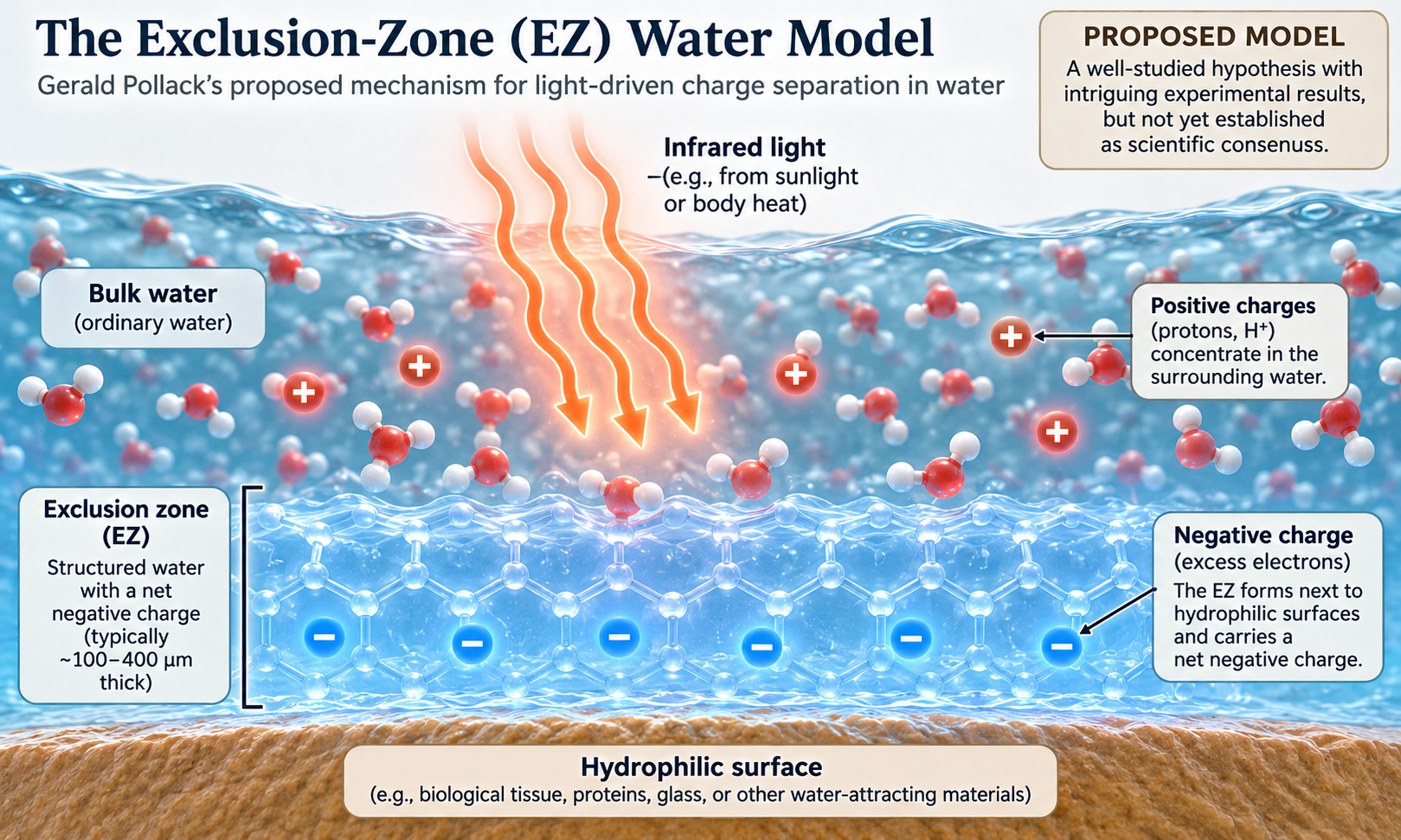
Meanwhile, Dr. Gerald Pollack’s research into water near hydrophilic surfaces has revealed unusual exclusion-zone phenomena and reported responses to radiant energy. His proposed explanation suggests that light can contribute to a battery-like separation of electrical charge in water.
These investigations approach life from different directions, but together they encourage us to reconsider how deeply water, light, and electrical processes are woven into biological organization.
For me, these discoveries also bring new meaning to something I’ve experienced firsthand: the distinctive, sustained warmth of wool.
Working with wool sleeping bags, blankets, and felt clothing, I’ve become increasingly interested in how wool’s interactions with moisture and radiant heat create an environment that feels different from other materials.
Could there be more to this relationship than conventional descriptions of insulation and moisture management have revealed?
Understanding the relationship between water, light, and electricity may help us better understand vitality itself—and why the materials we surround ourselves with matter.
To explore this possibility, we’ll begin with one of the most abundant and remarkable substances in the human body: water.
The Fourth Phase of Water
We learned in school that water exists in three familiar phases: solid, liquid, and vapor.
But water is far more complex than this simple description suggests.
Dr. Gerald Pollack, a professor of bioengineering at the University of Washington, has devoted years to investigating the behavior of water near surfaces.
His research focuses on a phenomenon known as exclusion-zone water, or EZ water.
In experiments involving water adjacent to hydrophilic, or water-attracting, surfaces, researchers have observed regions that exclude suspended particles and certain dissolved substances.
These exclusion zones can extend surprisingly far from the surface—sometimes hundreds of micrometers.
Pollack interprets these findings as evidence that water can organize into a more ordered structure than ordinary bulk water. He calls this proposed state the fourth phase of water.
The experimental observations are fascinating in their own right.
They demonstrate that the behavior of water near certain surfaces can differ significantly from what we observe in an ordinary glass of water.
The interpretation remains an active subject of scientific debate. Other researchers have reproduced exclusion-zone phenomena and proposed alternative explanations, including concentration gradients and a process known as diffusiophoresis, in which suspended particles move in response to differences in dissolved substances.
These competing explanations matter because they address the mechanism behind the observations.
What is already firmly established is that water interacts with the surfaces of proteins, membranes, and other biological structures in ways that influence their physical and chemical behavior.
Pollack’s research extends this investigation into a provocative new territory: the possibility that radiant energy contributes to the formation of electrically distinct regions within water.
And this is where the story becomes especially interesting.
Water as a Battery
One of Pollack’s most significant lines of research concerns the relationship between light and electrical charge separation in water.
His laboratory has reported that water adjacent to certain hydrophilic surfaces develops regions with different electrical characteristics.
In Pollack’s model, the exclusion zone becomes relatively negatively charged, while the surrounding water develops a corresponding positive charge.
This separation resembles an essential characteristic of a battery: the establishment of an electrical potential between regions.
And what supplies the energy?
Light Expands the Exclusion Zone
One of the most remarkable findings from Dr. Gerald Pollack’s research is that light can dramatically increase the size of exclusion zones in water.
In a peer-reviewed study published in the Journal of Physical Chemistry B in 2009, Pollack and his colleagues demonstrated that radiant energy, particularly infrared radiation, caused exclusion zones adjacent to hydrophilic surfaces to expand.
Under certain experimental conditions, infrared exposure increased exclusion-zone width severalfold. The effect depended on wavelength and continued to grow with sustained illumination.
The researchers also investigated whether ordinary heating could explain the expansion. Their temperature measurements indicated that the observed changes were not simply proportional to the modest warming of the water.
The existence of exclusion zones has since been independently reproduced by multiple research groups, confirming that these unusual interfacial effects are genuine physical phenomena.
Pollack interprets the light-driven expansion as evidence that radiant energy helps organize water and separate electrical charge, producing a battery-like system.
The precise molecular mechanism remains under investigation, but the experimental findings reveal a fascinating relationship between water, surfaces, and light.
Water near certain surfaces does not merely respond to temperature. Its behavior can change dramatically in response to radiant energy.
This finding opens an important avenue for investigating how light interacts with water in biological and other natural systems.
Every Living Cell Is an Electrical System
Electricity is fundamental to life.
We commonly associate biological electricity with nerve impulses, muscle contractions, and the rhythmic beating of the heart.
But electrical activity extends far beyond these familiar examples.
Every living cell maintains an electrical potential across its membrane.
These voltages arise from differences in the concentrations of electrically charged particles, or ions, inside and outside the cell.
Specialized proteins called ion channels and pumps regulate the movement of these ions.
The resulting electrochemical gradients participate in cellular communication, metabolism, growth, and development.
Researchers studying bioelectricity, including developmental biologist Michael Levin, have demonstrated that electrical signaling helps coordinate the organization of living tissues.
In experimental organisms, manipulating bioelectric signals can change developmental patterns and influence regeneration.
Electrical fields also participate in wound healing, helping guide the movement of cells involved in tissue repair.
This research is changing how we understand biological organization.
Electrical signaling is not merely a communication system for nerves and muscles. It is part of the machinery through which living tissues coordinate their activities and maintain their structure.
Science writer Sally Adee discusses this emerging understanding in her TEDx talk, How Bioelectricity Could Transform How We Think About the Body.
One of the most important lessons is that biological electricity operates at many levels, from individual cells to networks of tissues and organs.
And water is indispensable to all of it.
Water provides the molecular environment in which ions move, proteins change shape, and electrochemical reactions take place.
The electrical organization of life cannot be separated from the water within us.
Sunlight and the Water Within Us
In earlier installments of this series, we explored how sunlight influences our circadian rhythms and how different wavelengths interact with biological systems.
Now we can add water to the picture.
The human body is largely composed of water, but this water is not simply sitting in an empty container.
It surrounds proteins, membranes, connective tissues, and countless other molecular structures.
Water molecules interact continuously with these surfaces. Near biological interfaces, their orientation, mobility, and hydrogen-bonding behavior can differ from those of water in the surrounding bulk liquid.
These interactions are fundamental to biochemistry.
They influence protein folding, enzyme activity, membrane behavior, and molecular transport.
Pollack’s work raises an additional question: might radiant energy influence some of these water–surface interactions in ways that contribute to biological electrical processes?
His proposed large-scale exclusion-zone structures have not been established as a general mechanism within living tissues. But the broader relationship between light, hydration, and molecular organization is a legitimate and fascinating area of biophysical investigation.
Sunlight’s influence on life is already profound.
It provides the energy for photosynthesis, regulates circadian timing, and produces wavelength-dependent effects in tissues.
Understanding how water participates in these interactions may reveal additional details about the extraordinary complexity of living systems.
Mitochondria, Infrared Light, and Cellular Energy
Our mitochondria are often described as the powerhouses of our cells.
Their role is central to vitality.
Mitochondria produce much of the ATP that cells use to perform biological work.
They accomplish this through a series of biochemical reactions involving electron transport and the creation of an electrochemical gradient across the inner mitochondrial membrane.
This gradient drives the production of ATP.
The process is a striking example of how living organisms harness electrical and chemical potential to sustain life.
Cells then use ATP to operate ion pumps, synthesize molecules, transport substances, repair structures, and maintain the electrical conditions necessary for normal functioning.
In other words, biological energy production and electrical regulation are intimately connected.
Research into red and near-infrared light adds another dimension to this relationship.
Under appropriate experimental conditions, certain wavelengths can influence mitochondrial activity and cellular signaling.
This field, known as photobiomodulation, investigates mechanisms involving electron transport, nitric oxide, reactive oxygen species, and changes in cellular metabolism.
Researchers have also explored how light interacts with molecular vibrations, protein configurations, and electron-transfer reactions.
These investigations reveal that light can influence biological activity through mechanisms extending beyond vision and vitamin D production.
However, wavelength matters enormously.
The red and near-infrared wavelengths used in many photobiomodulation experiments are different from the longer-wavelength thermal infrared radiation emitted by ordinary objects at room or body temperature.
Their biological effects cannot be treated as interchangeable.
This distinction becomes especially important when we begin investigating fabrics.
Wool interacts with infrared radiation, but that fact alone does not mean it produces the same cellular effects observed in controlled photobiomodulation experiments.
What it does establish is that the radiant environment surrounding the body deserves attention alongside temperature and moisture.
Cellular Energy, Stress, and the Importance of Electrical Balance
Vitality depends on more than producing energy.
It also depends on regulating how that energy is used.
A healthy cell continually maintains electrochemical gradients across its membranes. This requires a steady supply of ATP.
When ion regulation becomes disrupted or membranes lose their normal selectivity, cells may expend additional energy restoring their internal conditions.
The nervous system operates through more complex regulatory processes, but energy demand and physiological regulation are equally important at the level of the whole organism.
Stress can increase the demands placed on these systems.
Prolonged sympathetic nervous system activation may increase heart rate, muscle tension, and other physiological activities associated with heightened arousal.
The heart, brain, and respiratory system continually coordinate their activity in response to changing conditions.
Heart-rate variability, brain-wave patterns, and breathing rhythms offer different windows into this coordination.
Healthy regulation is not simply a matter of reducing electrical activity.
It involves maintaining an appropriate balance between activity, recovery, and adaptation.
The body must respond effectively when action is needed and return to restorative states when the demand has passed.
This brings us to sleep.
Sleep is an active biological process during which the brain and body carry out essential functions involving cellular maintenance, metabolic regulation, memory, and recovery.
These processes require energy.
An uncomfortable sleeping environment can increase thermoregulatory demands, disrupt sleep, or sustain physiological arousal.
Conversely, an environment that supports stable body temperature, comfortable humidity, and uninterrupted sleep can contribute to restoration.
This provides an important connection between the materials surrounding our bodies and our experience of vitality.
The fabrics we sleep in are not merely passive coverings.
They influence the physical conditions under which our bodies regulate temperature, exchange moisture, and recover from the demands of the day.
What Does This Have to Do With Wool?
This is where my interest becomes especially personal.
For years, I’ve been fascinated by the way natural fibers interact with the human body.
Wool stands out because of its remarkable relationship with moisture.
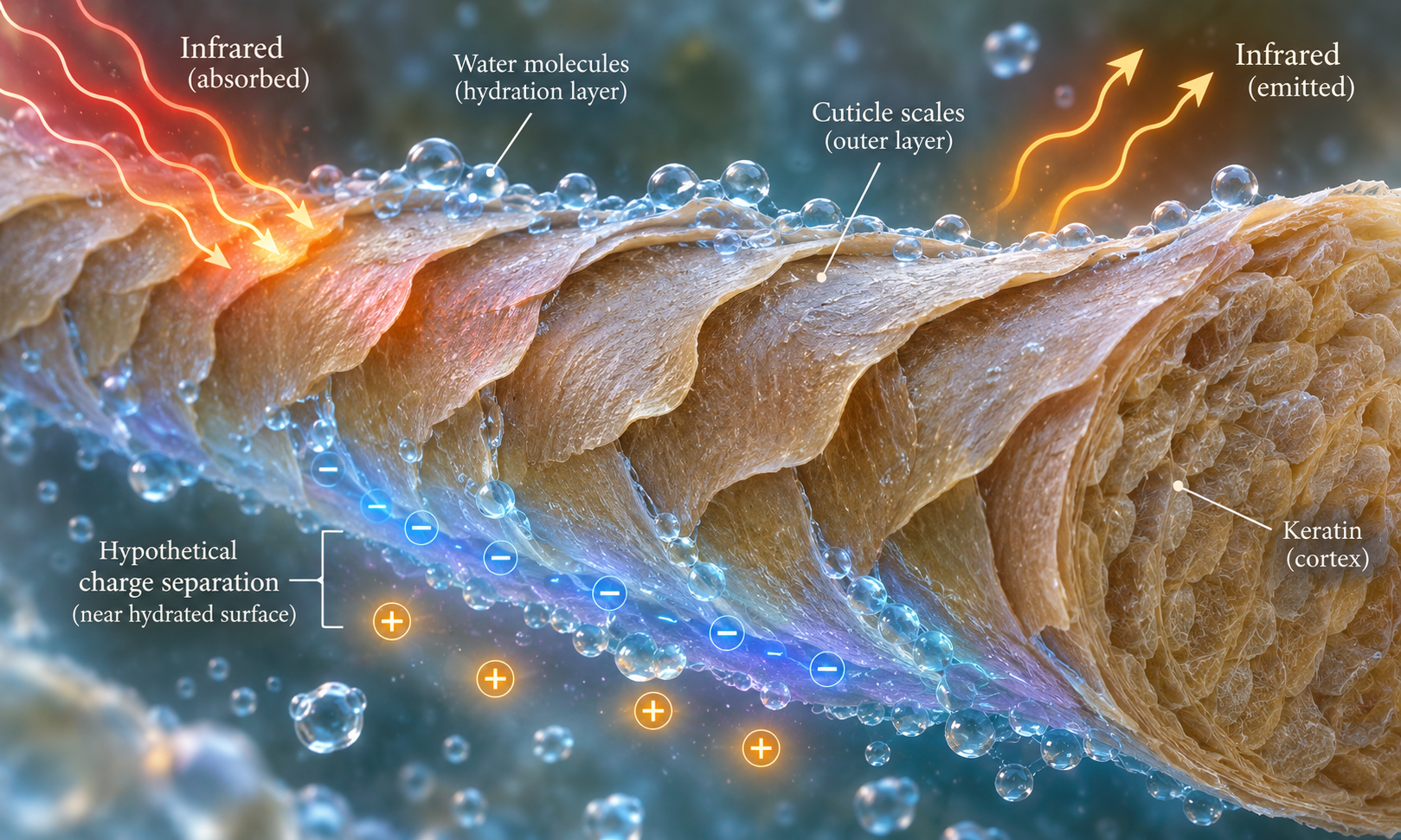
Wool fibers are hygroscopic, meaning they absorb water vapor from their surroundings.
Their complex keratin protein structure contains numerous sites that interact with water molecules.
Wool can absorb and release moisture as surrounding humidity changes, helping regulate the microclimate between our skin and clothing or bedding.
These properties influence thermal comfort and can reduce some of the physiological demands associated with maintaining body temperature.
But wool has other characteristics that deserve attention.
Keratin possesses a highly organized molecular structure. Wool fibers also exhibit distinctive electrical and dielectric properties that change with moisture content.
A dielectric material responds to an electrical field through the redistribution or polarization of charge within the material.
Wool’s electrical behavior is therefore influenced by its molecular structure, its water content, and the conditions surrounding it.
Wool also interacts with infrared radiation.
Like other materials, it absorbs, reflects, transmits, and emits radiant energy. The precise balance depends on its composition, structure, temperature, and hydration.
These are measurable physical properties.
Together, they create a complex relationship between wool, water vapor, electrical behavior, and radiant heat.
This makes wool an especially interesting material for investigating the physical environment surrounding the human body.
Different fibers can produce different temperature and humidity conditions near the skin. They can also differ in their infrared and electrical characteristics.
The next step is to understand how these properties work together—and whether some of their combined effects extend beyond our conventional descriptions of insulation and moisture management.
The established science gives us a strong starting point. The additional biological implications remain an open field for investigation.
A Different Experience of Warmth
My interest in these questions has grown through direct experience.
I’ve always been intrigued by how wool provides not just warmth, but a distinctive warm, glowing sensation that feels different from other fibers.
It reminds me of the gentle warmth of early morning sunlight, sitting beside a woodstove, or relaxing in an infrared sauna.
It isn’t simply the amount of warmth.
It’s the way the warmth feels.
The sensation begins almost immediately and continues as long as the wool surrounds my body.
I’ve noticed it with Lucky Sheep sleeping bags insulated with wool batting, as well as with our wool felt blankets and felt vests—even when there is clothing between the wool and my skin.
I’ve also observed that the closer the wool seems to be to its natural state, with less processing, the more pronounced this sensation can feel.
This has become one of the most interesting discoveries in my recent work with natural fibers.
Wool’s insulation, moisture regulation, and interaction with thermal radiation provide a strong physical foundation for understanding the experience.
But I suspect there is more to learn about how these properties work together.
The relationship between wool’s keratin structure, absorbed moisture, and radiant energy deserves closer examination.
Could wool’s structure influence the spectrum or intensity of infrared radiation exchanged with the skin?
Could its ability to absorb and release water vapor modify these interactions as humidity changes?
And could the resulting thermal and moisture environment influence the nervous system’s ability to settle into a more restful state?
These are questions that can be approached through measurement and experimentation.
They do not require assuming that wool directly increases mitochondrial energy production or creates Pollack’s proposed fourth phase of water inside the body.
Instead, they invite us to investigate the distinctive physical environment created by natural fibers and how that environment influences physiological comfort and regulation.
For me, the important point is that the experience is real, even while the full explanation remains to be discovered.
And the more I work with wool, the more interested I become in understanding the science behind it.
Rediscovering Our Relationship With Light and Water
When we spend time outdoors, we immerse ourselves in a complex natural environment.
Sunlight reaches our skin and eyes. The air carries moisture. Our bodies continually exchange heat with the surroundings.
Inside us, trillions of cells maintain electrical gradients, exchange ions, and carry out the intricate chemistry of life in an environment rich with water.
These processes are not separate from the natural world.
They are expressions of the same physical principles that govern light, matter, energy, and electrical charge.
We are part of this extraordinary system.
And our vitality depends on how effectively our bodies respond to the environment around us.
Water is central to this relationship.
Light is central to it.
Electrical activity is fundamental to the organization of living tissues.
The research of Pollack, Levin, and others provides different perspectives on these connections, from the behavior of water near surfaces to the electrical signals that help organize living organisms.
Together, they encourage us to think more deeply about the physical conditions that support life.
This brings me back to the materials we surround ourselves with.
We already know that fabrics create different thermal and moisture environments. Their molecular structures also determine how they interact with electrical fields and infrared radiation.
These differences are measurable, and some have practical consequences for comfort and sleep.
Understanding how they work together may deepen our appreciation of natural fibers and reveal additional relationships worth investigating.
Vitality is not something we manufacture through a single intervention. It emerges from the coordinated functioning of the entire organism in relationship with its environment.
Sunlight, water, temperature, sleep, and the materials touching our skin all belong to that larger picture.
Perhaps one of the most promising directions for understanding the body’s electricity begins with something as familiar as the water already within us—and extends to the fabrics we choose to surround ourselves with.
In the next installment, we’ll explore the microscopic structure of wool, its interactions with water and infrared radiation, and how natural and synthetic fibers differ in their electrical properties.
We’ll also look at an especially intriguing subject: the geometry of natural fibers and how their physical organization influences their behavior.
References and Further Reading
The following scientific publications provide background for the research and questions explored in this article. They include established biological mechanisms, experimental observations, and emerging or debated interpretations.
1. Light, Water, and Exclusion-Zone Formation
Chai, B., Yoo, H., & Pollack, G. H. (2009). Effect of radiant energy on near-surface water. The Journal of Physical Chemistry B, 113(42), 13953–13958.
This experimental study reports that radiant energy, including infrared radiation, can increase the size of exclusion zones adjacent to hydrophilic surfaces. It provides an important foundation for Pollack’s proposed relationship between light, water organization, and charge separation.
2. A Critical Scientific Review of Exclusion-Zone Water
Elton, D. C., Spencer, P. D., Riches, J. D., & Williams, E. D. (2020). Exclusion Zone Phenomena in Water—A Critical Review of Experimental Findings and Theories. International Journal of Molecular Sciences, 21(14), 5041.
This review examines the experimental evidence for exclusion-zone phenomena and evaluates competing explanations, including diffusiophoresis and other established physical mechanisms.
3. Bioelectricity and the Organization of Living Tissues
Levin, M. (2021). Bioelectric signaling: Reprogrammable circuits underlying embryogenesis, regeneration, and cancer. Cell, 184(8), 1971–1989.
https://doi.org/10.1016/j.cell.2021.02.034
This review explains how membrane potentials, ion channels, and electrical communication between cells participate in development, tissue organization, and regeneration.
4. Infrared Light and Mitochondrial Function
Hamblin, M. R. (2018). Mechanisms and mitochondrial redox signaling in photobiomodulation. Photochemistry and Photobiology, 94(2), 199–212.
https://doi.org/10.1111/php.12864
This review examines how red and near-infrared light may influence mitochondrial activity, electron transport, and cellular signaling, including why responses vary with experimental conditions.
5. Wool, Synthetic Bedding, and Sleep Physiology
Shin, M., Halaki, M., Swan, P., Ireland, A. H., & Chow, C. M. (2016). The effects of fabric for sleepwear and bedding on sleep at ambient temperatures of 17°C and 22°C. Nature and Science of Sleep, 8, 121–131.
https://doi.org/10.2147/NSS.S100271
This controlled study compared wool and cotton sleepwear, wool and polyester bedding, and different room temperatures. Wool sleepwear shortened sleep-onset latency under cooler conditions, while the study did not find a significant bedding effect on sleep outcomes.
6. Water, Radiant Energy, and Charge Separation
Pollack, G. H. (2010). Water, energy and life: Fresh views from the water’s edge. International Journal of Design & Nature and Ecodynamics, 5(1), 27–29.
Pollack outlines his interpretation of exclusion-zone water as a system capable of separating electrical charge through the absorption of radiant energy.
For an accessible introduction to bioelectricity, see Sally Adee’s TEDxManchester talk, How Bioelectricity Could Transform How We Think About the Body (2023).