

How sunlight, darkness, and the Earth’s natural signals help organize the electrical rhythms of life.e.
Part 2 of 6 — How Fabric Affects the Electricity of the Body
Sunlight and the Foundations of Vitality
Every sunrise sets an extraordinary sequence of biological events in motion.
As morning light spreads across the Earth, birds begin their songs, plants adjust their metabolism, and the internal clocks of countless organisms synchronize with the new day.
Within our own bodies, hormones, body temperature, alertness, metabolism, and cellular activity begin shifting toward daytime function.
Sunlight is doing much more than illuminating the landscape. It is helping organize the biological processes that sustain life.
And this relationship goes deeper than the familiar rhythms of sleeping and waking.
Our cells depend on the movement of electrical charges. Mitochondria harness electrochemical gradients to produce usable energy. Proteins and water molecules continually rearrange themselves as biochemical reactions unfold.
Light interacts with this living machinery in remarkable ways.
Some of these interactions are well established, including circadian signaling, vitamin D production, and the effects of particular wavelengths on cellular activity. Others are revealing new possibilities for understanding how radiant energy influences the electrical processes of life.
Together, they offer a richer picture of something we recognize instinctively: vitality.
Vitality is more than having enough energy to get through the day. It is the experience of being fully alive—mental clarity, physical resilience, restorative sleep, and the capacity to respond to life’s demands while maintaining balance.
It emerges from the coordinated functioning of the entire organism in relationship with its environment.
And few environmental influences are as fundamental as sunlight.
For billions of years, life has developed beneath a changing solar spectrum, within the Earth’s magnetic environment, and through recurring cycles of light and darkness.
Today, much of our lives unfold indoors, beneath artificial lighting and behind windows that alter the spectrum reaching our bodies.
Understanding what we have changed begins with understanding the extraordinary language of natural light.
The Body Reads the Language of Sunlight
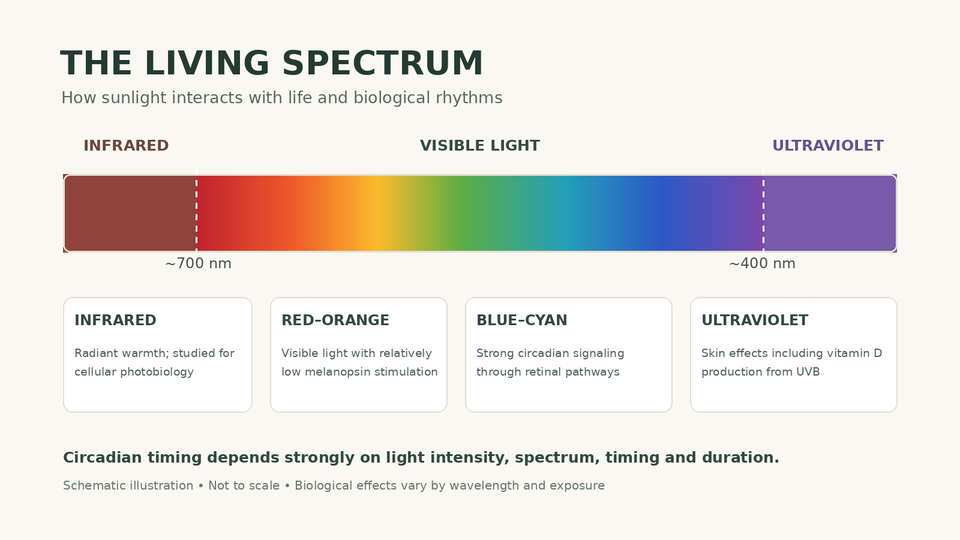
Sunlight is not a single form of energy. It contains a broad spectrum of electromagnetic radiation, with different wavelengths interacting with matter in different ways.
The visible spectrum extends from violet and blue through green and yellow to orange and red.
Beyond violet lies ultraviolet radiation. Beyond red lies infrared radiation.
Each region has distinctive physical properties and biological effects.
But the spectrum reaching us also changes throughout the day.
At sunrise, the atmosphere scatters shorter wavelengths from the direct solar beam, giving the low sun its characteristic golden and reddish appearance. As the sun rises, the intensity and spectral composition of daylight change.
By midday, sunlight is generally brighter and contains a broad distribution of wavelengths. Toward evening, the changing light signals the approach of darkness.
Living organisms have evolved ways to respond to this progression.
The biological importance of light depends on its wavelength, intensity, duration, and timing.
In other words, the body responds not simply to light, but to the character of light and when it arrives.
Blue and Cyan Light: Setting the Biological Clock
One of the great discoveries of modern circadian biology concerns specialized cells in the retina containing the light-sensitive pigment melanopsin.
These cells are particularly responsive to blue-cyan light, with peak sensitivity near 480 nanometers.
They communicate with the brain’s central circadian clock, helping synchronize our internal rhythms with the external day.
Bright light in the morning reinforces daytime alertness and helps establish the timing of our sleep-wake cycle.
The same wavelengths received late in the evening can suppress melatonin and delay the body’s preparation for sleep.
This is why timing matters so much.
The light that supports wakefulness during the day can interfere with restoration at night.
Our bodies evolved under bright days and dark nights. Modern lighting has dramatically altered that ancient pattern.
Red and Orange Light: The Colors of Transition
The warm colors of sunrise and sunset are among nature’s most beautiful daily transformations.
When sunlight travels through a longer atmospheric path, shorter wavelengths are scattered more strongly from the direct beam, leaving a greater proportion of reds and oranges.
These longer visible wavelengths generally stimulate the melanopsin system less strongly than blue-cyan light at comparable intensities.
The changing spectrum accompanies the transition between daytime activity and nighttime rest.
Red and orange light also have interesting biological properties beyond circadian timing.
Research into photobiomodulation has demonstrated that selected red and near-infrared wavelengths can influence cellular signaling under appropriate conditions.
This reminds us that different portions of the spectrum participate in different biological processes.
The progression from morning to evening is not merely a visual spectacle. It is part of the changing physical environment to which our biology has adapted.
Ultraviolet Light: Chemistry Beyond Vision
Ultraviolet radiation is invisible to the human eye, yet it participates in important biological chemistry.
UVB radiation initiates vitamin D production in the skin.
UVA radiation can release nitric oxide-related compounds from skin stores, influencing vascular signaling and, under some conditions, blood pressure.
Ultraviolet radiation also interacts with retinoids, including vitamin A-related compounds. Certain wavelengths can produce photochemical changes and degradation in these molecules.
These reactions are interesting in their own right, although they do not establish that sunlight produces beneficial vitamin A detoxification in living humans.
Ultraviolet radiation also carries well-established risks, including DNA damage, skin aging, and skin cancer.
Its biological effects depend on wavelength, dose, exposure history, and individual circumstances.
The larger lesson is that sunlight participates in biological chemistry extending far beyond vision.
Infrared Light and the Electrical Machinery of Life
At the longer-wavelength end of the spectrum lies infrared radiation.
We know infrared partly through the experience of radiant warmth—the feeling of sunlight on our skin, sitting beside a woodstove, or relaxing in an infrared sauna.
But infrared radiation is also capable of interacting with molecular structures.
Different infrared wavelengths can be absorbed by molecular bonds and influence their vibrational behavior.
This has inspired an especially interesting line of research into the relationship between light and the movement of electrons through biological molecules.
To appreciate its significance, we need to look inside the mitochondria.
Mitochondria: The Electrical Powerhouses of Life
Mitochondria produce much of the ATP used by our cells.
They accomplish this through an intricate sequence of chemical reactions involving the transfer of electrons.
Within the inner mitochondrial membrane, proteins of the electron transport chain pass electrons through a series of reactions.
The energy released helps pump protons across the membrane, creating an electrochemical gradient.
This gradient drives ATP production.
It is an elegant example of how living organisms use differences in electrical and chemical potential to perform biological work.
Every heartbeat, muscle contraction, nerve impulse, and act of cellular maintenance ultimately depends on energy supplied through these interconnected processes.
But the electron transport chain is not simply a mechanical conveyor belt.
Its reactions occur within a dynamic molecular environment.
Proteins move and vibrate. Water molecules rearrange. Electrical charges influence neighboring molecules.
The rates of electron-transfer reactions depend on this continually changing molecular landscape.
And this is where the physics of light becomes especially interesting.
Can Infrared Light Change the Speed of Electron Transfer?
In November 2026, I encountered a fascinating lecture by physician Dr. Roger Seheult titled Infrared Light Can Speed Mitochondria Up—or Slow Them Down.
Seheult presented a theoretical framework developed with astrophysicist Robert Fosbury, light engineer Scott Zimmerman, and neuroscientist Glen Jeffery.
Their proposal offers a more sophisticated way of thinking about the relationship between infrared light and mitochondrial activity.
Rather than assuming that infrared radiation simply stimulates mitochondria to produce more energy, they explore how different wavelengths might accelerate some electron-transfer reactions while slowing others.
This helps address a puzzle in photobiomodulation research.
Under particular experimental conditions, light near 810 nanometers has been reported to increase mitochondrial complex IV activity, while wavelengths around 750 and 950 nanometers have produced decreases.
Why would relatively nearby wavelengths produce different responses?
The researchers propose that the answer may lie in the physical requirements of electron transfer itself.
Marcus Theory: The Molecular Dance Behind Electron Transfer
In 1992, chemist Rudolph Marcus received the Nobel Prize in Chemistry for his contributions to electron-transfer theory.
His work established that electron transfer depends on more than the availability of an electron donor and acceptor.
The surrounding molecular environment must also reach a favorable energetic configuration.
Proteins are constantly moving.
Their atoms stretch, twist, and vibrate. Nearby water molecules continually rearrange themselves through changing hydrogen bonds.
When an electron transfers between molecular sites, the surrounding environment often undergoes reorganization.
The energy associated with this process is known as reorganization energy.
Imagine two people passing an object between them.
The transfer becomes easier when their hands are correctly positioned.
At the molecular level, the arrangement of participating structures likewise influences the ease and rate of electron transfer.
Now consider what happens when infrared radiation interacts with those molecules.
Infrared photons can excite particular molecular vibrations.
Seheult and his colleagues propose that these vibrations may influence how frequently an electron-transfer system reaches the configurations necessary for a reaction.
In one system, a particular wavelength might increase the rate of electron transfer.
In another, it might decrease that rate.
The result would depend on the molecular structure, the reaction involved, and the wavelengths received.
This is a far more interesting picture than simply saying that infrared light increases cellular energy.
It suggests that radiant energy may influence the kinetics—the speed—of specific electrical reactions.
Marcus theory is established physical chemistry, and laboratory experiments have demonstrated infrared-dependent changes in electron-transfer rates in certain model systems.
Applying this mechanism to the complete mitochondrial electron transport chain under ordinary sunlight is the newer part of the Fosbury–Seheult–Zimmerman–Jeffery proposal.
Their framework is an exciting direction for investigation because it connects established molecular physics with important questions about biological energy production.
Why the Full Solar Spectrum Matters
The sun delivers an extraordinary range of electromagnetic wavelengths.
A substantial portion of the solar energy reaching Earth’s surface lies in the infrared region.
Our atmosphere selectively absorbs some infrared wavelengths while allowing others to pass through.
The result is a complex spectrum of radiant energy reaching the living world.
Seheult and his colleagues suggest that this diversity may be biologically significant.
If different wavelengths interact with different molecular vibrations and electron-transfer reactions, the broad solar spectrum could influence multiple molecular pathways in different ways.
A narrowband therapeutic light source targets a limited range of wavelengths.
Sunlight provides a much broader distribution.
This does not make every wavelength equally beneficial, nor does it establish that sunlight is superior to targeted light therapy for a particular medical purpose.
But it gives us an important reason to study the complete solar spectrum rather than viewing light as a single interchangeable input.
Sunlight and the Scaling of Metabolism
Another intriguing feature of the researchers’ proposal concerns the relationship between sunlight and metabolic scaling.
Across many animal species, metabolic rate tends to increase with body mass according to a power-law relationship, often approximated by a three-quarter-power exponent.
The researchers explore whether the geometric scaling of intercepted solar radiation can produce a comparable mathematical relationship under particular assumptions.
The similarity is provocative.
It suggests a possible relationship between the physical geometry of organisms, their exposure to radiant energy, and the scaling of biological energy demands.
A matching mathematical exponent does not establish a causal relationship, but the proposal creates a testable direction for further research.
It also illustrates how the geometry of living systems may be relevant to the ways they interact with their environment.
Water, Infrared Light, and the Movement of Electrons
There is another essential participant in this story.
Water.
The movement of electrons through biological molecules takes place within a molecular environment rich in water.
Water molecules are electrically polar. They form dynamic hydrogen-bond networks and interact continuously with proteins, ions, membranes, and other cellular structures.
Their arrangement influences molecular behavior, including electron-transfer reactions.
Seheult discusses laboratory experiments in which changes in molecular organization involving water substantially altered electron-transfer rates.
He also describes research in which infrared excitation of hydrogen-bonded molecular bridges accelerated one electron-transfer reaction while slowing another.
Water plays an active role in the electrical machinery of life.
Its hydrogen-bond networks are constantly forming, breaking, and reorganizing around proteins and other molecules. Research has demonstrated that changes in these molecular arrangements can influence electron-transfer rates.
In one electrochemical study, researchers found that modifying water’s hydrogen-bonding environment increased electron-transfer rate constants. Other experiments have shown that the number and arrangement of water molecules surrounding a charged interface can alter electron-transfer dynamics.
Within mitochondria, hydrogen-bonded networks of water molecules also participate in the movement of protons through the respiratory machinery.
These findings reveal a remarkable connection: the organization of water helps determine how electrical charges move through molecular systems.
The emerging research into infrared light adds another dimension. Because infrared radiation can interact with molecular vibrations, researchers are investigating whether light can influence these water-dependent processes and thereby affect mitochondrial electron-transfer kinetics.
These experiments demonstrate an important physical principle:
Molecular vibrations and the organization of the surrounding environment can influence the speed of electron transfer.
This brings us toward another fascinating area of research: the behavior of water near surfaces.
Dr. Gerald Pollack and his colleagues have investigated exclusion-zone phenomena in water adjacent to certain hydrophilic surfaces.
These regions exclude suspended particles and some dissolved substances.
In peer-reviewed experiments, Pollack’s laboratory also reported that radiant energy, particularly infrared radiation, caused exclusion zones to expand substantially.
Exclusion-zone phenomena have been reproduced by independent researchers, although explanations for their formation differ.
Pollack interprets the light-responsive behavior as evidence of a more ordered state of water capable of supporting charge separation.
His proposed molecular structure and battery-like mechanism remain subjects of scientific investigation.
What makes these studies particularly interesting is the recurring relationship between water, molecular organization, radiant energy, and electrical behavior.
The electron-transfer experiments and Pollack’s exclusion-zone studies investigate different systems, but they encourage us to examine a larger picture.
Water is not merely a passive background for the chemistry of life.
It actively participates in molecular interactions, electrical transport, and the physical organization of biological structures.
We will explore this relationship in greater depth in Part Four, Water, Light, and the Electricity of Life.
The Built Environment: What Happens When We Move Indoors?
For most of human history, our daily lives unfolded under the changing light of the sun.
We experienced bright outdoor days, the colors of sunrise and sunset, and nights illuminated primarily by firelight, moonlight, and stars.
Today, many people spend most of their waking hours indoors.
The light environment inside a building is fundamentally different from natural sunlight.
Common artificial lighting systems produce very different spectral distributions from sunlight, often with relatively little infrared radiation.
Windows also modify the solar spectrum, particularly when coatings are designed to reduce heat transmission.
Indoor illumination is frequently far dimmer than outdoor daylight, even when a room appears adequately lit.
And after sunset, electric lights and screens can expose us to brightness and wavelengths that interfere with the body’s natural preparation for sleep.
We have changed both the quantity and timing of the light reaching our bodies.
Circadian biology already demonstrates that this matters.
Bright daytime light helps synchronize our biological clocks, while excessive evening illumination can disrupt melatonin timing and sleep.
The emerging research into infrared radiation and molecular electron transfer introduces another dimension worth examining.
Certain red and near-infrared wavelengths can penetrate biological tissues, although penetration varies greatly with wavelength, absorption, scattering, and tissue thickness.
Many longer infrared wavelengths are strongly absorbed by water and remain near the surface.
The biological effects of ordinary solar infrared exposure are therefore not interchangeable with those of specialized therapeutic light sources.
Nevertheless, our modern indoor environments differ substantially from the natural solar environment in which humans evolved.
This is an important subject for anyone interested in vitality, sleep, and physiological regulation.
And it brings us back to a simple but powerful principle.
The Full Spectrum—and the Timing—Matter
Sunlight is remarkable not because every wavelength performs the same function, but because it delivers a changing combination of energy and biological signals.
Blue-cyan light plays an especially important role in circadian timing.
Ultraviolet radiation participates in skin chemistry.
Red and near-infrared wavelengths can influence cellular signaling under particular conditions.
Other portions of the infrared spectrum interact strongly with water and molecular vibrations.
The intensity, duration, and timing of exposure help determine the biological response.
A bright morning, a sunlit afternoon, a gradually darkening evening, and a genuinely dark night provide a sequence of environmental conditions that artificial lighting often fails to reproduce.
Our bodies can receive too little light during the day and too much at night.
The solution is not simply to maximize light exposure.
It is to restore a healthier relationship with the natural progression of day and night.
This was one of the most important things I began to appreciate while living in my tipi.
My days were naturally organized by sunlight, and my nights by the arrival of darkness.
I wasn’t deliberately programming my biological clock.
I was allowing the natural environment to provide its timing signals.
And the results were remarkable.
Life Evolved Within the Earth’s Rhythms
The circadian system is one expression of a much larger relationship between life and the physical environment.
For billions of years, organisms have evolved within recurring cycles of light and darkness, warmth and cold, seasonal change, and the Earth’s electromagnetic environment.
Temperature cycles influence biological timing.
Seasonal changes regulate reproduction, migration, growth, and dormancy in many species.
The Earth’s magnetic field provides navigational information to certain animals.
Research into magnetoreception has revealed especially fascinating connections between quantum physics and biology.
One leading hypothesis involves light-sensitive proteins called cryptochromes and magnetic-field-sensitive chemical reactions involving pairs of electrons with correlated quantum spin states.
In this proposed mechanism, the Earth’s magnetic field can influence the outcome of particular chemical reactions.
The research has opened a remarkable window into the possibility that quantum-scale processes contribute to biological sensing.
It also reminds us that organisms can respond to environmental information far beyond the light and sound we consciously perceive.
Life is an electrochemical process unfolding within a larger physical environment.
And that environment has electrical rhythms of its own.
The Earth’s Electromagnetic Rhythms
The Earth is surrounded by a dynamic electromagnetic environment.
The sun continually releases a stream of charged particles known as the solar wind.
During periods of heightened solar activity, coronal mass ejections can send enormous clouds of plasma and magnetic fields toward Earth.
These events can disturb the Earth’s magnetic environment and influence the ionosphere.
Between the Earth’s surface and the electrically charged ionosphere lies a vast natural electromagnetic cavity.
Lightning storms around the world continually excite this cavity, producing extremely low-frequency electromagnetic oscillations known as Schumann resonances.
The fundamental resonance occurs near 7.83 hertz, with additional resonances around 14, 20, 26 hertz, and higher frequencies.
These oscillations are measurable features of the Earth’s electromagnetic environment.
Their amplitudes and precise frequencies vary with global lightning activity, atmospheric conditions, and influences associated with solar activity.
Schumann resonances are not perfectly fixed tones.
They are dynamic features of a planetary electrical system.
The Fascinating Overlap With Biological Rhythms
One of the most intriguing characteristics of Schumann resonances is that some of their frequencies overlap with those found in the electrical activity of living organisms.
The human brain produces oscillations across several frequency ranges, including theta and alpha rhythms.
The fundamental Schumann resonance falls within the conventional theta range and near the lower boundary of the alpha range.
Researchers have investigated correlations and apparent coherence between variations in the Earth’s electromagnetic environment and biological electrical activity.
Studies have also explored relationships between geomagnetic conditions, heart-rate variability, and other physiological rhythms.
Experiments involving plants have examined responses to weak magnetic fields at frequencies near Schumann resonances, including possible effects on photosynthesis and electrical responses to light.
These investigations raise an important question.
Could living organisms have developed sensitivities to some of the natural electromagnetic rhythms present throughout their evolutionary history?
We already know that certain biological systems respond to magnetic fields.
The extent to which naturally occurring Schumann resonances participate in human physiological regulation is a more specialized and developing area of research.
A frequency overlap alone does not establish biological synchronization, and laboratory responses to applied fields do not automatically demonstrate effects from naturally occurring fields.
But the subject deserves serious investigation.
The Earth has a measurable electromagnetic environment, and living organisms possess electrical and, in some cases, magnetic sensitivities.
Understanding how these systems interact is an exciting frontier connecting atmospheric physics, biophysics, and physiology.
We are electrical beings living within an electrical environment.
The sunlight reaching our eyes and skin is one part of that environment.
The Earth’s magnetic field, atmospheric electricity, and naturally occurring electromagnetic oscillations form another.
These are not abstract ideas. They are physical features of the world in which life evolved.
Their biological significance varies from well-established mechanisms to active research questions.
Together, they broaden our understanding of the environment surrounding every living organism.
What I Began to Understand in the Tipi
Looking back on my years of outdoor living, I now see that experience in a different light.
Being so close to the earth, the stars, the dew and fog, rain and snow, sunrise and sunset gave my life a natural order that felt deeply nourishing.
The gradual arrival of dawn, the changing temperatures, the darkness after sunset, and the seasonal shifts of the mountains were all part of my daily environment.
I had not deliberately set out to improve my circadian rhythms.
I was simply living outdoors.
But I experienced remarkably sound sleep, natural awakening at sunrise, and a sense of vitality that became one of the most memorable aspects of those years.
At the time, I wasn’t thinking about mitochondrial electron transfer, infrared photons, molecular vibrations, or the Earth’s electromagnetic cavity.
I was experiencing the natural world directly.
Now, as I learn more about the relationship between sunlight and biology, I can see how many physical processes were operating around me.
The daily progression of light and darkness was helping synchronize my biological clock.
The changing temperatures, natural sounds, fresh air, and seasonal rhythms formed a rich sensory environment.
Sunlight was interacting with my eyes, skin, and the materials surrounding my body.
And all of this occurred within the larger electromagnetic environment of the Earth.
I cannot isolate one factor as the explanation for everything I experienced.
But I no longer think of those years simply as a pleasant escape from modern life.
They were an immersion in the environmental rhythms that have accompanied life throughout its evolution.
The vitality I experienced outdoors gave me a reason to investigate the science. The science now gives me a deeper appreciation of the experience.
Rediscovering Our Relationship With the Living Spectrum
Modern civilization has given us extraordinary control over our surroundings.
We can illuminate the night, maintain nearly constant indoor temperatures, and spend entire days without stepping outside.
These technologies provide real benefits.
But they have also changed our relationship with the natural conditions that shaped human biology.
We have altered our exposure to sunlight, darkness, temperature cycles, and the broader physical environment.
Circadian research already demonstrates the importance of restoring appropriate light exposure and nighttime darkness.
Research into photobiomodulation, molecular electron transfer, magnetoreception, and natural electromagnetic rhythms is revealing additional dimensions of the relationship between life and its surroundings.
The central lesson is not that every natural influence is beneficial or that every modern technology is harmful.
It is that our bodies are not isolated machines operating independently of the environment.
They are living systems continuously responding to physical signals and conditions.
Vitality emerges from this ongoing relationship.
Sunlight, water, temperature, sleep, and the materials surrounding our bodies all contribute to the environment in which our physiology operates.
And this brings us back to the central theme of this series: How Fabric Affects the Electricity of the Body.
Clothing, bedding, and shelter influence the exchange of heat, moisture, and radiant energy between our bodies and the environment.
Different fibers have different molecular structures, electrical characteristics, and interactions with infrared radiation.
These differences give us another important reason to investigate the materials we surround ourselves with.
The more we understand about the living spectrum, the more meaningful those questions become.
For me, the journey began with a simple experience: sleeping outdoors, waking with the sunrise, and feeling more alive.
The science is revealing just how extraordinary that relationship may be.
Continuing the Exploration
In the next installment, we’ll explore the electrical rhythms of the brain and heart, biological coherence, and the research connecting living organisms with the Earth’s electromagnetic environment.
We’ll also return to the fascinating relationship between water, light, and the electrical processes of life in Part Four.
Next: Body, Emotions, and Earth — The Electrical Rhythms of Life
Stay Wild,
— Patrick
Lucky Sheep® Outdoor Gear
Research and Further Reading
The following resources provide a foundation for the established science and emerging research discussed in this article.
Schumann resonance and biological-rhythm research. Investigations into correlations between natural extremely low-frequency electromagnetic variations and biological electrical activity, including research on brain rhythms, heart-rate variability, and plant responses.Part 2 of 6 — How Fabric Affects the Electricity of the Body
Fosbury, Seheult, Zimmerman, and Jeffery (2026). Metabolism in the Solar Photon Field: A Physical Framework for Photon-Assisted Modulation of Mitochondrial Electron-Transfer Kinetics. Preprint. A theoretical framework connecting infrared photons, molecular vibrations, and mitochondrial electron-transfer reactions.
Roger Seheult (November 11, 2026). Infrared Light Can Speed Mitochondria Up—or Slow Them Down. Lecture presented through Neuronic Discussion Rounds. An accessible discussion of the theoretical framework, supporting laboratory findings, and possible implications for sunlight and metabolism.
Rudolph A. Marcus. Foundational research on electron-transfer reactions and molecular reorganization energy. Marcus received the 1992 Nobel Prize in Chemistry for his contributions to electron-transfer theory.
Chai, B., Yoo, H., and Pollack, G. H. (2009). Effect of Radiant Energy on Near-Surface Water. Journal of Physical Chemistry B, 113(42), 13953–13958. Experimental research on radiant-energy-induced expansion of exclusion zones.https://doi.org/10.1021/jp908163w
International Commission on Illumination and circadian-light researchers. Research and consensus recommendations concerning daytime light exposure, evening illumination, and human circadian timing.
Magnetoreception and cryptochrome research. Experimental and theoretical studies investigating radical-pair mechanisms and the role of light-sensitive proteins in biological magnetic-field detection.
When the first light of morning reaches the Earth, something extraordinary happens.
Long before we consciously recognize the sunrise, the changing light begins delivering information to the living world. Birds prepare for the day. Plants adjust their metabolism. Within our own bodies, biological clocks coordinate a remarkable sequence of physiological changes.
Hormones, body temperature, alertness, metabolism, and countless cellular processes begin shifting toward daytime activity.
And as evening approaches, another transformation begins.
The changing light signals the approach of darkness. Our physiology gradually prepares for rest, restoration, and the processes associated with nighttime.
The sun is not simply lighting our world.
It is helping to organize our biology.
But recent research suggests that sunlight’s relationship with life may extend even deeper than the biological clocks we have come to understand.
It may reach into the electrical machinery of our cells.
The Body Reads the Language of Sunlight
Sunlight is far more than illumination. It is a constantly changing spectrum of electromagnetic energy, carrying information that living organisms have evolved to respond to.
From the soft golden light of dawn to the brilliance of midday and the deepening colors of sunset, the character of sunlight changes throughout the day.
And our biology responds.
The visible spectrum extends from violet and blue through green and yellow to orange and red. Beyond the visible spectrum lie ultraviolet radiation at shorter wavelengths and infrared radiation at longer wavelengths.
Each region interacts with the body in different ways.
Understanding these interactions reveals that sunlight is not a single biological influence. It is a complex combination of wavelengths, each with its own physical properties and potential biological effects.
Blue and Cyan Light: The Biological Signal for Daytime
One of the most important discoveries in circadian biology concerns specialized light-sensitive cells in the retina containing a pigment called melanopsin.
These cells are especially sensitive to blue-cyan light around 480 nanometers. They communicate with the brain’s central circadian clock, helping synchronize our internal rhythms with the external day.
Exposure to bright daylight after awakening helps reinforce daytime alertness and the normal timing of the sleep-wake cycle.
But the same wavelengths received late in the evening can suppress melatonin and delay the body’s preparation for sleep.
This reveals something remarkable: the biological effect of light depends not only on its wavelength, but also on when it reaches us.
Our bodies evolved in a world where bright days were followed by dark nights.
Modern artificial lighting has dramatically changed that pattern.
Red and Orange Light: The Changing Character of Dawn and Dusk
When the sun is low on the horizon, its light travels through a longer path in the atmosphere.
More of the shorter wavelengths are scattered out of the direct sunlight, leaving the warm reds, oranges, and yellows that characterize sunrise and sunset.
These longer visible wavelengths generally stimulate the melanopsin system less strongly than blue-cyan light at comparable intensities.
The result is a changing pattern of light that accompanies the transition between day and night.
Red and orange wavelengths are not simply decorative colors in the sky. They are part of the natural spectrum to which our visual and physiological systems have adapted.
Their direct contribution to circadian timing is less powerful than that of shorter visible wavelengths, but the overall changing light environment provides information about the progression of the day.
The gradual changes of sunrise and sunset are part of a much larger natural rhythm.
Ultraviolet Light: Sunlight’s Influence Beyond Vision
Beyond violet lies ultraviolet radiation, invisible to the human eye.
Ultraviolet light has several important biological effects.
UVB radiation can initiate vitamin D production in the skin, while UVA can trigger the release of nitric oxide-related compounds from skin stores, potentially influencing vascular function.
Researchers have also investigated how ultraviolet radiation interacts with retinoids, including vitamin A compounds, within the skin.
Certain ultraviolet wavelengths can cause photochemical changes or degradation of these compounds. Whether such reactions contribute to beneficial vitamin A clearance or detoxification in living humans remains uncertain.
These findings illustrate that sunlight participates in biological chemistry extending well beyond vision and circadian timing.
However, ultraviolet radiation also has established risks, including DNA damage, premature skin aging, and skin cancer.
Its biological effects do not mean that greater exposure is always beneficial. Wavelength, dose, and individual circumstances matter.
Infrared Light: Sunlight and the Electrical Machinery of Life
At the opposite end of the spectrum lies infrared radiation.
We experience part of its effect as radiant warmth—the comforting sensation of morning sunshine, sitting beside a woodstove, or relaxing in an infrared sauna.
But infrared light also interacts with molecules in biological tissues.
And some recent research raises an intriguing possibility:
Could infrared light influence the movement of electrons within our mitochondria?
To understand why this question matters, we need to look inside our cells.
Mitochondria: The Electrical Powerhouses of Life
Every living cell requires energy.
Within our cells, mitochondria perform much of the work of converting energy from food into ATP, the molecule that powers numerous biological processes.
They accomplish this through an extraordinary sequence of chemical reactions involving the movement of electrons.
Inside the mitochondria is a collection of proteins known as the electron transport chain.
Electrons pass through these proteins in a carefully organized sequence.
As they move, energy is used to pump protons across the inner mitochondrial membrane.
This creates an electrochemical gradient—a separation of electrical charge and chemical potential.
The mitochondria then use this gradient to drive ATP production.
In a very real sense, our cells operate through the controlled movement and separation of electrical charges.
This process is fundamental to life.
But what determines how quickly electrons move through these molecular pathways?
And could sunlight influence that movement?
A New Theory: Infrared Light Can Speed Up—or Slow Down—Mitochondria
In November 2026, I encountered a fascinating lecture by physician Dr. Roger Seheult titled Infrared Light Can Speed Mitochondria Up—or Slow Them Down.
Seheult presented a theoretical framework developed with astrophysicist Robert Fosbury, light engineer Scott Zimmerman, and neuroscientist Glen Jeffery.
Their proposal challenges the idea that infrared light simply stimulates mitochondria to produce more energy.
Instead, they suggest that infrared radiation may influence the rates of individual electron-transfer reactions—and that the effects can sometimes be positive and sometimes negative.
This helps address an interesting puzzle in photobiomodulation research.
Under particular experimental conditions, light around 810 nanometers has been reported to increase the activity of mitochondrial complex IV, while wavelengths around 750 and 950 nanometers have produced decreases.
Why should closely related wavelengths produce different results?
The researchers propose that the answer may lie in the physics of electron transfer itself.
Marcus Theory: When Molecules Must Move Before Electrons Can Flow
To explain their hypothesis, Seheult introduces the work of Rudolph Marcus, who received the 1992 Nobel Prize in Chemistry for his contributions to electron-transfer theory.
Marcus demonstrated that electron transfer between molecules depends on more than the simple availability of an electron donor and an acceptor.
The molecular environment must also reach an energetically favorable configuration.
Proteins are not rigid structures.
Their atoms move, twist, stretch, and vibrate.
Water molecules surrounding these proteins also move and continually rearrange themselves.
When an electron transfers from one molecule to another, the surrounding molecular environment may need to reorganize.
The energy associated with this process is called reorganization energy.
Imagine two people passing an object between them.
The transfer becomes easier when their hands are positioned correctly.
Something conceptually similar happens at the molecular level.
The arrangement of the participating molecules influences how readily an electron can move between them.
This is where infrared light becomes interesting.
Infrared radiation can excite certain molecular vibrations.
Seheult and his colleagues propose that these vibrations might influence how frequently the molecular environment reaches a favorable arrangement for electron transfer.
In some reactions, additional vibrational energy could help the system reach the necessary configuration.
In others, it could move the system away from that configuration, reducing the reaction rate.
The effect would depend on the particular molecular reaction and the infrared wavelengths involved.
This is a more nuanced picture than simply saying that infrared light increases cellular energy.
It suggests that light might influence the kinetics of electrical reactions—the speed at which they occur.
Marcus electron-transfer theory is well established, and experiments in model chemical systems have demonstrated infrared-dependent changes in electron-transfer rates.
However, the proposed application to sunlight-driven mitochondrial metabolism remains a developing hypothesis. The Fosbury–Seheult–Zimmerman–Jeffery framework was presented as a preprint and has not yet established that ordinary sunlight controls mitochondrial electron transfer through this mechanism in living humans.
Nevertheless, it opens a fascinating new direction for understanding light and biology.
Why Sunlight Contains So Much Infrared Energy
One of the most intriguing aspects of Seheult’s lecture concerns the relationship between the sun’s spectrum and biological systems.
The sun emits an enormous number of infrared photons.
Much of the solar energy reaching Earth’s surface lies outside the visible spectrum.
Our atmosphere allows some infrared wavelengths to pass relatively freely while absorbing others.
The result is a complex spectrum of radiant energy reaching living organisms.
Seheult and his colleagues propose that this natural distribution of infrared wavelengths may have biological significance.
They also explore an interesting mathematical relationship between the amount of solar radiation intercepted by organisms and the way metabolic rates scale with body size.
Across many animals, metabolic rate approximately follows a three-quarter-power relationship with body mass, although the exponent varies among species and circumstances.
The researchers suggest that the scaling of intercepted solar radiation may show a comparable relationship under certain geometric assumptions.
This similarity does not establish that sunlight regulates metabolism. But it raises a question about whether the solar environment may influence biological energy processes in ways we have not fully appreciated.
Why the Full Spectrum May Matter
Much of modern photobiomodulation research focuses on specific wavelengths of red or near-infrared light.
These targeted approaches have produced interesting experimental results.
But sunlight is not a single-wavelength source.
It contains a broad distribution of visible and infrared wavelengths.
Seheult and his colleagues propose that this diversity may be important because different wavelengths could interact with different molecular vibrations and electron-transfer reactions.
A narrowband light source might influence a limited number of molecular processes, while broad-spectrum sunlight could potentially interact with a wider range.
The lecture discusses studies of visual function involving incandescent lighting and targeted near-infrared exposure.
These were separate experiments, not a direct head-to-head comparison, so they cannot establish that incandescent light is superior.
Still, the larger question is intriguing.
Could the complexity of natural sunlight provide biological influences that are difficult to reproduce with a single artificial wavelength?
The evidence is not yet sufficient to answer that question definitively.
But it suggests that the entire solar spectrum deserves attention.
Water, Infrared Light, and the Movement of Electrons
Another fascinating part of Seheult’s lecture concerns water.
The movement of electrons through biological molecules is influenced partly by the surrounding molecular environment.
And in living organisms, that environment is rich with water.
Water molecules possess electrical polarity.
They form constantly changing networks of hydrogen bonds and interact with proteins, ions, membranes, and other cellular structures.
These interactions can influence molecular organization and electron-transfer reactions.
Seheult discusses experiments in which molecular arrangements involving water substantially altered electron-transfer rates in particular laboratory systems.
He also describes research in which infrared excitation of hydrogen-bonded molecular bridges accelerated one electron-transfer reaction while slowing another.
These experiments provide an important demonstration: molecular vibrations and the organization of the environment surrounding an electron-transfer pathway can influence reaction rates.
However, these model systems are not the same as living mitochondria.
Nor do they establish that the proposed exclusion-zone water described by Gerald Pollack exists throughout living cells or enhances mitochondrial energy production.
Pollack’s research raises a related but distinct question.
His laboratory has investigated regions of water near hydrophilic surfaces that exclude certain particles and solutes.
He has also reported that radiant energy, including infrared radiation, can influence the extent of these exclusion zones.
Pollack interprets these observations as evidence for a more organized state of water capable of supporting charge separation.
Other researchers have proposed alternative explanations, and the idea of a distinct fourth phase of water remains scientifically disputed.
Nevertheless, these lines of research invite us to examine a larger question:
How do light, water, and molecular organization interact with the electrical processes of life?
We will return to this fascinating subject in a later installment.
The Built Environment: What Happens When We Move Indoors?
For most of human history, daily life unfolded under the changing light of the sun.
People experienced bright outdoor days, the changing spectrum of sunrise and sunset, and nights illuminated primarily by firelight, moonlight, and stars.
Today, many of us spend most of our waking hours indoors.
Our indoor lighting environment is dramatically different from natural sunlight.
Most common artificial lighting systems emit relatively little infrared radiation compared with direct sunlight.
Modern windows can also alter the solar spectrum entering buildings, particularly when coatings are designed to reduce infrared heat transmission.
Seheult’s lecture discusses research suggesting that certain near-infrared wavelengths can penetrate biological tissues and some clothing materials.
This is particularly interesting because it suggests that some wavelengths of light may interact with tissues beneath the skin rather than affecting only the surface.
However, penetration varies greatly with wavelength, tissue thickness, absorption, and scattering. Many infrared wavelengths are strongly absorbed by water and do not penetrate deeply.
The biological significance of ordinary solar infrared exposure remains an active research question.
But the contrast between indoor and outdoor environments is unmistakable.
We have changed the light environment in which we live.
We often receive less bright daylight during the day, more artificial light at night, and a different spectrum of radiation than we would experience outdoors.
What consequences might these changes have for our physiology?
Circadian science already provides part of the answer.
The emerging research on infrared light and mitochondrial electron transfer suggests there may be additional questions worth exploring.
The Full Spectrum—and the Timing—Matter
What makes natural sunlight so extraordinary is not that every wavelength performs the same function, or that every wavelength is equally important for the circadian clock.
It is the combination of light’s spectrum, intensity, timing, and daily progression.
The human circadian system responds strongly to light received through the eyes, particularly wavelengths that stimulate melanopsin-containing retinal cells.
Other portions of the solar spectrum participate in different biological processes.
A bright morning, a sunlit afternoon, a dimming evening, and a genuinely dark night provide a changing sequence of environmental information.
Modern indoor living often disrupts that sequence.
We may spend our days in relatively dim indoor light, then expose ourselves to bright artificial lighting long after sunset.
Our bodies can receive too little daytime light and too much nighttime light.
Perhaps one of the simplest lessons of circadian biology is that the right light at the right time matters more than simply having light available.
And that was one of the most important things I began to appreciate while living in the tipi.
My days were naturally organized by the progression of sunlight, and my nights by the arrival of darkness.
I wasn’t deliberately programming my biological clock.
I was simply allowing the natural environment to provide its timing signals.
Life Evolved Within the Earth’s Rhythms
The circadian system is only one expression of a much larger relationship.
For billions of years, life has developed within recurring cycles of daylight and darkness, warmth and cold, seasonal change, and the Earth’s electromagnetic environment.
Living organisms have evolved remarkable mechanisms for responding to these conditions.
Temperature cycles can influence biological timing.
Seasonal changes help regulate reproduction, migration, growth, and dormancy in many species.
Even the Earth’s magnetic field provides information to certain animals.
Research into magnetoreception has revealed intriguing connections between light-sensitive proteins called cryptochromes and the ability of some organisms to detect magnetic fields.
This is a particularly fascinating intersection of quantum physics and biology.
One leading hypothesis involves magnetic-field-sensitive chemical reactions occurring through pairs of electrons whose quantum spin states are correlated.
The idea that living organisms can respond to such subtle physical processes challenges the old picture of biology as merely a collection of chemical reactions.
Life is an electrochemical process unfolding within a larger physical environment.
What About the Earth’s Electromagnetic Rhythms?
The Earth itself possesses natural electromagnetic rhythms, and their story begins with the sun.
Our sun continually releases a stream of electrically charged particles known as the solar wind.
During periods of heightened solar activity, enormous eruptions called coronal mass ejections can send clouds of plasma and magnetic fields toward Earth, disturbing its magnetic environment and influencing the ionosphere.
Between the Earth’s surface and the electrically charged ionosphere lies an enormous natural electromagnetic cavity.
Lightning storms around the world continually excite this cavity, producing a family of extremely low-frequency electromagnetic oscillations known as Schumann resonances.
The fundamental resonance occurs near 7.83 hertz, with additional resonances at approximately 14, 20, 26, and higher frequencies.
These rhythms are not perfectly constant.
Their strength and precise frequencies change with lightning activity, atmospheric conditions, and solar influences.
Researchers have measured changes in Schumann resonance amplitude during geomagnetic disturbances, as well as frequency shifts associated with solar activity.
But perhaps the most fascinating observation is that some of these frequency ranges overlap with those found in the electrical activity of living organisms.
Studies investigating human brain waves have reported periods of apparent coherence or correlation with Schumann resonances.
Other researchers have explored relationships between variations in the Earth’s electromagnetic environment and the rhythms of the human heart.
These observations remain preliminary. Shared frequencies and correlations do not by themselves establish direct synchronization or biological dependence.
And the research extends beyond humans.
Experiments involving plants have investigated whether magnetic fields at frequencies near Schumann resonances can influence photosynthesis and electrical responses to light.
This raises an extraordinary possibility.
For countless generations, life has developed within an electromagnetic environment shaped by the sun, the Earth’s magnetic field, and the electrical activity of its atmosphere.
Could living organisms have evolved sensitivities to these rhythms, just as they evolved mechanisms for responding to sunlight and the changing seasons?
Some biological systems demonstrably respond to magnetic fields. Whether naturally occurring Schumann resonances serve as important regulatory signals across living organisms remains an open question.
What interests me most is the larger picture.
We are electrical beings living within an electrical environment.
The sunlight reaching our eyes and skin is only one part of that environment.
The Earth itself is surrounded by electromagnetic activity, and researchers continue investigating how natural physical signals interact with biological processes.
The exact mechanisms and significance remain subjects of investigation.
In particular, Schumann resonances have not been established as primary human circadian timing signals in the way that sunlight has.
Nevertheless, the possibility of additional electromagnetic influences on biological rhythms opens a fascinating field of inquiry.
If life evolved within these natural signals, what roles might they play in the organization of living systems?
And how might our increasingly artificial environments affect our relationship with them?
What I Began to Understand in the Tipi
Looking back on my years of outdoor living, I began to see my experience in a different light.
Being that close to the earth, the stars, the dew and fog, rain and snow, sunrise and sunset was giving me an order to my life that felt nourishing and revitalizing.
The gradual arrival of dawn, the changing temperatures, the darkness after sunset, and the seasonal shifts of the mountains were all part of my daily environment.
I had not deliberately set out to improve my circadian rhythms.
But by living outdoors, I had changed many of the environmental signals my body received.
And the changes I experienced—especially my remarkably sound sleep and natural awakening at sunrise—made me wonder how much of our well-being depends on the timing and quality of those signals.
At the time, I wasn’t thinking about mitochondrial electron transfer, infrared photons, or molecular vibrations.
I was simply living outdoors.
But the more I learn about the relationship between sunlight and biology, the more I wonder whether my experience involved far more than the circadian rhythms we already understand.
Perhaps the natural environment was influencing my physiology through several interconnected pathways.
Some of those pathways are well established.
Others are only beginning to be explored.
And some may remain mysteries for years to come.
What strikes me is how easily we can overlook the complexity of the natural world when we separate ourselves from it.
We construct buildings to protect ourselves from weather, regulate temperatures, and provide convenient lighting.
These are remarkable accomplishments.
But in creating our artificial environments, we have also changed our relationship with the natural conditions in which life developed.
Perhaps one of the most important questions in health is not simply what we put into our bodies.
Perhaps we should also ask what information our bodies receive from the world around us.
The sunlight, the darkness, the changing seasons, and the electrical environment of the Earth are all part of the world in which our biology evolved.
And perhaps rediscovering that relationship begins with something as simple as spending more time outdoors.
Continuing the Exploration
In the next installment, we’ll explore another dimension of this relationship: the electrical rhythms of the brain and heart, the phenomenon of biological coherence, and the intriguing research connecting human physiology with the Earth’s electromagnetic environment.
We’ll also continue investigating the relationship between sunlight, water, and the electrical processes of life in a later article.
Next: Body, Emotions, and Earth — The Electrical Rhythms of Life.
Stay Wild,
— Patrick
Lucky Sheep® Outdoor Gear
Research and Further Reading
The following references provide a starting point for exploring the established science and emerging theories discussed in this article.
- Fosbury, Seheult, Zimmerman, and Jeffery (2026). Metabolism in the Solar Photon Field: A Physical Framework for Photon-Assisted Modulation of Mitochondrial Electron-Transfer Kinetics. Preprint. A proposed framework for understanding how infrared photons might influence mitochondrial electron-transfer reactions.
- Roger Seheult (November 11, 2026). Infrared Light Can Speed Mitochondria Up—or Slow Them Down. Lecture presented through Neuronic Discussion Rounds. An accessible explanation of the theoretical framework, experimental observations, and possible implications for sunlight and metabolism.
- Rudolph A. Marcus. Foundational research on electron-transfer reactions in chemical systems. Marcus received the 1992 Nobel Prize in Chemistry for this work.
- Pollack and colleagues (2009). Effect of Radiant Energy on Near-Surface Water. Experimental research investigating the expansion of exclusion zones near hydrophilic surfaces under radiant energy exposure.
- International Commission on Illumination and circadian-light researchers. Research and consensus recommendations concerning daytime light exposure, evening illumination, and the human circadian system.
- Magnetoreception and cryptochrome research. Studies investigating radical-pair mechanisms and the possible role of light-sensitive proteins in biological magnetic-field detection.
- Schumann resonance and biological-rhythm research. Investigations into correlations between natural extremely low-frequency electromagnetic variations and biological electrical activity.
Research note: The proposed infrared–mitochondrial electron-transfer mechanism is an emerging hypothesis, not an established explanation of human metabolism. Similarly, proposed biological roles for Schumann resonances remain under investigation. These ideas are included as promising directions for scientific inquiry rather than settled conclusions.