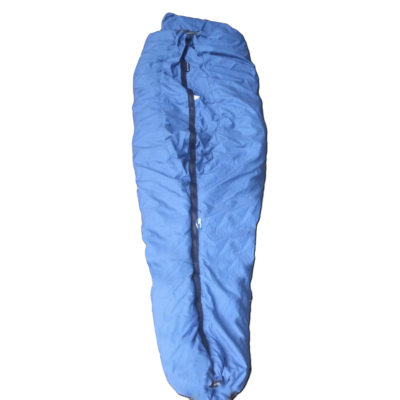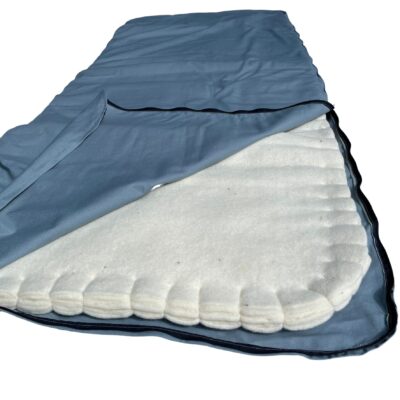

Does wool keep you warm when wet? In my experience, yes—and the reason has a name: the heat of adsorption. Two questions land in my inbox every week: does wool absorb water, and is wool absorbent at all if rain beads up on a wool coat? The answer to both is that wool takes water vapor inside the fiber and gives back a little heat as it does so, while the outside of the fiber sheds liquid. That is why a damp wool sweater feels warm and a damp fleece feels cold, and why I built the Lucky Sheep® Rewilder wool sleeping bag around wool batting instead of down or polyester. Here is what happens to wool when wet, and where the magic stops.
Why an ex-Marine switched to wool when wet
A few years ago a customer wrote to me after one damp night too many in his down bag. He had already moved his underclothes to wool.
“I’m an avid camper and spend almost every weekend outside. I transitioned to wool under clothes and found myself so much more happy. Then I bought a wool throw for the house and beach days and have been so impressed. Then, when I’d camp, I’d wake up damp or sticky or whatever in my down bag. I was curious if someone moved forward with a wool bag and found you! Prior to my camping days, I was in the Marines and spent a ton of time outside around the world. The Marines need your bag.”
A Lucky Sheep® customer, quoted in A Rewilder’s Guide to Outdoor Adventure
“Damp or sticky” is the whole problem in three words. Down and polyester leave your own moisture on the surface of the insulation, where it sits against you all night. Wool puts it inside the fiber. Everything else here follows from that one difference.
Does wool absorb water?
Strictly speaking, no—and this is the distinction that clears up most of the confusion. Absorption is what a cotton towel does: liquid soaks into the spaces between the fibers and the cloth is wet to the touch. Adsorption is what wool does: water molecules get trapped inside the naturally porous fiber itself, and because the water is held in there, the wool does not feel wet.
Look at a single wool fiber and you can see why. The outside is a layer of overlapping scales with a thin waxy coating, and liquid water beads up on it and runs off. The inside is a protein cortex full of sites that attract water vapor. Vapor slips in between the scales, binds to those sites, and the fiber swells a little to make room. Liquid stays out; vapor goes in.
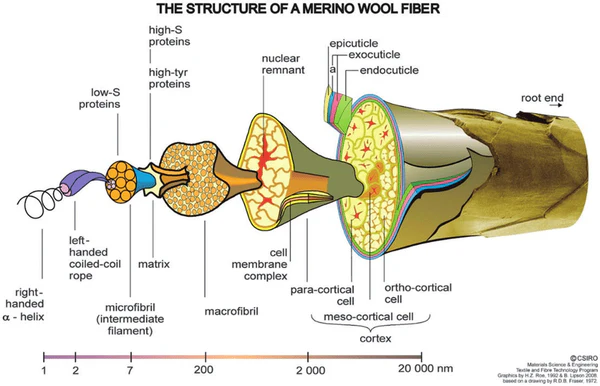
So when someone asks does wool absorb moisture, the honest answer is: it adsorbs it, as vapor, from your skin and from the air, and moves it out through the fibers themselves—before it even turns into sweat. That turns out to be the more useful trick.
Is wool absorbent? Wool absorbency by the numbers
Typical wool can take up about 30 percent of its own weight in water without feeling wet, because the water is trapped inside the fibers. Published textile figures for moisture regain—how much water a fiber holds from the air at 65 percent relative humidity—tell the same story: wool 13–16 percent, silk 9–11, cotton 7–8, nylon 4–4.5, polyester 0.4.
Wool is also hygroscopic. Bone dry, it pulls vapor out of the air until it comes into balance with its surroundings; textile people call this conditioning. The two pounds or so of wool batting in a Rewilder can take up a good share of a night’s moisture before a single fiber has any free water on its surface.
Heat of adsorption: why wool is warm when wet
Here is the part I call wool’s superpower. Water molecules are polar—they have a positive side and a negative side. Once inside the fiber, they form new bonds with the wool protein, and forming those bonds releases small amounts of heat. That is the heat of adsorption. All adsorption is exothermic; it makes heat.
The amount is not trivial. Published textile data put it at roughly 960 kJ for every kilogram of water wool takes up. The way I put it in my book: a kilogram of dry wool set in air saturated with moisture gives off about as much heat as an electric blanket running for eight hours. In 1858 the French scientist J. P. Coulier was the first to notice it—dry wool carried into a humid room warmed up on its own.

The heat arrives as the humidity around you rises—evening damp, fog off the creek, your own breath in the small hours—exactly when a down or synthetic bag starts to feel clammy. It is a top-up, not a furnace, but it shows up when you need it.
Does wool absorb heat?
It does that too, when the moisture runs the other way. As wool dries it takes heat from its surroundings, which is why a wool shirt feels cool as it gives moisture back on a warm afternoon. In cold weather the natural crimp traps tiny pockets of warm air next to the body; in warm weather the same pockets hold cool air while the wool pulls moisture off the skin to evaporate. That two-way action is why I call wool an active fiber. Down and polyester are indifferent to moisture; they only trap air.
Which material provides warmth even when wet? Wool, cotton, polypropylene or nylon
If that is the homework question, the one-word answer is wool. Here is why the others fall short, from years of testing all of them on my own back.
| Fiber | What happens to the water | Warm when damp? | Dries from body heat? |
|---|---|---|---|
| Wool | Vapor goes inside the fiber; the outside sheds liquid | Yes—releases heat as it takes up vapor and keeps its loft | Yes, slowly, overnight |
| Cotton (untreated) | Soaks up all the liquid it can, immediately | No; a hypothermia hazard. Only waxed cotton works, and only as a shell | No |
| Polypropylene, polyester fleece | The fiber takes in almost nothing; water sits between the fibers against your skin | Loft stays, but it feels cold and clammy | No—only by air or fire |
| Nylon (shells, down-bag fabric) | Sheds at first, then holds moisture in the weave and traps your breath and sweat inside | No insulation of its own; makes the layers under it damp | No |
| Down | Clusters wet, clump and collapse | No | No—needs sun or a dryer |
Does wool trap heat? Breathing inside the bag
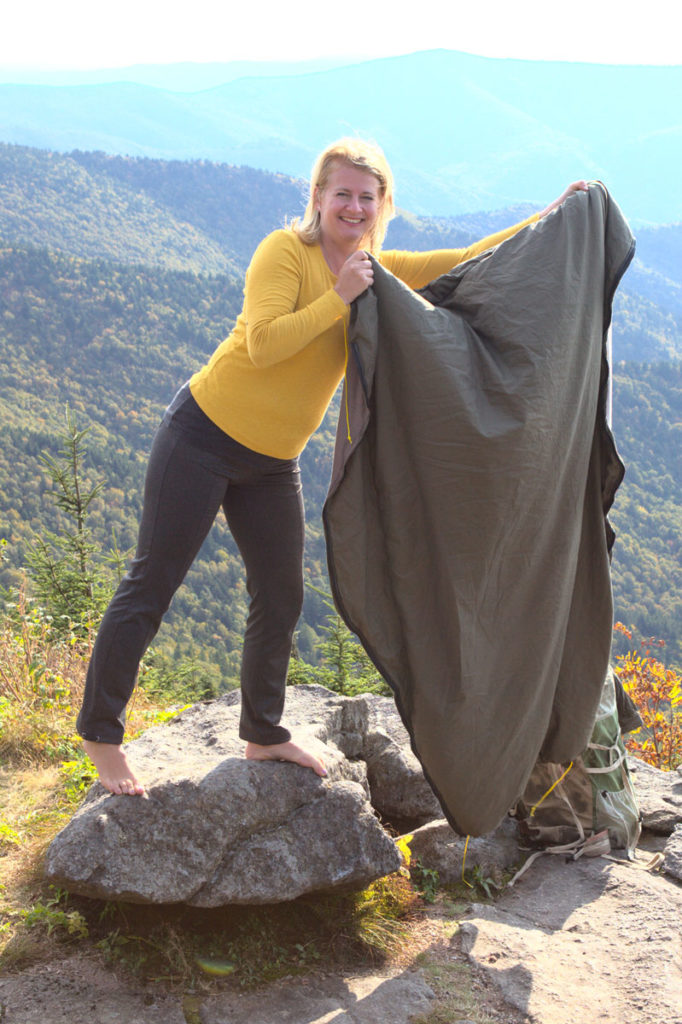
Wool traps heat the way any insulation does—still air in the crimp—but it also lets you do something no other bag can. On a cold, wet night I pull the top of my wool sleeping bag over my head and breathe inside it. The warm, moist breath is adsorbed into the wool, releases its heat there, and migrates to the outside of the bag, where it leaves.
Try that in a synthetic or down-filled bag and you get the opposite: the moisture is held inside, the air turns humid, and you get colder. I have done it under an open tarp in November rain in Linville Gorge and woken up drier than I went to bed, using my breath as heat. It is unique to wool alone.
Warmth-to-weight only counts when it is dry
Many people claim wool doesn’t work because its warmth-to-weight ratio is lower than down or synthetic. That is true—under ideal conditions, meaning dry conditions. A Rewilder in Standard 2-inch loft weighs 4 pounds; a 20°F down quilt weighs about a third of that, and I don’t hide it. But where there is exertion, rain, mist, wind and a body giving off warm vapor all night, the light stuff stops performing and the wool keeps going. Three pounds costs you roughly three-quarters of a mile on a twenty-mile day. What it buys is a bag that feels the same thickness at 3 a.m. as at bedtime, dries from your body heat instead of needing sun or a fire, and lets you breathe into it. I’ll carry that.
Where wool when wet stops working
Let me be plain about the limits, because I have hit every one of them.
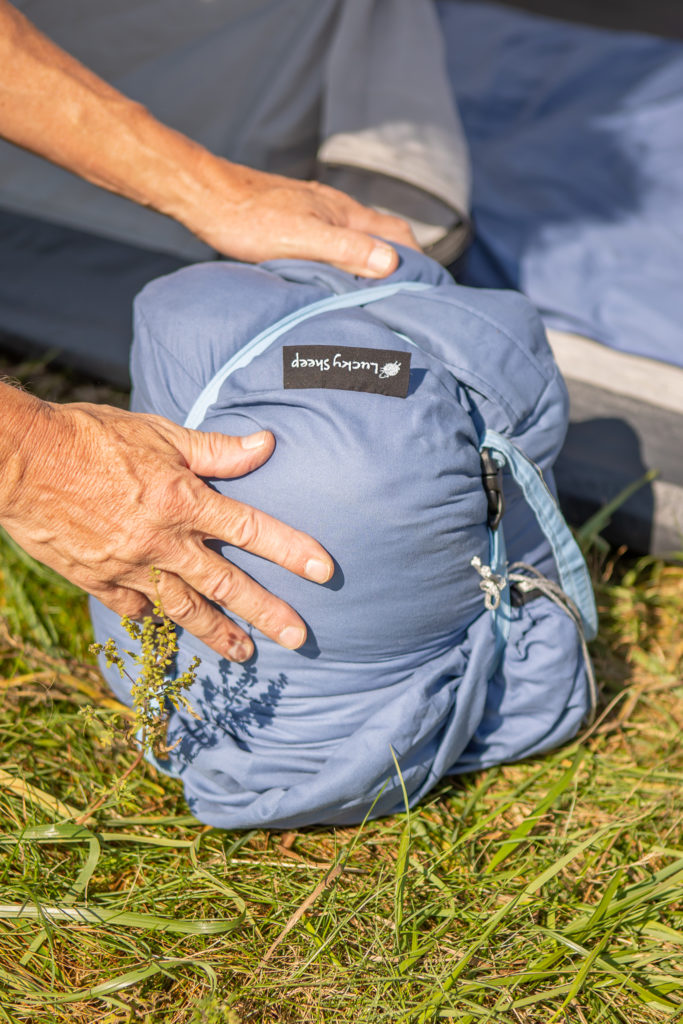
- Soaked is not damp. Past roughly a third of its weight in water, free liquid fills the spaces between the fibers and a wool bag becomes a wet blanket—heavy and slow to dry. Keep it in a silnylon stuff sack inside the pack when rain is likely; silnylon is one of the few places I use synthetic, and gladly.
- The reservoir has a bottom. The heat of adsorption comes as wool goes from dry to damp. On the fourth foggy night in a row the batting is already carrying moisture and has less heat left to give. Twenty minutes over a branch each morning resets it—moving air matters more than sun.
- It sheds; it does not seal. Wool and the beeswaxed organic cotton shell shed dew, drizzle and tent drip. They do not stop a leaking fly or a river. Fix the pitch.
And on the general question—why does being wet make you cold—that is a story about water pulling heat away from you faster than air does, whatever the fiber, and I go into it in why damp weather feels colder. Wool’s trick is to keep the water as vapor, inside the fiber, for as long as it can, so the chilling never gets started.
So, does wool keep you warm when wet? What I do
I sleep under an open tarp most nights out, in fog, dew and Appalachian drizzle, in wool. Not because wool is light—it isn’t—but because it is the one insulation that works with the moisture my body makes instead of against it. The Rewilder wool sleeping bag is built on that principle for backpacking; the Aurora Borealis is the same idea with more loft for basecamp and winter. Our materials page explains the batting, shell and liner and where to get a free swatch packet.
Invite the weather in—and sleep in a fiber that knows what to do with it.
Reviewed September 2026 by the Lucky Sheep® team.
Sleep warm out there — in wool
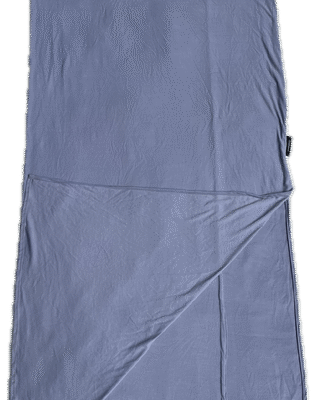
The Rewilder is a 20°F backpacking sleeping bag (4 lb, packs to 11 × 11 in) that keeps insulating when conditions turn damp. Add the merino liner for another ~10°F and a wool pad underneath for a complete natural-fiber sleep system.
-
Lightweight Wool Sleeping Bag–The Rewilder
The lightest all-natural backpacking bag
4 lb / 1.8 kg20°F / −6°C (10°F option)Packs to 11 × 11 in
Price range: $557.00 through $888.00 Select options This product has multiple variants. The options may be chosen on the product page -
Merino Wool Sleeping Bag Liner & Sleep Sack
Warm, washable wool liner for any bag
1.9 lb / 0.9 kgAdds ~10°F30 oz merino jersey
Price range: $200.00 through $235.00 Select options This product has multiple variants. The options may be chosen on the product page -
Organic Wool Sleeping Pad
Firm, breathable, machine-washable cover
¼ – 1.5 in wool felt24 – 60 in wide
Price range: $150.00 through $1,100.00 Select options This product has multiple variants. The options may be chosen on the product page