

How the heart, brain, emotions, and Earth’s electromagnetic environment may participate in the electrical organization of life.
Part 3 of 6 — How Fabric Affects the Electricity of the Body
There is a rhythm to everything in nature.
The rising and setting of the sun. The changing seasons. The movement of the tides. The electrical activity of the atmosphere.
And within our own bodies, another extraordinary collection of rhythms is constantly unfolding.
Our hearts beat in changing patterns. Our brains generate electrical oscillations. Our nervous systems continually adjust to the world around us.
Even the individual cells of our bodies maintain electrical voltages that are essential to their survival.
These electrical processes are not isolated events. They are part of the intricate organization that makes life possible.
And they raise a fascinating question:
How deeply are the electrical rhythms of our bodies connected with those of the Earth itself?
The Electrical Rhythms of the Brain
The human brain is an electrical organ.
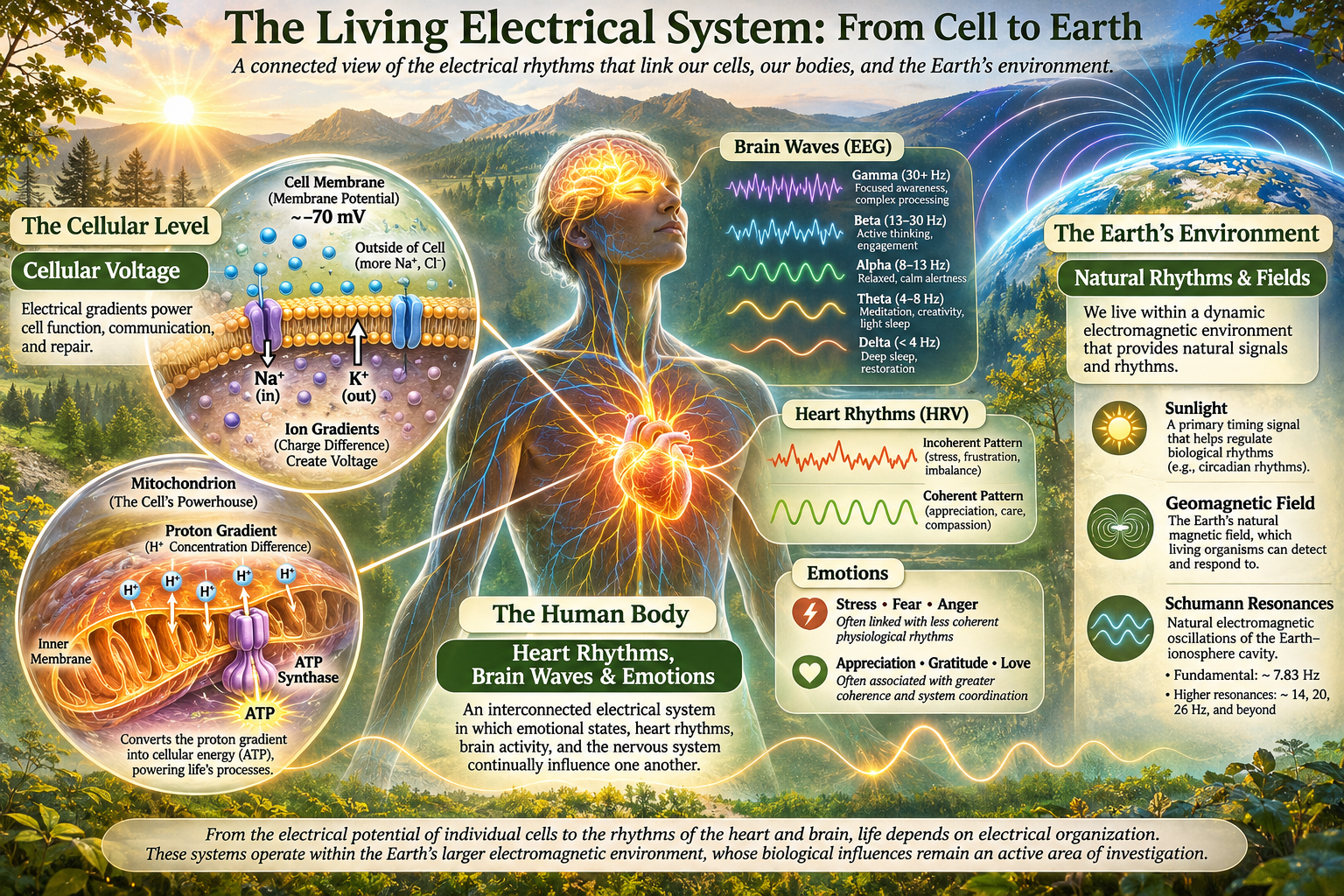
Billions of neurons communicate through electrochemical signals, producing patterns of activity that can be measured using electroencephalography, or EEG.
These patterns are commonly described in terms of brain waves, each associated with different frequencies and states of activity.
Delta waves, generally below 4 hertz, are especially prominent during deep, dreamless sleep.
Theta waves, approximately 4–8 hertz, appear during drowsiness, certain stages of sleep, and some meditative states.
Alpha waves, approximately 8–13 hertz, are often associated with relaxed wakefulness, particularly when the eyes are closed.
Beta waves, roughly 13–30 hertz, commonly accompany active thinking, attention, and engagement with the outside world.
Gamma activity, generally above 30 hertz, has been investigated in relation to sensory processing, attention, and the coordination of neural activity.
These categories overlap, and the brain produces many frequencies simultaneously. They are not separate switches that turn on and off.
Instead, they represent a constantly changing electrical landscape.
As we move from alertness into relaxation, from waking into sleep, and from one stage of sleep into another, the patterns shift.
The brain is not simply producing electricity.
It is organizing electrical activity in time.
The Heart Has Its Own Rhythms
The heart is another remarkable electrical organ.
Each heartbeat begins with an electrical impulse that coordinates the contraction of cardiac muscle.
But a healthy heart does not beat with the mechanical regularity of a metronome.
The intervals between successive heartbeats are constantly changing.
This variation, known as heart rate variability, or HRV, reflects the dynamic regulation of the heart by the autonomic nervous system.
Breathing, physical activity, emotional states, sleep, and many other factors influence these patterns.
During inhalation, the heart rate often increases slightly. During exhalation, it commonly slows.
This rhythmic interaction between breathing and heart rate is called respiratory sinus arrhythmia.
It illustrates how different physiological systems continually coordinate their activity.
Researchers also study relationships between heart rhythms, brain activity, blood pressure, and other biological oscillations.
These interactions reveal something important about the nature of living systems.
Health is not simply a matter of individual organs functioning correctly. It also depends on how effectively those organs coordinate their activity.
The Electrical Energy of Healing
In his fascinating lecture Healing as Voltage, physician Dr. Jerry Tennant proposes that the electrical organization of the body plays a fundamental role in health and healing.
His interest in this subject grew from his own experience with a debilitating illness that interrupted his medical career.
Seeking to understand how the body repairs itself, Tennant began studying cellular biology and the electrical processes that sustain living tissues.
One of his central observations is that every living cell maintains an electrical potential across its membrane.
This voltage arises from differences in the concentrations of charged particles, or ions, inside and outside the cell.
Sodium, potassium, calcium, and chloride ions all participate in maintaining these electrical gradients.
The resulting membrane potentials are essential for nerve signaling, muscle contraction, cellular transport, and many other biological functions.
The mitochondria within our cells also depend on electrical gradients.
These tiny organelles use an electrochemical potential across their inner membranes to help produce ATP, the molecule that supplies energy for countless cellular processes.
In other words, electrical gradients are fundamental to the machinery of life.
Tennant takes this understanding further.
He proposes that healthy tissues require adequate electrical potential not only to function, but also to regenerate and repair themselves.
In his model, he describes the body as an interconnected system of rechargeable batteries.
Muscles, cell membranes, mitochondria, and other structures all participate in the body’s electrical organization.
He suggests that chronic illness can arise when parts of this electrical system lose their ability to maintain sufficient charge.
His model also proposes particular voltage values associated with normal cellular activity and tissue regeneration. These specific values are part of Tennant’s proposed framework rather than universal requirements demonstrated for every type of human cell.
Nevertheless, the larger question he raises is fascinating.
Could disturbances in the body’s electrical organization contribute to its ability—or inability—to heal?
Research into bioelectricity provides compelling reasons to investigate this possibility.
Electrical fields have been observed around injured tissues, and experimental studies have shown that electrical signals can influence cell migration and wound repair.
Cells do not respond only to chemical messages.
They also respond to electrical information.
And that opens an entirely new perspective on the body’s remarkable capacity for regeneration.
The Heart, Emotions, and Biological Coherence
What happens when we experience love, gratitude, fear, or anger?
We usually think of emotions as psychological experiences. But emotions also produce measurable changes throughout the body.
Our breathing changes. Our muscles respond. Hormones are released. And the electrical rhythms of our hearts and brains shift.
The HeartMath Institute has spent decades investigating these relationships, particularly the connection between emotional states and heart rate variability.
One of its most fascinating contributions is the concept of heart coherence.
When a person experiences appreciation, compassion, or other positive emotional states, the rhythm of the heart can become smoother and more organized.
Researchers can observe these changes through measurements of heart rate variability.
During coherent states, the heart’s changing rhythm often develops a smooth, wave-like pattern, reflecting increased coordination among breathing, blood pressure regulation, and the autonomic nervous system.
This is not merely a subjective feeling of calmness. It is a measurable physiological phenomenon.
HeartMath researchers have also explored how signals traveling from the heart to the brain influence emotional regulation, attention, and cognitive activity.
The relationship works in both directions.
Our emotional states influence our heart rhythms, and signals from the cardiovascular system help shape how the brain regulates our physiological and emotional responses.
The heart and brain are engaged in a continuous conversation.
Can Emotions Become Imprinted in the Body?
This relationship between emotions and physiology raises another fascinating possibility.
What happens when an emotional experience is never fully resolved?
Most of us have experienced the lasting physical effects of emotional stress.
A painful memory may produce a racing heart, muscular tension, or a feeling of tightness in the chest, even years after the original event.
The body can respond to a remembered experience almost as though it were happening again.
Dr. Bradley Nelson explores this phenomenon from an energetic perspective in his book The Emotion Code.
Nelson proposes that intense or unresolved emotional experiences can leave behind what he calls trapped emotions—energetic imprints that may continue influencing the body’s functioning.
His method uses muscle testing to identify these proposed imprints and magnets as part of a process intended to release them.
The idea that emotional experiences can produce lasting physiological patterns is supported by research into stress, trauma, memory, and autonomic regulation.
Nelson’s more specific explanation—that individual emotions persist as identifiable magnetic energies that can be released through his technique—is a proposed energetic model rather than a demonstrated physical mechanism.
Nevertheless, the questions underlying his work are worth exploring.
How does the body retain the effects of past experiences?
Can persistent patterns of nervous-system activity influence the way we experience health and well-being?
And can changing those patterns help restore a more coordinated physiological state?
Wilhelm Reich and the Body’s Emotional Memory
Long before the development of the Emotion Code, Austrian physician and psychoanalyst Wilhelm Reich was investigating how emotional experiences might become embedded in the physical body.
Reich developed the concept of muscular armoring—the idea that unresolved emotions and psychological defenses can manifest as chronic muscular tension, restricted breathing, and habitual patterns of posture.
In his view, the body and emotions were inseparable. Emotional experiences could become expressed through physical patterns that persist long after the original experience has passed.
We recognize something similar in everyday life. Anxiety can tighten the chest, fear can constrict breathing, and emotional stress can cause the shoulders, neck, and jaw to tense. Over time, some of these responses may become habitual.
Reich took these observations further, proposing that muscular armoring interfered with the natural movement of biological energy through the body.
Later, he developed his controversial theory of orgone energy, which he believed was a fundamental life energy present not only in living organisms but also in the atmosphere and the natural world.
Could Reich have been observing phenomena related to the electrical and energetic processes we now recognize in cellular biology? It’s an intriguing possibility to consider, although orgone energy itself has not been scientifically established or demonstrated to be equivalent to cellular electrical energy.
What makes Reich’s work particularly relevant to our discussion is his attempt to connect emotions, muscular tension, biological energy, and the surrounding environment into a single picture of the living organism.
His work raises a question that continues to resonate today: When we release chronic physical tension and emotional stress, are we also changing the electrical and physiological patterns through which our bodies function?
The Body as an Interconnected Electrical System
These ideas bring us back to Dr. Jerry Tennant.
In his Healing as Voltage lecture, Tennant proposes that emotions can affect the body’s electrical organization. He goes further, suggesting that emotional experiences may become associated with magnetic patterns that interfere with the functioning of particular biological circuits.
HeartMath, Nelson, and Tennant approach these questions from different directions.
HeartMath investigates measurable relationships between emotions and cardiovascular rhythms.
Nelson explores the possibility of persistent emotional energy patterns.
Tennant proposes an electrical model linking cellular voltage, emotional experiences, and tissue function.
Their explanations are not identical, and they do not all have the same experimental support.
But they share an important underlying question:
Could our emotional experiences influence the electrical organization of our bodies more deeply than we ordinarily recognize?
We already know that emotions influence the autonomic nervous system, breathing, circulation, hormonal signaling, and brain activity.
The emerging research and energetic models invite us to investigate whether additional mechanisms may also be involved.
Perhaps the most interesting insight is that the body is not a collection of independent parts.
It is an extraordinarily interconnected system in which electrical, chemical, mechanical, and emotional processes continually influence one another.
And if our internal rhythms are so responsive to our experiences, might they also respond to the natural electromagnetic rhythms of the Earth?
The Earth’s Natural Electromagnetic Pulse
In the previous installment, we introduced the Schumann resonances.
These naturally occurring electromagnetic oscillations arise primarily from lightning activity within the enormous cavity between the Earth’s surface and the ionosphere.
Their fundamental frequency is approximately 7.83 hertz, with additional resonances near 14, 20, 26 hertz, and higher frequencies.
What makes these frequencies so intriguing is their proximity to some of the electrical rhythms measured in the human brain.
The fundamental Schumann resonance lies near the boundary between theta and alpha brain-wave frequencies.
Higher resonances overlap portions of the alpha and beta ranges.
This similarity has attracted the attention of researchers investigating possible relationships between atmospheric electromagnetic activity and biological rhythms.
Of course, sharing a frequency does not automatically mean that two systems influence one another.
But it provides a question that can be investigated experimentally.
And researchers have begun doing just that.
Can the Brain Respond to the Earth’s Electromagnetic Rhythms?
Studies examining human EEG recordings alongside Schumann resonance measurements have reported periods of similarity and apparent synchronization between certain frequencies.
Other investigations have examined relationships between geomagnetic activity and physiological measurements, including heart rate variability.
These findings are intriguing because they suggest that biological electrical activity may be sensitive to changes in the natural electromagnetic environment.
The mechanisms remain an active subject of investigation.
One possibility is that biological systems possess sensitivities to weak electromagnetic signals that are not yet fully understood.
Research into magnetoreception in animals provides an important precedent.
Some birds and other organisms can detect aspects of the Earth’s magnetic field. One proposed mechanism involves quantum-sensitive chemical reactions associated with cryptochrome proteins.
These discoveries demonstrate that living organisms can possess remarkably subtle ways of detecting their physical environment.
Whether similar mechanisms contribute to human responses to Schumann resonances is a question worth exploring.
The possibility invites us to think about the body not as an electrically isolated machine, but as a living system operating within a larger electromagnetic world.
The Importance of Natural Rhythms
One of the most important discoveries in modern biology is that timing matters.
Our circadian clocks help coordinate sleep, metabolism, hormone secretion, body temperature, and many other processes.
But circadian rhythms are only one part of a much larger collection of biological oscillations.
The heart operates on the scale of seconds. Brain waves oscillate many times per second. Breathing follows its own rhythm. Hormones may fluctuate over minutes, hours, or longer periods.
Life depends on the coordination of these processes.
And throughout our evolutionary history, these internal rhythms have developed within an environment characterized by recurring patterns of sunlight, darkness, temperature, and electromagnetic activity.
We know that light is a powerful signal for synchronizing the human circadian system.
The possibility that other natural electromagnetic rhythms also influence biological timing remains a fascinating frontier of research.
What interests me is not simply whether one particular frequency produces one particular effect.
It is the larger possibility that living organisms are continually exchanging information with the physical environment around them.
Nature as Therapy: Returning to Our Natural Rhythms
Perhaps this helps explain something most of us have experienced firsthand.
Why do we feel so good after spending time in nature?
A walk through the forest, sitting beside a flowing stream, watching the sunrise, or simply resting beneath the trees can produce a remarkable change in how we feel.
Our breathing slows. Muscular tension begins to release. The mind becomes quieter. Emotions that seemed overwhelming may begin to settle.
The Japanese practice of shinrin-yoku, or forest bathing, recognizes the restorative effects of immersing ourselves in a natural environment.
Scientific studies have found that spending time in forests can reduce perceived stress and anxiety, influence heart rate and heart-rate variability, and produce measurable changes in physiological stress responses.
But what is actually happening?
Part of the explanation may involve the sensory environment of nature: natural light, fresh air, gentle sounds, movement, and the absence of many of the demands of modern life.
There may also be something deeper involving the synchronization of our internal biological rhythms with the rhythms of the natural world.
We already know that sunlight helps synchronize our circadian clocks. Our nervous systems also respond to changes in light, temperature, sound, and the surrounding environment.
Could the Earth’s natural electromagnetic rhythms contribute to this process as well?
Researchers have reported intriguing relationships between geomagnetic activity and certain physiological measurements, including heart-rate variability. Whether these relationships involve meaningful biological synchronization remains an open question.
Nevertheless, the possibility invites us to consider nature therapy from a broader perspective.
Perhaps time spent in nature does more than simply help us relax. It may provide conditions in which our body’s many physiological rhythms can become more coordinated, allowing us to move away from patterns of chronic stress.
And if emotional experiences are reflected in muscular tension, breathing, and nervous-system activity, then spending time in nature may also help us gradually loosen some of those patterns.
Nature may be more than a beautiful place to visit. It may be an environment in which our bodies remember how to find their natural balance.
Listening to the Rhythms of Nature
When I think back on my years living outdoors in the tipi, I remember how naturally my days and nights unfolded.
I awakened with the sunrise, felt the gradual warming of the day, and experienced the arrival of darkness without the constant interruption of artificial lighting.
I was surrounded by the sounds and movements of the natural world.
The wind through the trees. The changing weather. The quiet of the mountains at night.
My sleep became remarkably deep, and I often awakened feeling refreshed and energized.
At the time, I wasn’t thinking about brain waves, heart rate variability, cellular voltage, or electromagnetic coherence.
I was simply living within the rhythms of nature.
Looking back, I wonder how many different physiological processes were responding to that environment.
We can measure some of those relationships. Others are only beginning to be investigated.
But the experience left me with a lasting appreciation for something that modern life can make easy to overlook.
We are not separate from the natural world. Our bodies developed within it, and our physiology continues to respond to its signals.
Perhaps understanding health requires us to look beyond individual nutrients, organs, and biochemical reactions.
Perhaps we must also consider the timing, coordination, and electrical organization of life itself.
And that leads to another extraordinary question.
If the body is an electrical system, what role does the water within our cells play in receiving, organizing, and transmitting energy?
That is where our exploration will take us next.
Next: Water, Light, and the Electricity of Life.
Stay Wild,
— Patrick
Lucky Sheep® Outdoor Gear
Research Notes & Further Reading
Brain Waves and Neural Oscillations
Buzsáki, G. (2006). Rhythms of the Brain. Oxford University Press.
Heart Rate Variability
Shaffer, F., & Ginsberg, J. P. (2017). An Overview of Heart Rate Variability Metrics and Norms. Frontiers in Public Health.
https://doi.org/10.3389/fpubh.2017.00258
HeartMath and Physiological Coherence
HeartMath Institute. Science of the Heart: Coherence.
https://www.heartmath.org/research/science-of-the-heart/coherence/
The Emotion Code
Nelson, Bradley. The Emotion Code: How to Release Your Trapped Emotions for Abundant Health, Love, and Happiness. Updated and Expanded Edition, 2019.
Healing as Voltage
Jerry Tennant, M.D. Healing as Voltage. Presentation at the EU2017 Conference, published by The Thunderbolts Project.
Electrical Signals and Wound Healing
Zhao, M. (2009). Electrical fields in wound healing—An overriding signal that directs cell migration. Seminars in Cell & Developmental Biology.
https://doi.org/10.1016/j.semcdb.2008.12.009
Solar and Geomagnetic Activity and the Human Heart
Alabdulgader et al. (2018). Long-term study of heart rate variability responses to changes in the solar and geomagnetic environment. Scientific Reports.
https://www.nature.com/articles/s41598-018-20932-x
Magnetoreception and Quantum Biology
Ritz, T., Adem, S., & Schulten, K. (2000). A Model for Photoreceptor-Based Magnetoreception in Birds. Biophysical Journal.
https://doi.org/10.1016/S0006-3495(00)76629-X
The research on HeartMath’s coherence patterns and the role of endogenous electrical fields in wound healing supports two important parts of this narrative.HeartMath Institute+1
Nelson’s energetic model is described in his published work, but its proposed mechanism is a separate question from those measurable physiological effects.
Wilhelm Reich: Character Analysis, particularly his discussion of muscular armoring. Wilhelm Reich Museum — Research and Publications
Forest bathing: Andrade et al. (2026), Short-term cardiovascular and mental health responses to Shinrin-Yoku: A systematic review and meta-analysis. Read the study
Physiological effects of forest immersion: Effects of forest bathing (Shinrin-yoku) in stressed people. Read the study