Forty degrees and raining will chill you faster than twenty degrees and clear. Anyone who has camped in the Southern Appalachians in November knows it, and the question “why does damp weather feel colder” has a plain physical answer: water moves heat away from your body far more efficiently than air does, and damp conditions put water exactly where your insulation is supposed to be — in the air next to your skin, in your base layer, and inside your sleeping bag.
This article covers the physics, what actually happens inside a wet down bag, a wet synthetic bag and a wet wool bag, and the practical rules that keep you warm on a damp night. It is written for people who camp in the wet: the Appalachians, the Pacific Northwest, the UK, coastal anywhere.
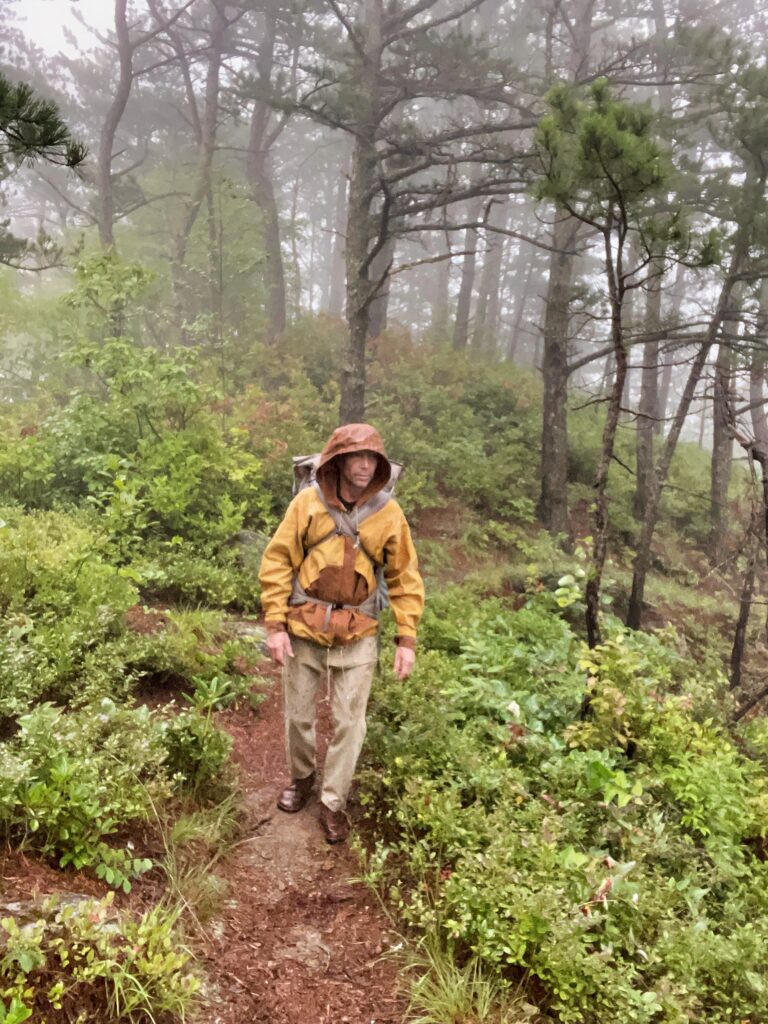
Why does damp weather feel colder: the physics in four parts
1. Water is a far better conductor than air
Every insulator you own — down, polyester batting, wool, a fleece — works the same way: it traps still air. Still air conducts heat at roughly 0.025 W/m·K. Liquid water conducts at about 0.6 W/m·K, roughly 25 times more. Water also has a specific heat capacity of about 4.2 kJ per kg per degree, four times that of air, so it takes far more of your body heat to warm a layer of water than a layer of air.
Replace some of the trapped air in your clothing or sleeping bag with water and the insulation stops doing its job. It does not have to be soaked. A base layer that is merely damp from sweat and fog has already lost a large share of its insulating value.
2. The humid air itself matters less than people think
You will read that humid air conducts heat better than dry air, and that is true, but at cold temperatures the effect is small. Saturated air at 40°F holds only about 6 g of water vapour per kilogram of air, so the change in the air’s conductivity and heat capacity is a few percent at most. Humidity’s real work is indirect: when the air is already near saturation, nothing dries. Your skin stays damp, your base layer stays damp, the inside of your shell stays damp, and every one of those damp surfaces keeps conducting heat away from you all night.
3. Evaporation from damp skin and clothing costs you heat
Evaporating one gram of water takes roughly 2.4 kJ of heat, and when the water is on your skin or in the fabric next to it, that heat comes from you. A damp cotton shirt holding 200 g of water needs about 480 kJ to dry out — an hour and a half of a resting adult’s total heat output. This is the same mechanism that makes sweat cool you on a hot day. In cool weather you are not sweating on purpose, but rain, fog, condensation and your own insensible perspiration keep supplying the water, and a breeze keeps the evaporation going. Wet plus wind is the combination that puts people in trouble.
4. Condensation puts water inside your insulation from the inside
An adult gives off roughly half a litre of water overnight through breath and skin, even without sweating. That vapour moves outward through your sleeping bag. Somewhere between your warm skin and the cold outer shell it hits the dew point and condenses. On a dry, cold night that point is near the outside of the bag and the moisture escapes. On a damp night the outside air is already saturated and the shell is cold and wet, so the condensation happens further in, inside the insulation. This is why a bag can be wet through in the morning even though it never rained on it.
Dry cold vs wet cold
At 10°F the air can hold almost no water — under 2 g per kg — so snow brushes off, sweat vapour leaves your clothing and disperses, and insulation stays dry. Plenty of experienced winter campers will tell you that 10°F and still is more comfortable than 38°F and raining, and the physics agrees with them.
The dangerous band is roughly 30°F to 50°F with precipitation, fog or heavy dew. The Wilderness Medical Society’s hypothermia guidance makes the same point: wet, windy conditions well above freezing are a common setting for accidental hypothermia, precisely because people underestimate them. If your camping happens in that band — and for most of the eastern US, the UK and the Pacific Northwest it does — how your sleeping bag behaves when damp matters more than its rating on a dry lab manikin.
What happens inside a wet sleeping bag: down, synthetic and wool
The three insulation types handle water in three different ways. Published moisture-regain figures (how much water a fibre holds at 65 % relative humidity, as a percentage of its dry weight) tell most of the story: wool 13–16 %, cotton 7–8 %, nylon 4–4.5 %, polyester 0.4 %.
| On a damp night | Down bag | Synthetic bag | Wool bag |
|---|---|---|---|
| Where the water goes | Onto the down clusters, which collapse and clump | Between the polyester fibres (the fibre itself holds ~0.4 %) | Into the wool fibre as vapour (13–16 % regain, more before it feels wet) |
| Loft when damp | Largely lost; hydrophobic treatments delay this, they do not prevent it | Mostly kept | Kept |
| Warmth when damp | Poor | Partial: loft stays but water between fibres conducts heat | Good: fibre stays insulating and releases heat as it takes up vapour |
| Feel against skin | Clammy nylon shell | Clammy nylon shell | Cotton shell and merino liner buffer moisture; no clammy layer |
| Dries from body heat overnight | No | Slowly; water is trapped under the shell | Yes, gradually; vapour keeps moving outward |
| After being soaked | Needs sun or a dryer; slow | Wrings out and air-dries fast | Heavy and slow to dry; still insulates while damp but not while saturated |
Two honest notes. Synthetic is genuinely the best choice if your bag is likely to be dunked and you need it dry again by evening; it holds the least water and releases it fastest. And wool is not magic: a saturated wool bag is a wet, heavy bag. What wool does is handle the common case — damp air, dew, condensation, a sweaty base layer — without losing its warmth or feeling clammy, which is the case that ruins most nights.
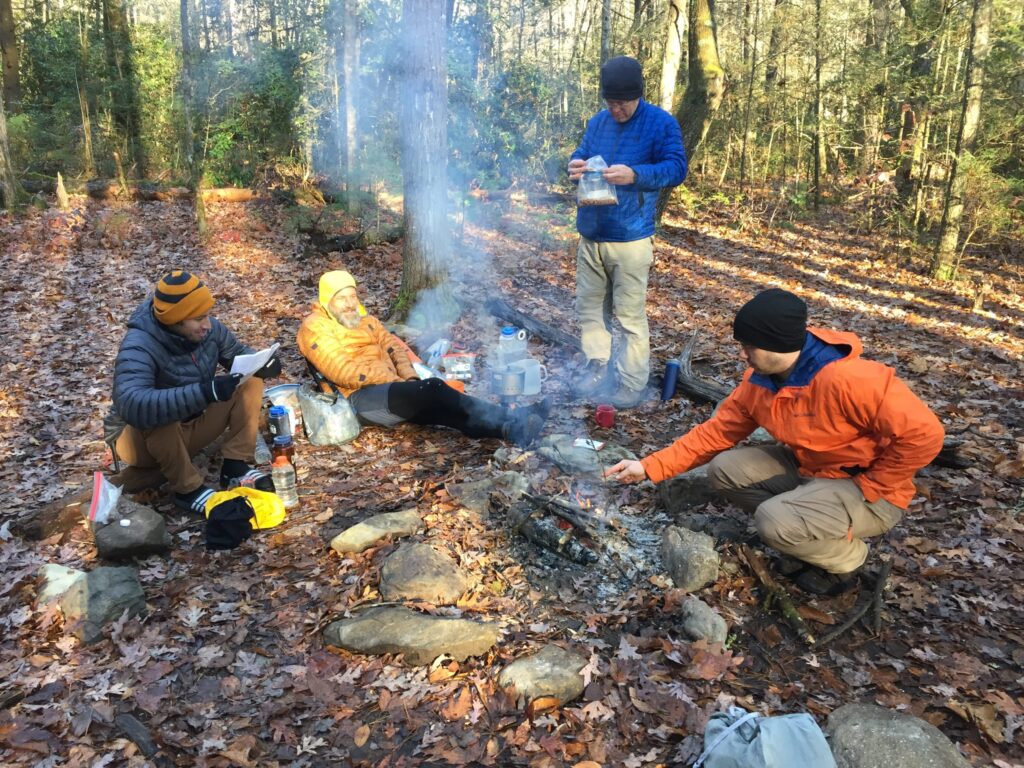
Heat of sorption: why wool feels warm as the damp arrives
When wool takes up water vapour, the water molecules bond to sites inside the fibre and give up energy as heat. Published textile data put wool’s heat of sorption at about 960 kJ per kilogram of water absorbed. The half-litre of vapour you give off overnight, if a good share of it is taken up by a wool bag and liner, represents a few hundred kilojoules released inside the bag over the night — a modest but continuous top-up, arriving exactly when the humidity around you rises. Synthetic fibres absorb almost nothing, so they release almost nothing. We go through the numbers in How wool stays warm when wet: heat of adsorption explained.
The reverse also happens: as wool dries it takes heat back. In practice that means wool warms you as the evening damp sets in and cools you gently as the morning sun dries it, which is the direction you want in both cases.
Practical rules for damp nights
- Manage vapour, not just rain. Your own half-litre of overnight moisture is the water that most often ends up in your bag. Go to bed in dry sleep clothes, never in the base layer you hiked in, and do not seal yourself in with a non-breathable bivy or a shell that cannot pass vapour.
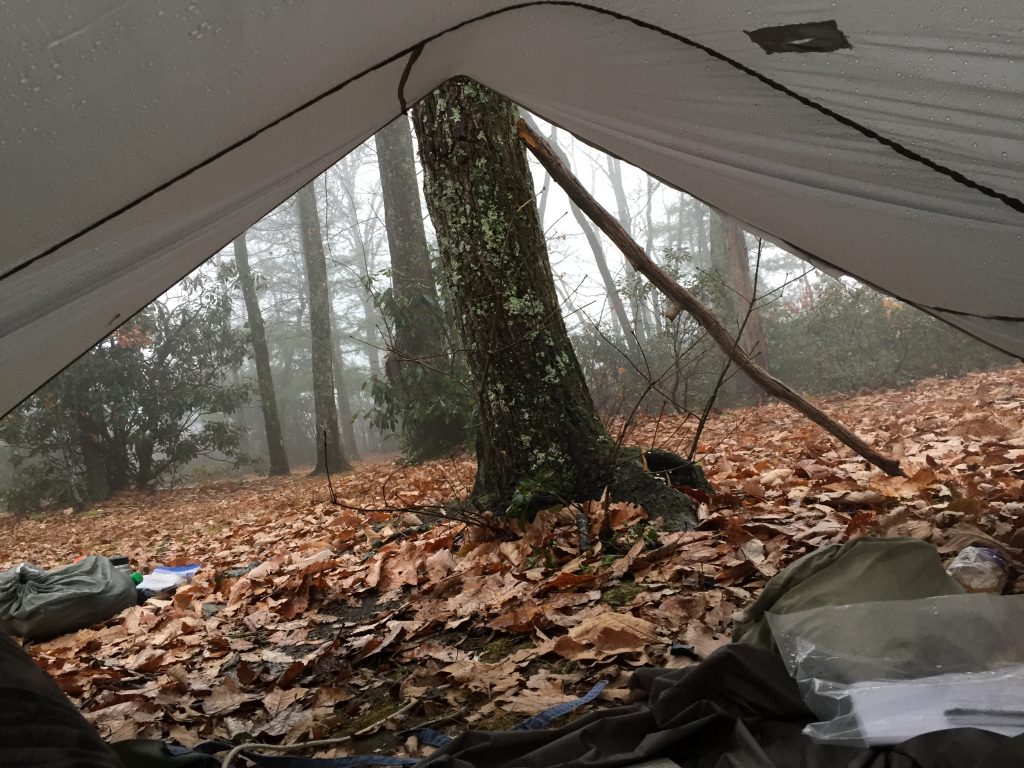
- Ventilate the shelter. A closed tent full of breathing people reaches 100 % humidity fast, and the fly then rains condensation on you. Leave a vent or door cracked, pitch a tarp with airflow, and if you use canvas, use it: an organic canvas tipi or canvas tarp breathes and condenses far less than coated nylon.
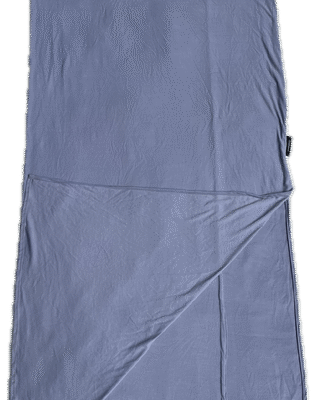
- Wool next to the skin. A merino base layer or a merino liner buffers the moisture at the skin, where damp does the most harm, and the liner adds roughly 10°F to any bag.
- A breathable shell, not a vapour trap. The beeswax-treated organic cotton shell on the Rewilder sheds dew and drips but lets vapour through. Any waterproof layer over a wool bag defeats the point.
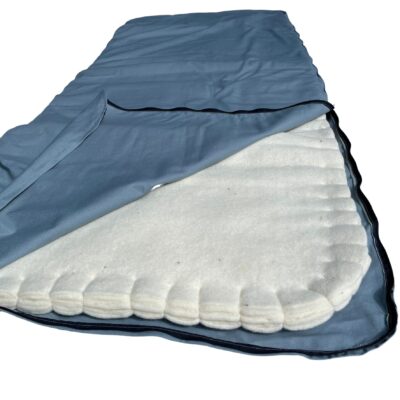
- Keep the ground out of the equation. Wet ground is a heat sink by conduction. A wool felt pad in its cotton cover keeps the bag off the ground and does not sweat the way a closed-cell foam or air pad does.
- Air the bag every morning. Open it flat over the tent or a branch for twenty minutes while you make coffee. Wool gives up moisture readily in moving air, even without sun.
- Eat and drink before bed. Heat has to be generated before insulation can keep it. A fatty, calorie-dense evening meal and a warm drink make more difference on a damp night than on a dry one, because the losses are higher.
- Hat and dry socks. The cheapest warmth you will carry.

Choosing a bag for damp country
If you camp mostly in dry, cold places — the Rockies in winter, the desert — down’s warmth-to-weight is hard to argue with, and we say so in Wool vs down sleeping bags. If your nights are in the 30–50°F band with fog, dew and rain, the calculation changes. A bag that stays warm when it is damp, that does not put a clammy nylon layer against your face, and that dries from your own body heat overnight is worth its extra weight, and the Rewilder’s 4 lb (Standard, 2″ loft, field rated 20°F) is the price of that behaviour. For basecamp, cabin and truck camping, where weight does not matter, the Aurora Borealis gives you the same wool system with 2″, 3″ or 5″ of loft.
Both use US wool batting inside a beeswax-treated organic cotton shell with a merino jersey or WeatherWool® worsted liner, with no synthetic fill, no PFAS and no DWR coating. Lucky Sheep ratings are field ratings from years of use in the Blue Ridge, not ISO 23537-1 lab figures; we explain the difference in Sleeping bag temperature ratings explained.
Still deciding? The five-question sleep-system finder narrows it down, and the free materials sample packet lets you feel the shell, batting and liner before you buy.
Reviewed August 2026. Physical constants are standard published values; textile moisture-regain and heat-of-sorption figures are from published textile data; sleeping-bag ratings referenced are ISO 23537-1 where stated and Lucky Sheep field ratings otherwise.
Sleep warm out there — in wool
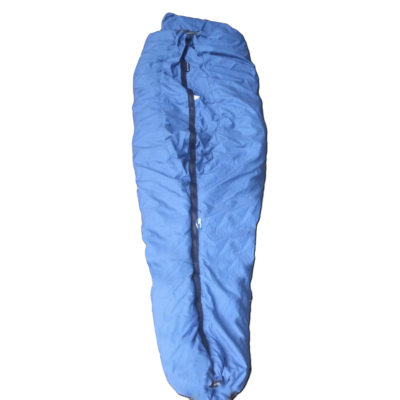
The Rewilder is a 20°F backpacking sleeping bag (4 lb, packs to 11 × 11 in) that keeps insulating when conditions turn damp. Add the merino liner for another ~10°F and a wool pad underneath for a complete natural-fiber sleep system.
-
Lightweight Wool Sleeping Bag–The Rewilder
The lightest all-natural backpacking bag
4 lb / 1.8 kg20°F / −6°C (10°F option)Packs to 11 × 11 in
Price range: $557.00 through $888.00 Select options This product has multiple variants. The options may be chosen on the product page -
Merino Wool Sleeping Bag Liner & Sleep Sack
Warm, washable wool liner for any bag
1.9 lb / 0.9 kgAdds ~10°F30 oz merino jersey
Price range: $200.00 through $235.00 Select options This product has multiple variants. The options may be chosen on the product page -
Organic Wool Sleeping Pad
Firm, breathable, machine-washable cover
¼ – 1.5 in wool felt24 – 60 in wide
Price range: $150.00 through $1,100.00 Select options This product has multiple variants. The options may be chosen on the product page