A 20°F down quilt weighs about a pound and a half and packs to the size of a loaf of bread. A 20°F wool sleeping bag weighs four pounds and packs to an 11-inch cylinder. If that were the whole comparison there would be no wool vs down sleeping bag debate. It is not the whole comparison, and this article lays out the rest of it honestly: where down wins outright, where wool wins outright, where synthetic fits, and who should still buy down.
Where down wins: weight and packed size
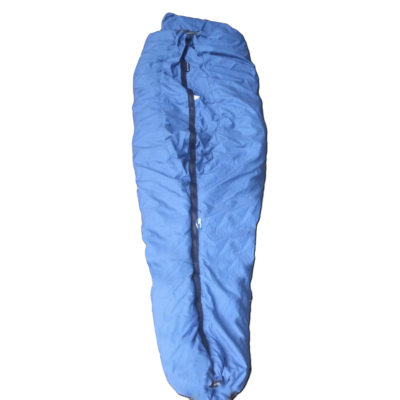
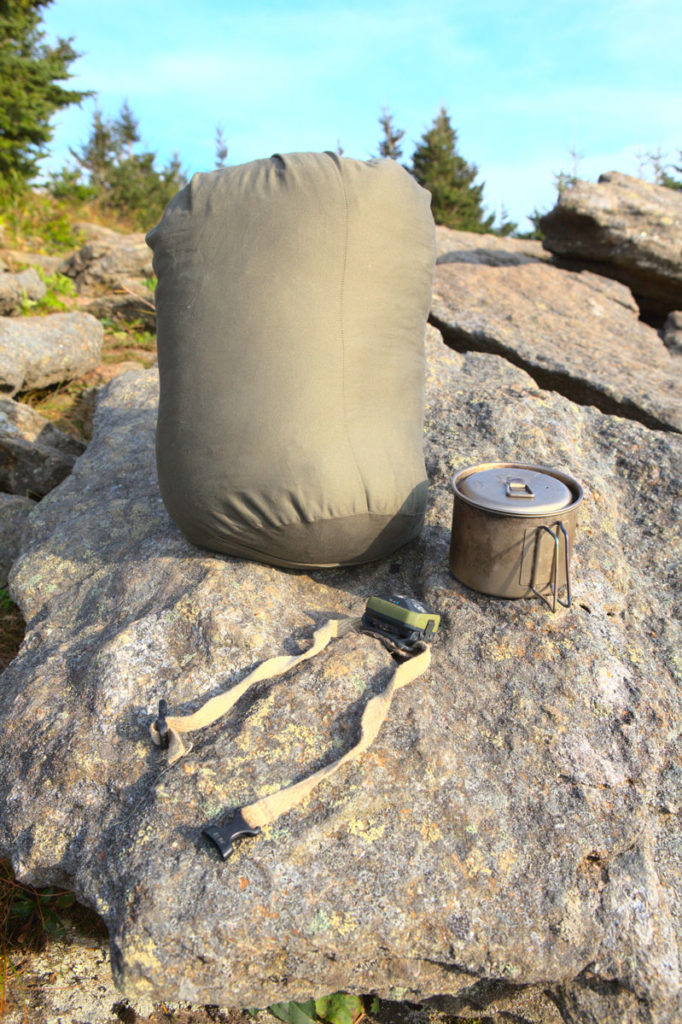
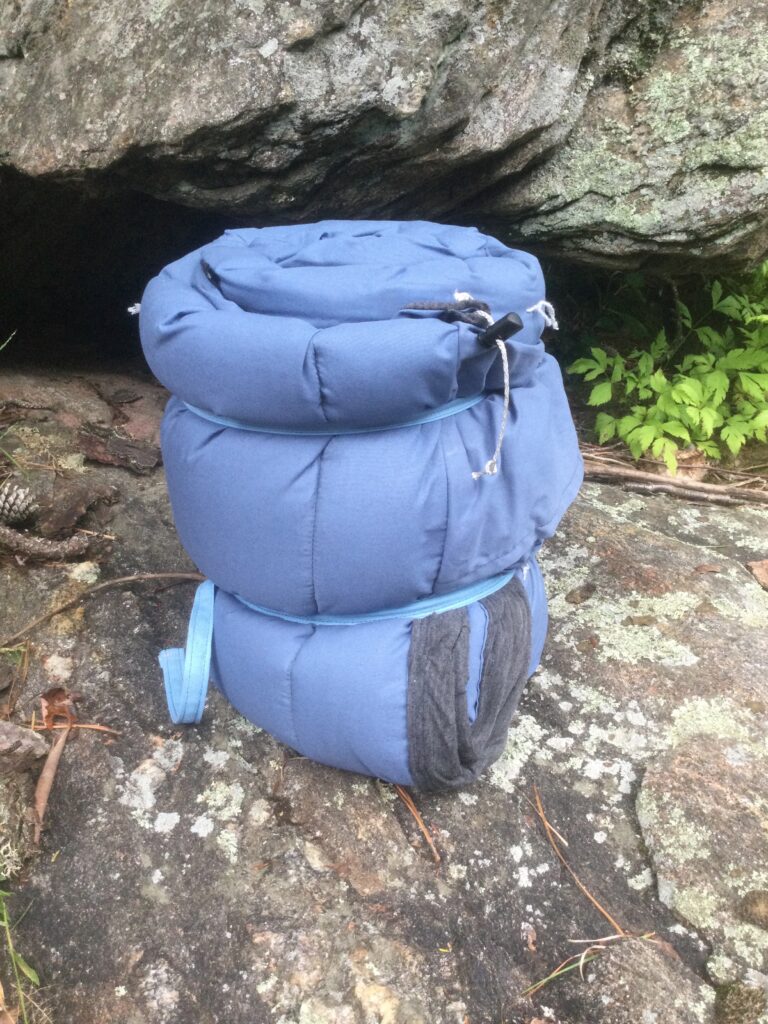
Down is the most efficient insulator per gram that anyone sells. High fill-power goose down traps an enormous volume of still air for its weight, and it compresses to almost nothing and springs back. A quality 20°F down quilt runs 1.3–1.5 lb; a 20°F down mummy bag with hood and zip, 1.8–2.5 lb. The Rewilder at the same field rating is 4 lb in Standard 2″ loft — roughly three times a down quilt. It packs to about 11 × 11 in with its compression straps, against 6–8 in for the quilt.
There is no way to talk around that. If your pack is 40 L, or you are doing 25-mile days for five months, or you are climbing with the bag on your back, down is the right insulation and we will say so. We do not call the Rewilder ultralight, and we do not sell it to people whose whole approach depends on the last two pounds.
Where wool wins: wet, humid and real-world nights
Wet performance
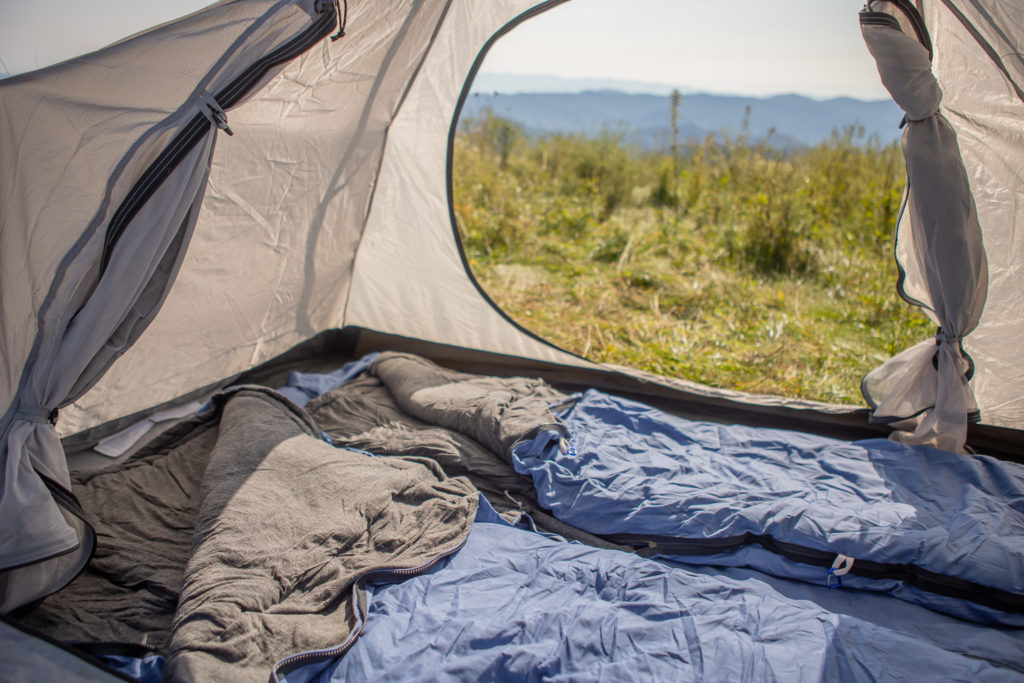
Down’s loft depends on dry, fluffy clusters. Damp clusters clump and collapse, and a down bag that has taken on moisture can lose a large share of its warmth. Hydrophobic-treated down slows this, but a treatment is a coating that wears and it does not change what happens once the water is in. Wool takes water vapour into the fibre (published moisture regain 13–16 % at 65 % RH, against 0.4 % for polyester and a down cluster that wets readily) and keeps its loft while it does. It also releases heat as it does so, about 960 kJ per kilogram of water absorbed. On a dry night in the Rockies this is irrelevant. On a foggy October night on a Blue Ridge bald it is the whole difference between sleeping and not. We work through it in How wool stays warm when wet.
Humidity from the inside
You give off about half a litre of water overnight. In a down bag, the shell that keeps the down in is nylon, and the vapour that does not get through it condenses inside. The result is the familiar clammy patch at the chest and the cold, slightly slick fabric against your face at 3 a.m. Wool batting under a beeswax-treated organic cotton shell with a merino liner moves that moisture outward and dries from your body heat as the night goes on. The bag on the fourth night feels like the bag on the first.
No cold spots
Down is loose fill, so it has to be sewn into baffles, and every baffle seam is a thin line. Down also migrates, so after a season of use you find it has bunched at the foot and thinned over the hip. Wool batting is a continuous sheet: the loft over your shoulder and the loft over your knee are the same loft, and they stay that way. It is also why the Rewilder can be opened flat and used as a quilt without a “warm side”.
No PFAS, no DWR, nothing off-gassing
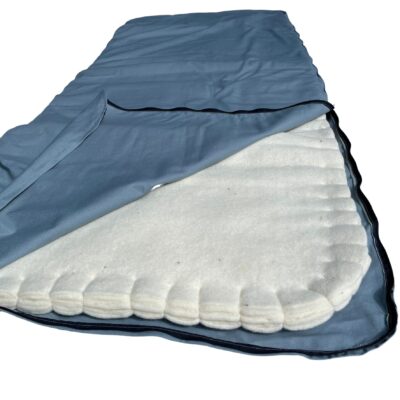
Most down and synthetic bags are shelled in nylon or polyester with a durable water repellent finish; until recently most DWR was fluorinated, and the industry is still working through replacements. Some markets also require flame-retardant treatment on sleeping bags. The Rewilder and Aurora use US wool batting, a beeswax-treated organic cotton shell and a merino jersey or WeatherWool® worsted liner, with no synthetic fill, no PFAS, no DWR, no foam and no flame retardants (wool is difficult to ignite and self-extinguishes). If you have ever unpacked a new synthetic bag and noticed the smell, that is the difference.
Durability and repair
Down bags are usually rated for a decade or so of regular use before the down has broken down and the baffles have leaked; light nylon shells tear and are patched with tape. Wool batting recovers its loft after compression year after year; the cotton shell can be re-waxed and sewn; the liner can be replaced. We give a lifetime workmanship guarantee on the bags and expect them to be repaired rather than replaced.
Noise and feel
Minor, but people mention it every time: a 10-denier nylon shell rustles with every turn, and it is cold to touch until you warm it. Cotton and merino are silent and do not feel cold on first contact.
Wool vs down sleeping bag, with synthetic as the third column
Typical figures for a 20°F bag in each category. The down and synthetic columns are representative of good current products, not any one brand; the wool column is the Rewilder Standard 2″.
| 20°F bag | Down quilt | Synthetic bag | Rewilder (wool) |
|---|---|---|---|
| Weight | About 1.3–1.5 lb | About 3 lb | 4 lb / 1.8 kg |
| Packed size | About 6–8 in cylinder | About 9–10 in cylinder | About 11 × 11 in, compression straps, no stuff sack |
| Warm when damp | No | Partly | Yes |
| Warm when soaked | No | Partly | No |
| Dries from body heat | No | Slowly | Yes |
| Breathability of shell | Low (nylon, DWR) | Low (nylon or polyester) | High (beeswax cotton) |
| Cold spots | Baffle seams, migration | Few | None (continuous batting) |
| Synthetic content | Shell, liner, treatment | Entire bag | Zipper only |
| PFAS / DWR / flame retardant | Commonly some | Commonly some | None |
| Repairable | Patch tape; baffles hard to repair | Patch tape | Sew, re-wax, replace liner |
| Typical service life | About 10 years | About 5 years before loft fades | Decades; lifetime workmanship guarantee |
| Typical price | $300–500 | $150–300 | From $557 |
| Made in USA | Some | Rarely | Yes, Burnsville NC |
Synthetic deserves its column. It is the cheapest way to get a rated bag, it is the best of the three after a full soaking because it wrings out and dries fast, and it is what we would take on a canoe trip. Its weaknesses are the ones people live with for years without naming: the loft fades with each compression, and the clammy shell is the same as down’s.
Who should still buy down
- Thru-hikers and anyone whose base weight is under about 12 lb and who intends to keep it there.
- Alpinists and anyone carrying the bag on multi-day climbs, where volume in the pack is the constraint.
- People who camp almost entirely in dry cold: high desert, the interior West in winter, the Alps above the cloud.
- Anyone who sleeps with a small pack and needs the bag to fit inside it with everything else.
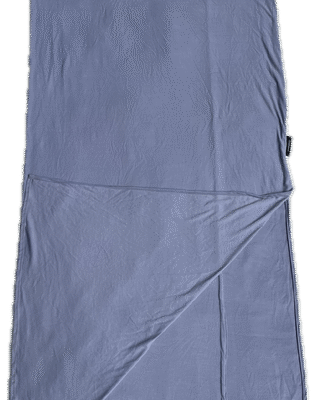
Even in those cases the merino liner (30 oz, adds about 10°F, machine washable) is worth carrying inside a down bag: it puts wool at the skin, where the clamminess starts, and lets you wash the liner instead of the bag.
Who should buy wool
Weekend and week-long backpackers in the eastern US, the UK and the Pacific Northwest, where most nights are damp; anyone who has woken cold and clammy in a down bag on the second night out; hunters and winter campers at a fixed camp; and anyone furnishing a cabin, a truck or a bed at home, where the Aurora Borealis (rectangular, 2″/3″/5″ loft, opens into a queen quilt, two zip together) is the obvious choice and weight is irrelevant.
“I’m an avid camper and spend almost every weekend outside. I transitioned to wool under clothes and found myself so much more happy. Then when I’d camp, I’d wake up damp or sticky or whatever in my down bag. I was curious if someone moved forward with a wool bag and found you. Prior to my camping days I was in the Marines and spent a ton of time outside around the world. The Marines need your bag.”
Rewilder customer

Cost per night
Price on the tag favours synthetic and then down. Price per night over the life of the bag is closer than it looks. Take a $400 down bag used 20 nights a year for 10 years, then replaced: 200 nights, $2.00 a night. A Rewilder at $557 used the same 20 nights a year: after 10 years it has cost $2.79 a night, after 20 years $1.39, and it is still in service with a re-waxed shell and perhaps a new liner. Your numbers will differ, and this is arithmetic rather than a promise, but the shape of it is why people who buy a wool bag tend to buy one.
If you want to compare the two against your own trips, the sleep-system finder takes five questions; Sleeping bag temperature ratings explained covers how our field ratings relate to ISO figures; and How much does a wool sleeping bag weigh has every size and loft with its weight.
Reviewed August 2026. Down and synthetic figures are typical of current products and are not test results; Lucky Sheep ratings are field ratings, not ISO 23537-1; cost-per-night figures are illustrative arithmetic.
Sleep warm out there — in wool
The Rewilder is a 20°F backpacking sleeping bag (4 lb, packs to 11 × 11 in) that keeps insulating when conditions turn damp. Add the merino liner for another ~10°F and a wool pad underneath for a complete natural-fiber sleep system.
-
Lightweight Wool Sleeping Bag–The Rewilder
The lightest all-natural backpacking bag
4 lb / 1.8 kg20°F / −6°C (10°F option)Packs to 11 × 11 in
Price range: $557.00 through $888.00 Select options This product has multiple variants. The options may be chosen on the product page -
Merino Wool Sleeping Bag Liner & Sleep Sack
Warm, washable wool liner for any bag
1.9 lb / 0.9 kgAdds ~10°F30 oz merino jersey
Price range: $200.00 through $235.00 Select options This product has multiple variants. The options may be chosen on the product page -
Organic Wool Sleeping Pad
Firm, breathable, machine-washable cover
¼ – 1.5 in wool felt24 – 60 in wide
Price range: $150.00 through $1,100.00 Select options This product has multiple variants. The options may be chosen on the product page