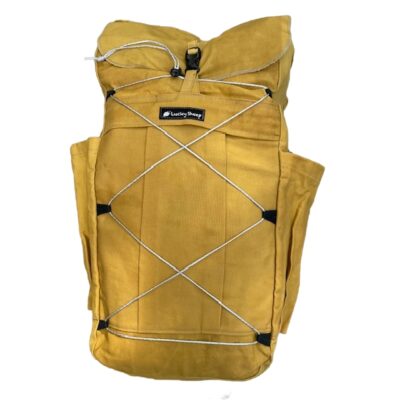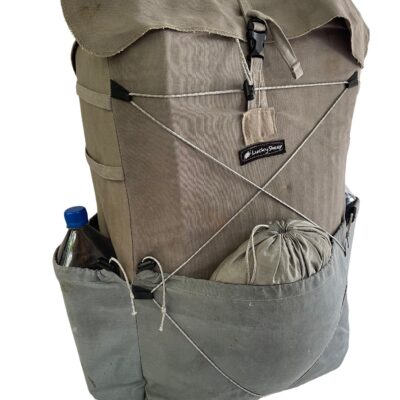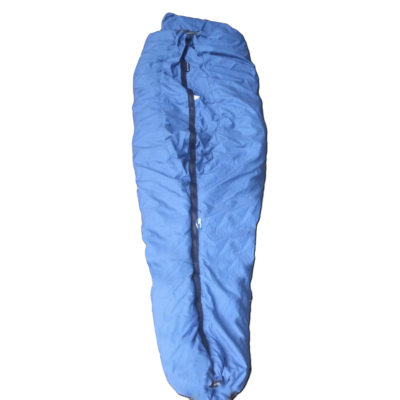
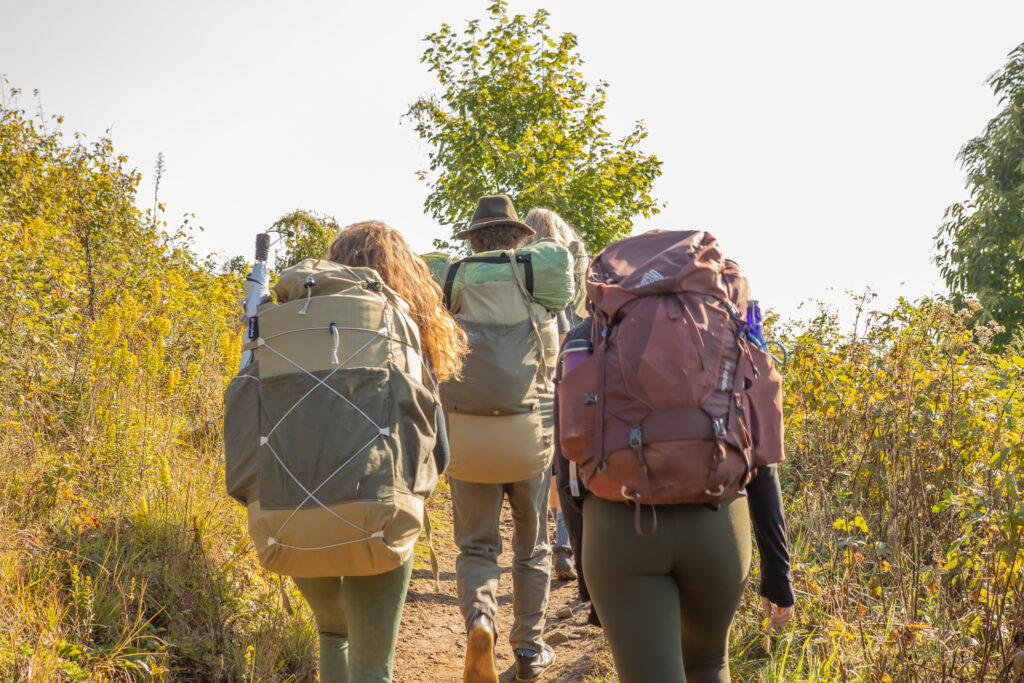
A canvas backpack for hiking has to answer one question before any other: how much does it weigh. The Lucky Sheep 65 L organic canvas backpack comes in at 32 oz, or 2 lb. That is lighter than most framed nylon packs of the same volume, and heavier than a frameless Dyneema pack. The rest of this guide is about what those numbers mean on the trail: how a frameless pack uses your wool sleeping pad as its frame, how much load it carries comfortably, how waxed organic cotton stands up to rock, sun and rain compared with nylon, and how to keep it in service for decades.
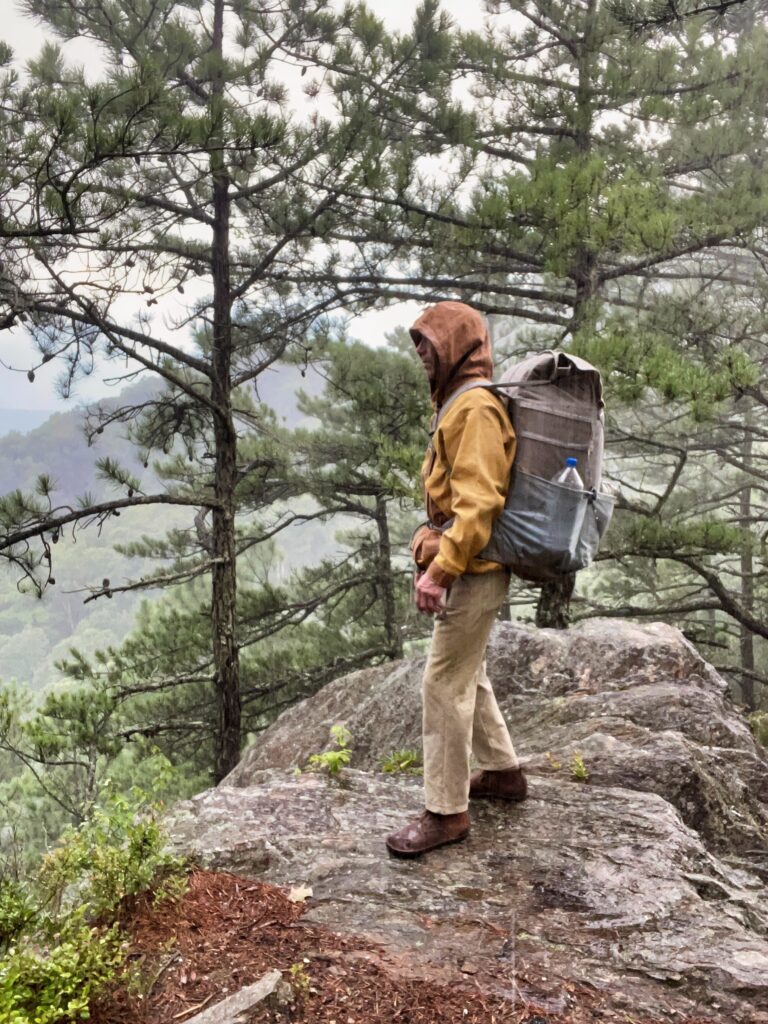
The honest weight story
Pack weights fall into three rough bands. Traditional framed nylon packs of 60–70 L, with an internal stay, load lifters and a lot of pockets, typically weigh 3.5–5 lb. Frameless or minimally framed packs in nylon or polyester grid fabrics land around 1.5–2.5 lb. Frameless packs sewn from Dyneema composite fabric get down to 1–1.5 lb, at two to three times the price and with a fabric that cannot be re-treated once it wears.
At 32 oz the 65 L canvas pack sits in the middle band. It is competitive with framed nylon packs and lighter than most of them; it is not competitive with Dyneema on the scale, and we do not pretend otherwise. What you get for the extra 8–16 oz over a Dyneema pack is a fabric you can sew, patch and re-wax in the field, no PFAS or polyurethane coatings, and a pack that is silent against the brush instead of crackling.
Note on the old name: this article used to describe the pack as 80 L. The current production pack is 65 L. Everything below is written for the 65 L.
Frameless, with your sleeping pad as the frame
The pack has no aluminium stay or plastic framesheet. Instead it borrows a trick from ultralight packs: the sleeping pad you are already carrying becomes the frame. This is where a wool pad has an advantage over an inflatable, because it is dense felt with real stiffness, not a bag of air.
The ¼ in organic wool sleeping pad (24 × 76 in, 32 oz) folds to fit the pack two ways:
- Folded flat against the back panel. Fold the pad in half lengthwise to 12 in wide, then fold it in thirds so you have a stack about 12 × 25 in. Slide it into the pack against the back panel before you load anything else. This gives a stiff, padded panel between the load and your spine, and it is the setup we recommend for loads over 20 lb.
- Rolled as a liner. Fold the pad in half lengthwise, roll it into a loose cylinder and open it inside the main compartment so it lines the walls. Your gear packs into the middle. This spreads stiffness around the whole bag and works well for bulky, lighter loads.
Either way, the pad does double duty, the pack has nothing rigid to break, and the total system (pack plus pad) is 4 lb.
How much load it carries
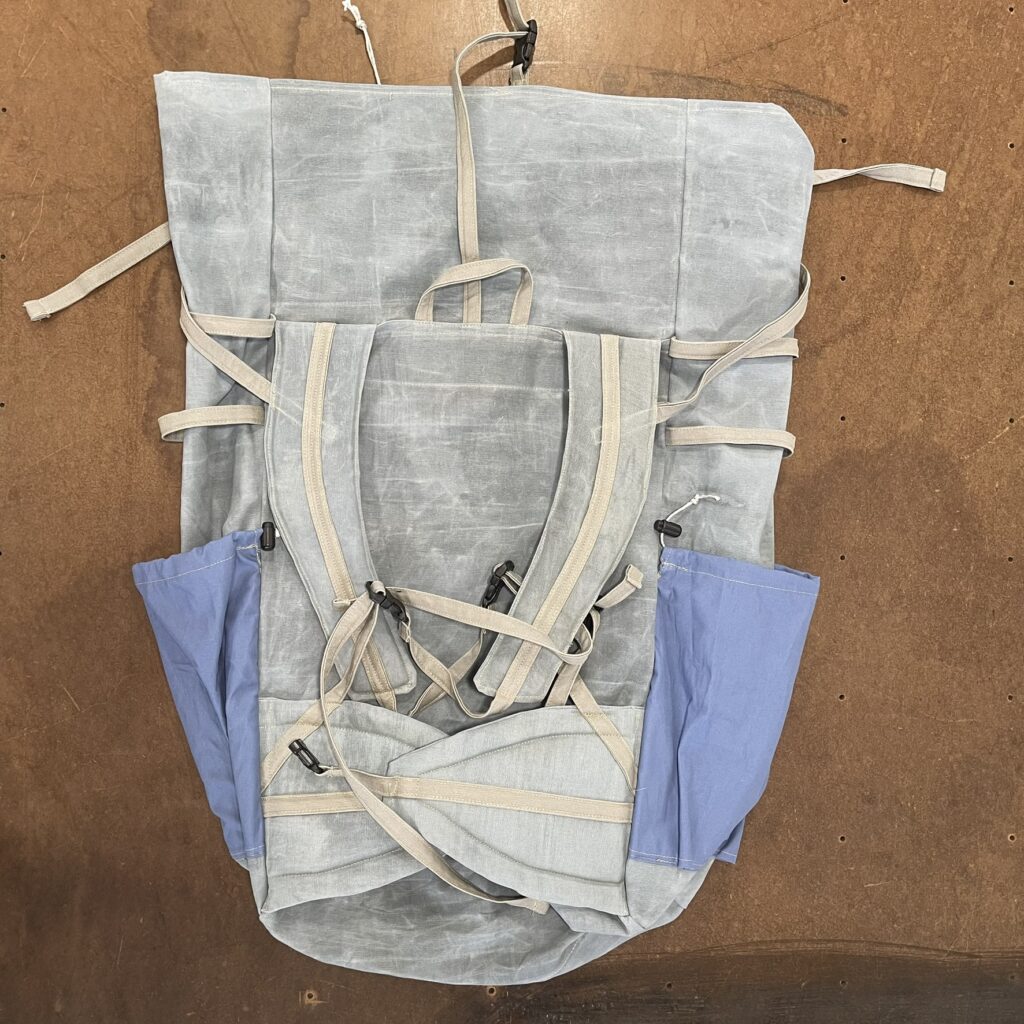
With the pad folded as a frame, the pack carries comfortably up to about 30 lb. That covers a 3–5 day trip with a Rewilder wool sleeping bag, tarp, food and water for most people. Above 30 lb the hip belt still takes the load, but a frameless pack starts to barrel and the shoulders feel it; if you routinely carry 40 lb, a framed pack is the right tool.
Fit matters more on a frameless pack than a framed one, which is why the pack is made in three torso lengths, S, M and L. Measure from the bump at the base of your neck (C7) to the top of your hip bones and pick the size that matches; the hip belt should sit on the iliac crest, not above it. The padded shoulder straps and sternum strap pull the load in against your back rather than letting it sway.
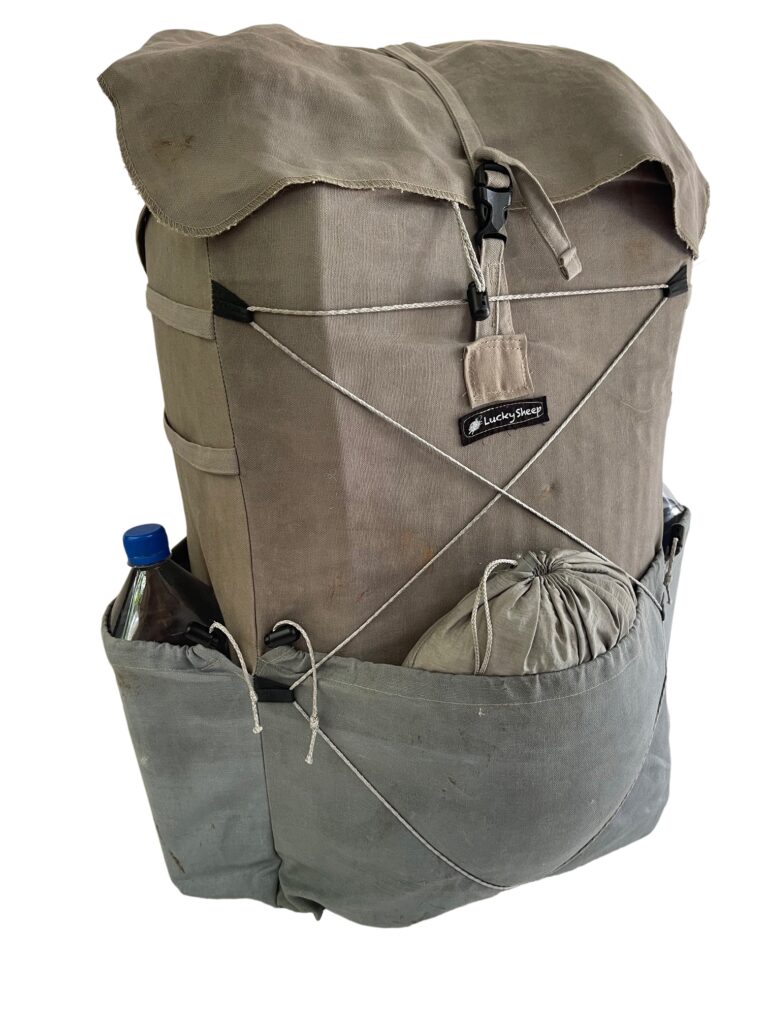
Pack heavy items (food, water) high and close to your back, sleeping bag at the bottom, and use the three outer pockets for anything wet: rain jacket, tarp, water bottles. The main compartment closes with a roll-top and a single buckle, and the cord lacing across the front takes a wet tarp or a fleece so it does not go in with the dry gear.
A canvas backpack for hiking: organic canvas and beeswax versus nylon
The pack body is organic cotton canvas finished with beeswax. There is no nylon, no polyester and no PFAS anywhere in the fabric. Here is how that compares with a coated nylon pack on the things that actually wear a pack out.
- Abrasion. Canvas is thick where pack nylon is thin. Dragging it across granite or through rhododendron scuffs the wax and fuzzes the surface but takes a long time to wear through. Light nylons cut on a sharp edge and then run. When canvas does wear, you rub wax back in or sew a patch; a nylon pack gets a tape patch that lifts at the corners.
- UV. Nylon loses strength with sun exposure and its polyurethane coating eventually goes tacky and peels. Waxed cotton fades in colour and the wax needs topping up, but the cloth itself stays sound.
- Water. Beeswaxed canvas sheds showers and short rain. In a long soak it gradually darkens and takes on water, and cotton is heavier when wet than nylon is. That is the trade: honest water resistance that you can renew, instead of a coating that is waterproof until the day it delaminates.
- Repair. Every seam on the pack can be re-sewn with a needle and heavy thread. Straps and buckles are replaceable. Workmanship is guaranteed for life.
- Noise. Canvas is quiet. If you hunt, birdwatch or just like hearing the woods, this matters.
Packing a canvas backpack for rain
Because the canvas is water-resistant and not waterproof, use a liner bag. This is how ultralight hikers pack Dyneema and nylon packs too, since seams and roll-tops leak on every pack in a long enough rain. A single trash-compactor bag or a lightweight dry bag inside the main compartment, closed with a twist and a fold, keeps your sleeping bag and camp clothes dry no matter what the outside of the pack looks like.
Put the wool sleeping bag and spare wool layers in the liner. Everything that can get wet (tarp, cook kit, water, rain jacket) goes in the outer pockets or under the front lacing. A wool sleeping bag is forgiving if it does get damp, since wool keeps insulating with moisture in it, but a dry bag at bedtime is still the goal.
At camp, empty the pack, shake it out and hang it open under the tarp. Waxed canvas dries far faster than untreated cotton because the wax stops the fibres from absorbing much water in the first place.
Re-waxing and repair
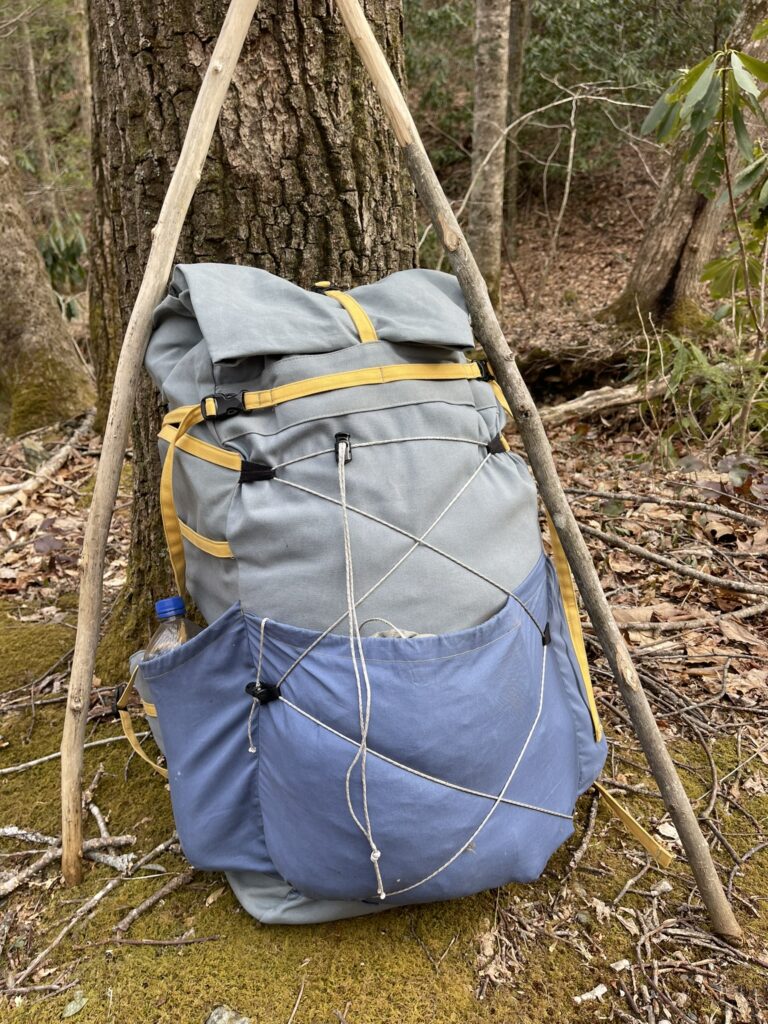
A pack needs re-waxing when the bottom and the shoulder-strap contact points go pale and stop beading water. For most people that is every year or two of regular use. The method is the same as for a jacket, with Trail Wax:
- Empty the pack, brush out the inside, and let it dry completely.
- Rub the bar firmly on the bottom panel, the seams and the back of the side pockets first, then across the body.
- Warm it in with a hair dryer or an hour in direct sun until the streaks melt into the weave. Stuff the pack with a towel so you can work the panels flat.
- Wipe any excess and let it cure overnight.
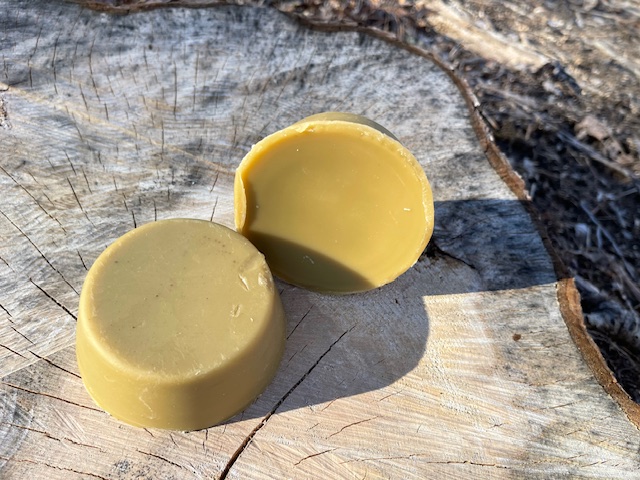
Clean with cold water and a brush only. No detergent, no washing machine, no dryer; all three strip the wax. For a tear, sew it closed with a heavy needle and waxed thread, then rub wax over the stitch line. The full care routine for jackets, packs, tarps and the tent is in the waxed canvas care guide.
The 25 L daypack for day trips
For day hikes, travel and the commute, the canvas daypack is the same organic canvas and beeswax finish in a 25 L size, with five pockets and padded straps. It is the pack most people use most days: big enough for a rain jacket, lunch, two litres of water and a wool layer, small enough to carry on a plane. It comes in lavender, stone and gold and costs $249.
Specifications
| 65 L canvas backpack | 25 L canvas daypack | |
|---|---|---|
| Volume | 65 L | 25 L |
| Weight | 32 oz / 2 lb | — |
| Fabric | Organic cotton canvas, beeswax finish | Organic cotton canvas, beeswax finish |
| Frame | Frameless; wool sleeping pad as frame | None |
| Comfortable load | Up to about 30 lb | Day loads |
| Sizes | Torso S / M / L | One size |
| Closure and pockets | Roll-top, 3 outer pockets, front cord lacing | 5 pockets, padded straps |
| Synthetics | No nylon, polyester or PFAS in the fabric | No nylon, polyester or PFAS in the fabric |
| Care | Re-waxable, repairable, lifetime workmanship guarantee | Re-waxable, repairable, lifetime workmanship guarantee |
| Price | $350 | $249 |
Both packs ship in 2–5 days from Burnsville, North Carolina. For a complete backpacking system, pair the 65 L with the Rewilder wool sleeping bag and the ¼ in wool pad, and read the waxed canvas rain jacket guide for the shell that goes with it.
Reviewed August 2026. Pack weights for other categories are typical published ranges; the 65 L weight and load guidance are Lucky Sheep figures from field use, not lab tests.
The book behind these articles
A Rewilder’s Guide to Outdoor Adventure
The complete Lucky Sheep approach to time outdoors — skills, gear, food and natural sleep, from the founder. Everything the field guide covers, in one book you can take with you.
Get the book →Gear for the trail, made from natural fibers
Carry your food and your sleep system in organic canvas: the 25 L daypack for day hikes, the 65 L lightweight canvas backpack (32 oz) for multi-day trips, and the 20°F Rewilder wool sleeping bag for the nights in between.
-
Eco-Friendly Canvas Daypack
Minimalist organic canvas daypack
25 LZero plastic, zero PFAS
$249.00 Select options This product has multiple variants. The options may be chosen on the product page -
Lightweight Organic Canvas Backpack
65 L, frameless, nothing synthetic
2 lb / 0.9 kg65 LFrameless · foam-pad frame
$350.00 Select options This product has multiple variants. The options may be chosen on the product page -
Lightweight Wool Sleeping Bag–The Rewilder
The lightest all-natural backpacking bag
4 lb / 1.8 kg20°F / −6°C (10°F option)Packs to 11 × 11 in
Price range: $557.00 through $888.00 Select options This product has multiple variants. The options may be chosen on the product page